髟

髟 U+9ADF, 髟
CJK UNIFIED IDEOGRAPH-9ADF
← 髞
[U+9ADE]
CJK Unified Ideographs 髠 →
[U+9AE0]
⾽ U+2FBD, ⾽
KANGXI RADICAL HAIR
← ⾼
[U+2FBC]
Kangxi Radicals ⾾ →
[U+2FBE]

Translingual

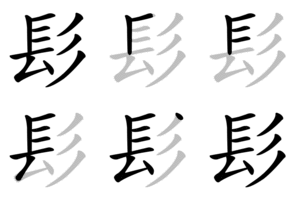
Stroke order

Han character

髟 (Kangxi radical 190, 髟+0, 10 strokes, cangjie input 尸戈竹竹竹 (SIHHH), four-corner 72722, composition ⿰镸彡)

  1. Kangxi radical #190, ⾽.

Derived characters

  • Appendix:Chinese radical/髟
  • 𧫄, 𪶰, 𤌩, 䭮, 𪄒

References

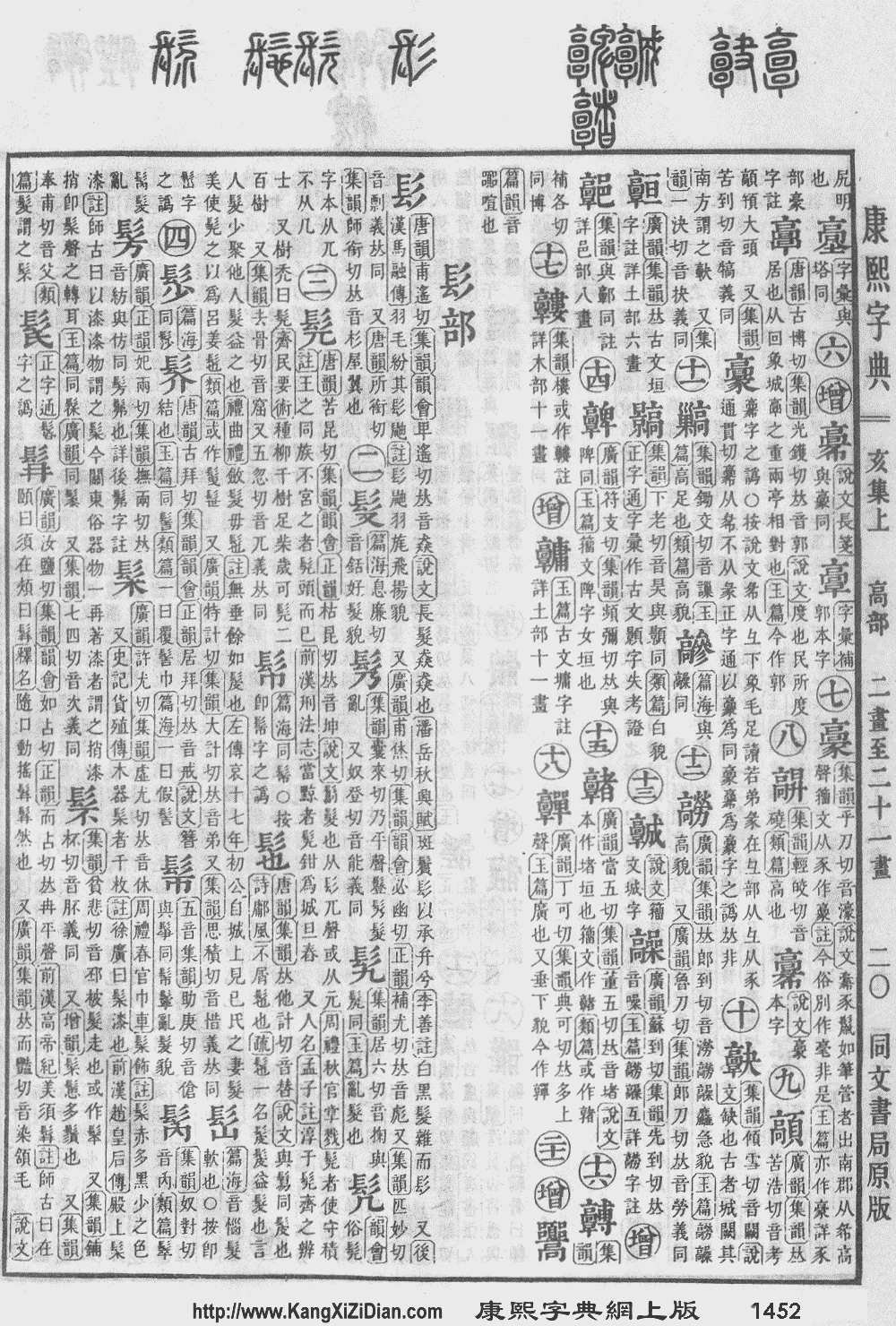
  • Kangxi Dictionary: page 1452, character 26
  • Dai Kanwa Jiten: character 45355
  • Dae Jaweon: page 1983, character 1
  • Hanyu Da Zidian (first edition): volume 7, page 4518, character 1
  • Unihan data for U+9ADF

Chinese

simp. and trad.
髟

Glyph origin

Historical forms of the character 髟
Shang Warring States Shuowen Jiezi (compiled in Han)
Bronze inscriptions Chu slip and silk script Small seal script

Ideogrammic compound (會意/会意) : 镸 (“long”) + 彡 (“hair”).

Pronunciation


Rime
Character 髟 髟
Reading # 1/3 2/3
Initial (聲) 幫 (1) 幫 (1)
Final (韻) 宵 (91) 幽 (138)
Tone (調) Level (Ø) Level (Ø)
Openness (開合) Open Open
Division (等) III III
Fanqie 甫遙切 甫烋切
Baxter pjiew pjiw
Reconstructions
Zhengzhang
Shangfang
/piᴇu/ /piɪu/
Pan
Wuyun
/piɛu/ /pɨu/
Shao
Rongfen
/pjæu/ /pieu/
Edwin
Pulleyblank
/piaw/ /pjiw/
Li
Rong
/piɛu/ /piĕu/
Wang
Li
/pĭɛu/ /piəu/
Bernard
Karlgren
/pi̯ɛu/ /pieu/
Expected
Mandarin
Reflex
biāo biāo
Expected
Cantonese
Reflex
biu1 bau1
Baxter–Sagart system 1.1 (2014)
Character 髟
Reading # 1/2
Modern
Beijing
(Pinyin)
biāo
Middle
Chinese
‹ pjiw ›
Old
Chinese
/*p(r)iw/
English long hair

Notes for Old Chinese notations in the Baxter–Sagart system:

* Parentheses "()" indicate uncertain presence;
* Square brackets "[]" indicate uncertain identity, e.g. *[t] as coda may in fact be *-t or *-p;
* Angle brackets "<>" indicate infix;
* Hyphen "-" indicates morpheme boundary;

* Period "." indicates syllable boundary.
Zhengzhang system (2003)
Character 髟 髟
Reading # 1/3 2/3
No. 792 793
Phonetic
component
髟 髟
Rime
group
幽 幽
Rime
subdivision
3 3
Corresponding
MC rime
彪 飊
Old
Chinese
/*priw/ /*piw/

Definitions

髟

  1. (literary) drooping of long hair
  2. (literary) long human hair; hair

Compounds

  • 髟髟
  • 髟鼬

Pronunciation


Definitions

髟

  1. (literary) long animal hair

Pronunciation


Rime
Character 髟
Reading # 3/3
Initial (聲) 生 (21)
Final (韻) 銜 (149)
Tone (調) Level (Ø)
Openness (開合) Open
Division (等) II
Fanqie 所銜切
Baxter sraem
Reconstructions
Zhengzhang
Shangfang
/ʃˠam/
Pan
Wuyun
/ʃᵚam/
Shao
Rongfen
/ʃam/
Edwin
Pulleyblank
/ʂaɨm/
Li
Rong
/ʃam/
Wang
Li
/ʃam/
Bernard
Karlgren
/ʂam/
Expected
Mandarin
Reflex
shān
Expected
Cantonese
Reflex
saam1
Baxter–Sagart system 1.1 (2014)
Character 髟
Reading # 2/2
Modern
Beijing
(Pinyin)
shān
Middle
Chinese
‹ sræm ›
Old
Chinese
/*s(ˁ)ram/
English long hair

Notes for Old Chinese notations in the Baxter–Sagart system:

* Parentheses "()" indicate uncertain presence;
* Square brackets "[]" indicate uncertain identity, e.g. *[t] as coda may in fact be *-t or *-p;
* Angle brackets "<>" indicate infix;
* Hyphen "-" indicates morpheme boundary;

* Period "." indicates syllable boundary.
Zhengzhang system (2003)
Character 髟
Reading # 3/3
No. 11045
Phonetic
component
彡
Rime
group
談
Rime
subdivision
3
Corresponding
MC rime
衫
Old
Chinese
/*sroːm/

Definitions

髟

  1. ‡ tip of the eaves

Japanese

Kanji

髟

(uncommon “Hyōgai” kanji)

  1. long hair
  2. mane

Readings

Korean

Hanja

髟 • (pyo, sam) (hangeul 표, 삼, McCune–Reischauer p'yo, sam, Yale phyo, sam)

  1. This term needs a translation to English. Please help out and add a translation, then remove the text {{rfdef}}.

Vietnamese

Han character

髟: Hán Nôm readings: tiêu

  1. This term needs a translation to English. Please help out and add a translation, then remove the text {{rfdef}}.

References

This article is issued from Wiktionary. The text is licensed under Creative Commons - Attribution - Sharealike. Additional terms may apply for the media files.