鬥
| ||||||||
| ||||||||
Translingual
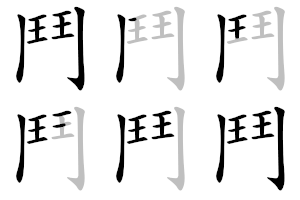
| Stroke order | |||
|---|---|---|---|
 | |||
| Japanese | 闘 |
|---|---|
| Simplified | 斗 |
| Traditional | 鬥/鬭 |
Han character
鬥 (Kangxi radical 191, 鬥+0, 10 strokes, cangjie input 中弓 (LN), four-corner 77114, composition ⿲𩰋王亅)
- Kangxi radical #191, ⾾.
Derived characters
- Appendix:Chinese radical/鬥
- 𫫅
Related characters
- 門 (Note: Some derived characters of 鬥 have alternative forms that have been simplified to contain 門. Example: 鬪 and 闘)
References
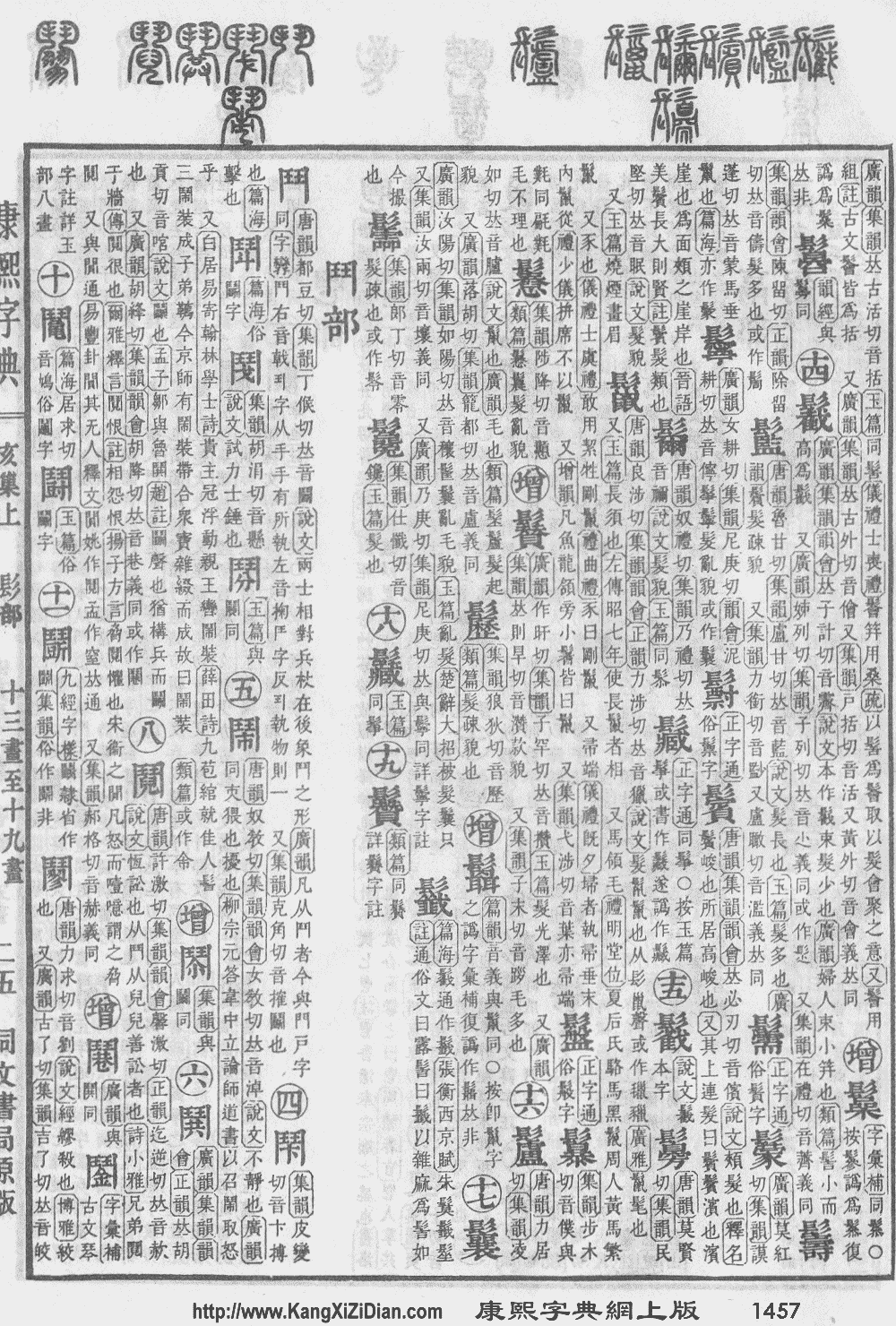
- Kangxi Dictionary: page 1457, character 29
- Dai Kanwa Jiten: character 45632
- Dae Jaweon: page 1989, character 16
- Hanyu Da Zidian (first edition): volume 7, page 4515, character 1
- Unihan data for U+9B25
Chinese
| trad. | 鬥/鬭 | |
|---|---|---|
| simp. | 斗* | |
| alternative forms | ||
Glyph origin
| Historical forms of the character 鬥 | ||
|---|---|---|
| Shang | Shuowen Jiezi (compiled in Han) | Liushutong (compiled in Ming) |
| Oracle bone script | Small seal script | Transcribed ancient scripts |
 |
 |
 |
Pictogram (象形) — two figures face-to-face, fighting with bare hands. Some oracle script characters of 鬥/斗 (dòu) show that both of their hair are bristled. The character shape resembles 𠨭 and 丮 opposite each other.
鬥/斗 (dòu) and 鬭/斗 (dòu) are original characters of this form; forms with the similar-looking radical 門 ("door") were non-standard variants.
Simplified form 斗 was derived via the variant form 鬦.
鬥/斗 (dòu) is also one of the 324 simplified characters introduced by the Republic of China (Kuomintang government) in 1935 as the simplified form of 鬭/斗 (dòu).
Etymology
Conflation of two roots "to fight" and "to meet", and the merger has been attested since ancient times.
- "to fight"
- Probably from Proto-Sino-Tibetan *daw (“to defy, interfere, be at enmity with”), which is the source of Tibetan སྡོ (sdo, “to bear up against, bid defiance”) and Burmese တော့ (tau., “to resent an insinuation, interfere in a quarrel”).
- "to meet"
- Schuessler (2007) considers this cognate with 注 (OC *tjos, “to apply; to be touched; to bring together; to join”); see there for more.
Pronunciation
Definitions
鬥
- to fight; to struggle
- 爭鬥/争斗 ― zhēngdòu ― to fight
- 戰鬥/战斗 ― zhàndòu ― battle
- 械鬥/械斗 ― xièdòu ― to fight with weapons
- 拳鬥/拳斗 ― quándòu ― fist fight
- 格鬥/格斗 ― gédòu ― grapple
- 搏鬥/搏斗 ― bódòu ― to wrestle
- 明爭暗鬥/明争暗斗 ― míngzhēng'àndòu ― both open strife and veiled struggle
- 龍爭虎鬥/龙争虎斗 ― lóngzhēnghǔdòu ― fierce struggle between two evenly-matched opponents
- 角鬥/角斗 ― jiǎodòu ― to battle
- 鬥士/斗士 ― dòushì ― warrior
- 鬥志/斗志 ― dòuzhì ― morale
- 鬥毆/斗殴 ― dòu'ōu ― to brawl
- 鬥氣/斗气 ― dòuqì ― to quarrel just to vent one's spleen
- 鬥艦/斗舰 ― dòujiàn ― man-of-war
- to make animals fight
- to contend; to compete with
- to strive one's best
- (archaic) (of stars) to collide with each other
- chaotic; disorderly, helter-skelter
- to take the opportunity to ...; to do something while it's ...
- to meet; to encounter; to face
- to face; to confront; to front; to be opposite
- to piece together; to fit together
- (dialectal) to help; to assist
- (dialectal) very, quite
- (dialectal) to collude, to plot
- fine tea; tea of the best quality
- (dialectal) bird nest
- Alternative form of 逗 (dòu, “to tease, to play with”)
- Alternative form of 兜 (dōu, “to solicit (customers or business)”)
- Alternative form of 陡 (dǒu, “suddenly, in a sudden”)
- a surname
Compounds
- 傲霜鬥雪/傲霜斗雪
- 內鬥/内斗 (nèidòu)
- 兩虎共鬥/两虎共斗
- 兩虎相鬥/两虎相斗
- 兩鼠鬥穴/两鼠斗穴
- 勾心鬥角/勾心斗角 (gōuxīndòujiǎo)
- 卵與石鬥/卵与石斗
- 單打獨鬥/单打独斗 (dāndǎdúdòu)
- 困獸之鬥/困兽之斗
- 困獸猶鬥/困兽犹斗
- 困鬥/困斗
- 奮鬥/奋斗 (fèndòu)
- 奮鬥不懈/奋斗不懈
- 好勇鬥狠/好勇斗狠 (hàoyǒngdòuhěn)
- 好鬥/好斗 (hàodòu)
- 廝鬥/厮斗 (sīdòu)
- 引鬥/引斗
- 惡鬥/恶斗 (èdòu)
- 戰天鬥地/战天斗地
- 戰鬥/战斗 (zhàndòu)
- 戰鬥人員/战斗人员
- 戰鬥力/战斗力 (zhàndòulì)
- 戰鬥機/战斗机 (zhàndòujī)
- 打鬥/打斗 (dǎdòu)
- 批鬥/批斗 (pīdòu)
- 拚鬥/拚斗
- 挌鬥/挌斗
- 挑鬥/挑斗 (tiǎodòu)
- 搏鬥/搏斗 (bódòu)
- 搬鬥/搬斗
- 撩鬥/撩斗
- 政治鬥爭/政治斗争
- 明爭暗鬥/明争暗斗 (míngzhēng'àndòu)
- 暗鬥/暗斗 (àndòu)
- 格鬥/格斗 (gédòu)
- 械鬥/械斗 (xièdòu)
- 權力鬥爭/权力斗争
- 武鬥/武斗 (wǔdòu)
- 歹鬥/歹斗
- 歹鬥毛/歹斗毛
- 殷師牛鬥/殷师牛斗
- 決鬥/决斗 (juédòu)
- 油鬥/油斗
- 爭奇鬥妍/争奇斗妍
- 爭奇鬥異/争奇斗异
- 爭奇鬥豔/争奇斗艳
- 爭妍鬥奇/争妍斗奇
- 爭妍鬥豔/争妍斗艳 (zhēngyándòuyàn)
- 爭強鬥勝/争强斗胜
- 爭紅鬥紫/争红斗紫
- 爭鬥/争斗 (zhēngdòu)
- 私鬥/私斗
- 纏鬥/缠斗 (chándòu)
- 耍鬥/耍斗
- 臨潼鬥寶/临潼斗宝
- 自由鬥士/自由斗士 (zìyóu dòushì)
- 艱苦奮鬥/艰苦奋斗 (jiānkǔfèndòu)
- 虎鬥龍爭/虎斗龙争
- 蚊動牛鬥/蚊动牛斗
- 誇多鬥靡/夸多斗靡
- 誇能鬥智/夸能斗智
- 負氣鬥狠/负气斗狠
- 賭鬥/赌斗
- 轉鬥千里/转斗千里
- 辯鬥/辩斗
- 鉤心鬥角/钩心斗角
- 階級鬥爭/阶级斗争 (jiējí dòuzhēng)
- 雞吵鵝鬥/鸡吵鹅斗
- 雞爭鵝鬥/鸡争鹅斗
- 食好鬥相報/食好斗相报 (chia̍h hó tàu sio-pò)
- 高昂鬥志/高昂斗志
- 鬥分子/斗分子
- 鬥力/斗力 (dòulì)
- 鬥勁/斗劲
- 鬥口/斗口
- 鬥口齒/斗口齿
- 鬥合/斗合
- 鬥嘴/斗嘴 (dòuzuǐ)
- 鬥士/斗士 (dòushì)
- 鬥富/斗富
- 鬥巧/斗巧
- 鬥巧爭奇/斗巧争奇
- 鬥幌子/斗幌子
- 鬥引/斗引
- 鬥彆氣/斗别气
- 鬥彩/斗彩
- 鬥很/斗很
- 鬥心眼/斗心眼
- 鬥志/斗志 (dòuzhì)
- 鬥志昂揚/斗志昂扬 (dòuzhì'ángyáng)
- 鬥志高昂/斗志高昂
- 鬥悶子/斗闷子
- 鬥打/斗打
- 鬥文/斗文
- 鬥智/斗智 (dòuzhì)
- 鬥暴/斗暴
- 鬥武/斗武
- 鬥毆/斗殴 (dòu'ōu)
- 鬥氣/斗气 (dòuqì)
- 鬥法/斗法
- 鬥爭/斗争 (dòuzhēng)
- 鬥爭鬥合/斗争斗合
- 鬥牌/斗牌
- 鬥牙拌齒/斗牙拌齿
- 鬥牙鬥齒/斗牙斗齿
- 鬥牛/斗牛 (dòuniú)
- 鬥牛士/斗牛士 (dòuniúshì)
- 鬥牛陣/斗牛阵
- 鬥犀臺/斗犀台
- 鬥犬/斗犬
- 鬥疊/斗叠
- 鬥百草/斗百草
- 鬥眼/斗眼 (dòuyǎn)
- 鬥而鑄兵/斗而铸兵
- 鬥而鑄錐/斗而铸锥
- 鬥腳/斗脚
- 鬥艦/斗舰
- 鬥草/斗草
- 鬥茶/斗茶
- 鬥葉兒/斗叶儿
- 鬥葉子/斗叶子 (dòuyèzi)
- 鬥蟋蟀/斗蟋蟀
- 鬥話/斗话
- 鬥豔爭芳/斗艳争芳
- 鬥趣/斗趣 (dòuqù)
- 鬥閑氣/斗闲气
- 鬥雞/斗鸡 (dòujī)
- 鬥雞眼/斗鸡眼 (dòujīyǎn)
- 鬥雞臺/斗鸡台
- 鬥雞走狗/斗鸡走狗
- 鬥雪紅/斗雪红
- 鬥頭/斗头
- 鬥風/斗风
- 鬥飣/斗饤
- 鬥鬨/斗哄
- 鬥魚/斗鱼 (dòuyú)
- 鬥鴨/斗鸭
- 鬥鵪鶉/斗鹌鹑
- 鬥麗/斗丽
- 龍爭虎鬥/龙争虎斗
- 龍虎鬥/龙虎斗
References
- “鬥”, in 漢語多功能字庫 (Multi-function Chinese Character Database), 香港中文大學 (the Chinese University of Hong Kong), 2014–
- Dictionary of Chinese Character Variants (教育部異體字字典), A04678
Japanese
Readings
As a variant/kyūjitai kanji of 闘:
- Go-on: つ (tsu)
- Kan-on: とう (tō)
- Kun: たたかう (tatakau, 鬥う)←たたかふ (tatakafu, 鬥ふ, historical); あらそう (arasou, 鬥う)←あらそふ (arasofu, 鬥ふ, historical)
As a radical:
- Kun: たたかいがまえ (tatakaigamae, 鬥)←たたかひがまへ (tatakafigamafe, 鬥, historical); とうがまえ (tōgamae, 鬥)←とうがまへ (tougamafe, 鬥, historical)