兜
| ||||||||
Translingual
Han character
兜 (Kangxi radical 10, 儿+9, 11 strokes, cangjie input 竹女竹山 (HVHU), four-corner 77217).
References
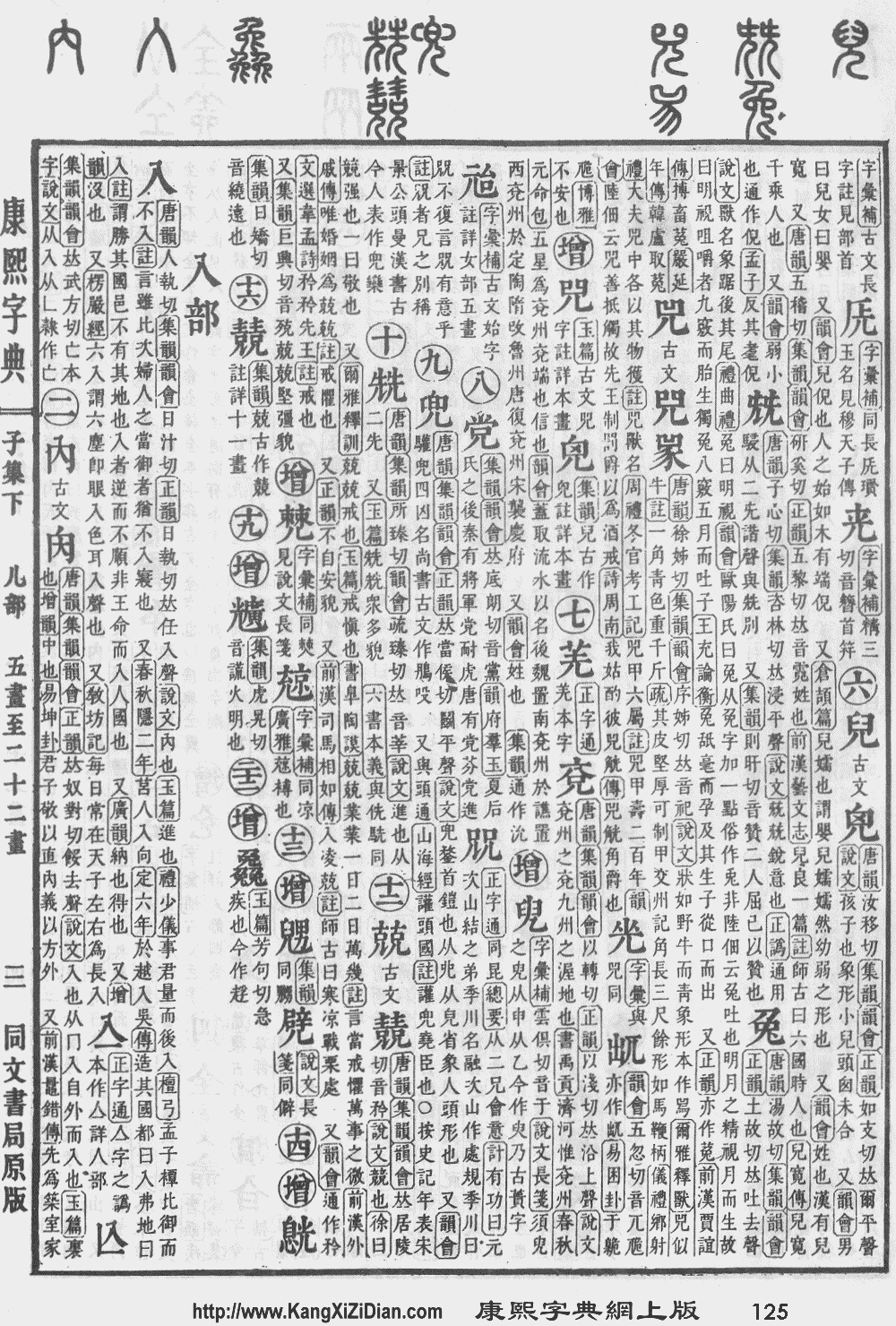
- Kangxi Dictionary: page 125, character 20
- Dai Kanwa Jiten: character 1386
- Dae Jaweon: page 265, character 27
- Hanyu Da Zidian (first edition): volume 1, page 273, character 16
- Unihan data for U+515C
Chinese
| simp. and trad. |
兜 | |
|---|---|---|
| alternative forms | 兠/兜 ancient | |
Glyph origin
| Historical forms of the character 兜 | |||||
|---|---|---|---|---|---|
| |||||
|
References: Mostly from Richard Sears' Chinese Etymology site (authorisation),
|


Ideogrammic compound (會意/会意) : 𠑹 (“cover”) + 皃 (“head”): a helmet.
Etymology 1
Baxter and Sagart (2014) suggests a connection to 頭 (OC *[m-t]ˤo, “head”). See there for more.
Pronunciation
Definitions
兜
- helmet; hood
- helmet-shaped
- armor
- to wrap in a bag; to encase; to carry in a wrap
- bag; pouch; plastic bag
- to pocket; to keep; to retain; to acquire dishonestly
- to reach
- to move around; to move in a circle
- to canvass; to solicit
- 兜生意 ― dōu shēngyi ― to solicit business
- to take responsibility for
- to relate in detail
- to peddle; to hawk
- (Hokkien) home
- (Hokkien) nearby
- (Singapore Hokkien) place; side; location
- 這兜/这兜 [Hokkien] ― chit-tau [Pe̍h-ōe-jī] ― this place; this side; this location
- (Cantonese) flat or shallow container; flat or shallow bowl
- (Cantonese) to contain; to hold in a container; to hold with one's hand(s) in a horizontal positional
- (Cantonese) to make a detour; to bypass; to deviate
- (Cantonese, of routes or journeys) indirect; lengthy; with detours or deviations
- (Cantonese) to explain one's way out of a bad situation
- (Cantonese) Classifier for things put in a flat or shallow container.
- (Cantonese) to scoop with a flat or shallow container
- (Cantonese) to hit with one's limbs, in a curved trajectory; to slap (someone); to kick
Synonyms
- (pocket): 口袋 (kǒudai), 衣袋 (yīdài), 衣兜 (yīdōu)
- (bag): (Hokkien) 袋仔 (tē-á)
- (to move in a circle): 繞/绕 (rào)
Dialectal synonyms of 家 (“home”) [map]
Compounds
- 傴兜/伛兜
- 兜來兜去/兜来兜去
- 兜兒/兜儿 (dōur)
- 兜兜
- 兜兜嘴兒/兜兜嘴儿
- 兜兜答答
- 兜兜褲兒/兜兜裤儿
- 兜剿
- 兜口兜面
- 兜售 (dōushòu)
- 兜喜神方
- 兜嘴
- 兜圈子 (dōu quānzi)
- 兜子 (dōuzi)
- 兜巴星
- 兜底 (dōudǐ)
- 兜底兒/兜底儿
- 兜得轉/兜得转
- 兜抄
- 兜拖
- 兜捕
- 兜搭
- 兜攬/兜揽 (dōulǎn)
- 兜攬生意/兜揽生意
- 兜率天 (Dōushuàitiān)
- 兜率天宮/兜率天宫
- 兜率宮/兜率宫
- 兜的
- 兜答
- 兜籠/兜笼
- 兜紗/兜纱
- 兜羅/兜罗 (dōuluó)
- 兜翻
- 兜老底
- 兜肚 (dōudù)
- 兜肚兒/兜肚儿
- 兜胸
- 兜膝
- 兜臉/兜脸
- 兜襠/兜裆
- 兜路
- 兜轎/兜轿
- 兜銷/兜销
- 兜鍪 (dōumóu)
- 兜頭/兜头
- 兜頭蓋臉/兜头盖脸 (dōutóugàiliǎn)
- 兜風/兜风 (dōufēng)
- 冤兜
- 圍兜/围兜 (wéidōu)
- 帽兜子
- 慲兜/𰒆兜
- 揸兜
- 暖雲兜/暖云兜
- 橋兜/桥兜 (Qiáodōu)
- 漏兜
- 肚兜 (dùdōu)
- 觀音兜/观音兜
- 阿兜眼
- 露兜樹/露兜树
Etymology 2
(This etymology is missing or incomplete. Please add to it, or discuss it at the Etymology scriptorium.)
Pronunciation
Definitions
兜
Synonyms
Dialectal synonyms of 些 (“some, a few”) [map]
| Variety | Location | Words |
|---|---|---|
| Formal (Written Standard Chinese) | 些 | |
| Mandarin | Taiwan | 些 |
| Singapore | 些 | |
| Cantonese | Guangzhou | 啲 |
| Hong Kong | 啲 | |
| Taishan | 尼 | |
| Singapore (Guangfu) | 啲 | |
| Hakka | Meixian | 兜 |
| Miaoli (N. Sixian) | 兜 | |
| Pingtung (Neipu; S. Sixian) | 兜 | |
| Hsinchu County (Zhudong; Hailu) | 兜 | |
| Taichung (Dongshi; Dabu) | 兜 | |
| Hsinchu County (Qionglin; Raoping) | 兜 | |
| Yunlin (Lunbei; Zhao'an) | 兜 | |
| Southern Min | Xiamen | 寡 |
| Zhangzhou | 寡 | |
| Tainan | 寡 | |
| Singapore (Hokkien) | 寡 | |
| Manila (Hokkien) | 寡 | |
| Shantou | 撮 | |
| Jieyang | 撮 | |
| Singapore (Teochew) | 撮 | |
| Wu | Shanghai | 眼, 點, 些 formal or Mandarin-influenced |
| Wenzhou | 厘兒 | |
Further reading
- (Min Nan pronunciation audio) “Entry #6941”, in 臺灣閩南語常用詞辭典 [Dictionary of Frequently-Used Taiwan Minnan] (overall work in Mandarin and Hokkien), Ministry of Education, R.O.C., 2023.
Japanese
Etymology
| Kanji in this term |
|---|
| 兜 |
| かぶと Jinmeiyō |
| kun’yomi |
| Alternative spellings |
|---|
| 冑 甲 |
_hari_bachi_kabuto.jpg.webp)
From Old Japanese. Found in the Nihon Shoki of 720 CE with the reading kaputo.[1]
Derivation currently unknown.
- A surface analysis might suggest a derivation from 被る (kaburu, “to wear something on the head”). However, that reading derives from older form kagafuru and does not appear until 850,[1] some time after the first appearance of kabuto.
- An alternative analysis might suggest a compound of 頭 (kabu, “head”, kun'yomi and native Japanese term) + 兜 (to, “helmet”, on'yomi and borrowing from Chinese). However, the “head” sense with the kabu reading does not appear until near the end of the Muromachi period.[1]
- Word-medial bilabial plosives usually underwent lenition, shifting along the lines of /p/ → /f/ → /w/, then vanishing altogether except where the following vowel was /a/. This lenition often did not happen at morpheme boundaries in compound words. The persistence of the /b/ in kabuto might thus suggest that this term was originally a compound of ka + puto. The ka element is uncertain, possibly the か (ka-) intensifying prefix added to adjectives; Old Japanese puto would be the stem and root of modern 太い (futoi, “thick; fat; stout”), possibly in reference to the protective strength provided by a helmet. This puto would then have undergone rendaku (連濁) to become buto.
Derived terms
- 兜合わせ (kabutoawase, “frot”)
References
- Shōgaku Tosho (1988) 国語大辞典(新装版) [Unabridged Dictionary of Japanese (Revised Edition)] (in Japanese), Tōkyō: Shogakukan, →ISBN
- Matsumura, Akira, editor (2006), 大辞林 [Daijirin] (in Japanese), Third edition, Tōkyō: Sanseidō, →ISBN
- NHK Broadcasting Culture Research Institute, editor (1998), NHK日本語発音アクセント辞典 [NHK Japanese Pronunciation Accent Dictionary] (in Japanese), Tōkyō: NHK Publishing, →ISBN
Korean
Vietnamese
This article is issued from Wiktionary. The text is licensed under Creative Commons - Attribution - Sharealike. Additional terms may apply for the media files.