鰈
| ||||||||
Translingual
Han character
鰈 (Kangxi radical 195, 魚+9, 20 strokes, cangjie input 弓火心廿木 (NFPTD), four-corner 24394, composition ⿰魚枼)
References
- Kangxi Dictionary: page 1474, character 24
- Dai Kanwa Jiten: character 46322
- Dae Jaweon: page 2006, character 16
- Hanyu Da Zidian (first edition): volume 7, page 4700, character 2
- Unihan data for U+9C08

Chinese
| trad. | 鰈 | |
|---|---|---|
| simp. | 鲽 | |
Glyph origin
| Old Chinese | |
|---|---|
| 貰 | *ɦljebs, *hljebs |
| 跇 | *l̥ʰebs, *lebs |
| 迣 | *ʔljebs |
| 世 | *hljebs |
| 泄 | *lebs, *sled |
| 枻 | *lebs |
| 詍 | *lebs |
| 靾 | *lebs |
| 袣 | *lebs |
| 抴 | *lebs, *led |
| 呭 | *lebs |
| 勩 | *lebs, *libs |
| 屜 | *l̥ʰeːbs |
| 鰈 | *l̥ʰaːb, *l'eːb |
| 渫 | *zreːb, *sled |
| 煠 | *zreːb, *l̥ʰeb, *leb |
| 喋 | *rlaːb, *ʔl'eːb, *l'eːb |
| 鞢 | *rlaːb, *sleːb |
| 殜 | *l'eb, *leb, *lab |
| 葉 | *hljeb, *leb |
| 弽 | *hljeb, *hleːb |
| 韘 | *hljeb, *sleːb |
| 枼 | *leb |
| 楪 | *leb |
| 揲 | *leb, *l'eːb, *ɦljed |
| 鍱 | *leb |
| 偞 | *leb, *hleːb |
| 蝶 | *l̥ʰeːb, *l'eːb |
| 牒 | *l'eːb |
| 蹀 | *l'eːb |
| 諜 | *l'eːb |
| 堞 | *l'eːb |
| 牃 | *l'eːb |
| 褋 | *l'eːb |
| 惵 | *l'eːb |
| 碟 | *l'eːb |
| 屧 | *sleːb |
| 屟 | *sleːb |
| 紲 | *sled |
| 齛 | *sled |
| 疶 | *sled |
| 緤 | *sled |
| 媟 | *sled |
Possibly a phono-semantic compound (形聲/形声, OC *l̥ʰaːb, *l'eːb) : semantic 魚 (“fish”) + phonetic 枼 (OC *leb). Another explanation is that it is an ideogrammic compound (會意/会意) : semantic 魚 (“fish”) + semantic 枼 (“flat, wide, thin”). It is possible that the two interpretations influenced each other.
Pronunciation
Compounds
- 鮫鰈/鲛鲽
- 鰈鶼/鲽鹣
- 鶼鰈/鹣鲽
- 鶼鰈情深/鹣鲽情深
Japanese
Readings
- Go-on: じょう (jō)←でふ (defu, historical); とう (tō)←たふ (tafu, historical)
- Kan-on: ちょう (chō)←てふ (tefu, historical); とう (tō)←たふ (tafu, historical)
- Kun: かれい (karei, 鰈)←かれひ (karefi, 鰈, historical)
Compounds
- 鰈川 (Karegawa)
Etymology
| Kanji in this term |
|---|
| 鰈 |
| かれい Hyōgaiji |
| kun’yomi |
/kara eɸi/ → /kareɸi/ → /karewi/ → /karei/
Originally from a shift of 王余魚 (kara-ei) attested in the Honzō Wamyō, itself a compound of 韓 (Kara, “Korea”, euphemism) + 鱝 (ei, “[a kind of] ray”); it is said that the flounder was imported from Korea to Japan in the Samhan period, and was regarded to the Koreans at that time as “beautiful”. From its ray-like appearance, the medieval Japanese had mistaken the flounder for such. (Can this(+) etymology be sourced?)
Noun
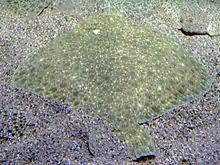
- a righteye flounder (flatfish of the family Pleuronectidae)
- 938, Minamoto no Shitagō, Wamyō Ruijushō, volume 8:
- 王餘魚 朱厓記云:南海有二王餘魚一[和名:加良衣比、俗二云:加禮比一]昔、越王作レ鱠不レ盡餘半棄レ水因以二半身一爲レ魚、故曰二王餘魚一也
- Righteye flounder (literally “king-remaining fish”): according to the Zhūyá chronicle, at the southern sea there exists a righteye flounder (Japanese name kara-ei, commonly said karei); long ago, the king of Yuè had not completely made kuài and discarded half of the remaining into the water; as a result half of his body turned into a fish, hence the name.
- 1603–1604, Nippo Jisho:
- (rare, obsolete) Synonym of 舌鮃 (shitabirame): a sole (flatfish of the family Soleidae)
Usage notes
- As with many terms that name organisms, this term is often spelled in katakana, especially in biological contexts (where katakana is customary), as カレイ.
Derived terms
- カレイ科 (karei-ka, “Pleuronectidae”)
- カレイ目 (karei-moku, “Pleuronectiformes”)
- 赤鰈 (akagarei, “flathead flounder”)
- 油鰈 (aburagarei, “Kamchatka flounder”)
- 石鰈 (ishigarei, “stone flounder”)
- 木の葉鰈 (konoha-garei)
- 鮫鰈 (samegarei)
- 縞鰈 (shimagarei)
- 角鰈 (tsunogarei, “Alaska plaice”)
- 滑多鰈 (nametagarei, “slime flounder”)
- 沼鰈 (numagarei, “starry flounder”)
- 婆婆鰈 (babagarei)
- 干し鰈 (hoshigarei)
- 星鰈 (hoshigarei)
- 真鰈 (magarei, “yellow striped flounder”)
- 真子鰈 (makogarei, “marbled flounder”)
- 蒸し鰈 (mushigarei)
- 目板鰈 (meitagarei)
Idioms
- 左鮃右鰈 (hidari hirame migi karei)
See also
- 鮃 (hirame, “olive flounder”)
- 牛の舌 (ushinoshita, “tonguefish”)
References
- Kindaichi, Kyōsuke et al., editors (1997), 新明解国語辞典 [Shin Meikai Kokugo Jiten] (in Japanese), Fifth edition, Tōkyō: Sanseidō, →ISBN
- NHK Broadcasting Culture Research Institute, editor (1998), NHK日本語発音アクセント辞典 [NHK Japanese Pronunciation Accent Dictionary] (in Japanese), Tōkyō: NHK Publishing, →ISBN
- Matsumura, Akira, editor (2006), 大辞林 [Daijirin] (in Japanese), Third edition, Tōkyō: Sanseidō, →ISBN
Korean
Hanja
鰈 • (jeop) (hangeul 접, revised jeop, McCune–Reischauer chŏp, Yale cep)
- This term needs a translation to English. Please help out and add a translation, then remove the text
{{rfdef}}.