或
| ||||||||
Translingual
| Stroke order | |||
|---|---|---|---|
 | |||
| Stroke order | |||
|---|---|---|---|
 | |||
Han character
或 (Kangxi radical 62, 戈+4, 8 strokes, cangjie input 戈口一 (IRM), four-corner 53100, composition ⿹戈⿱口㇀)
Derived characters
References
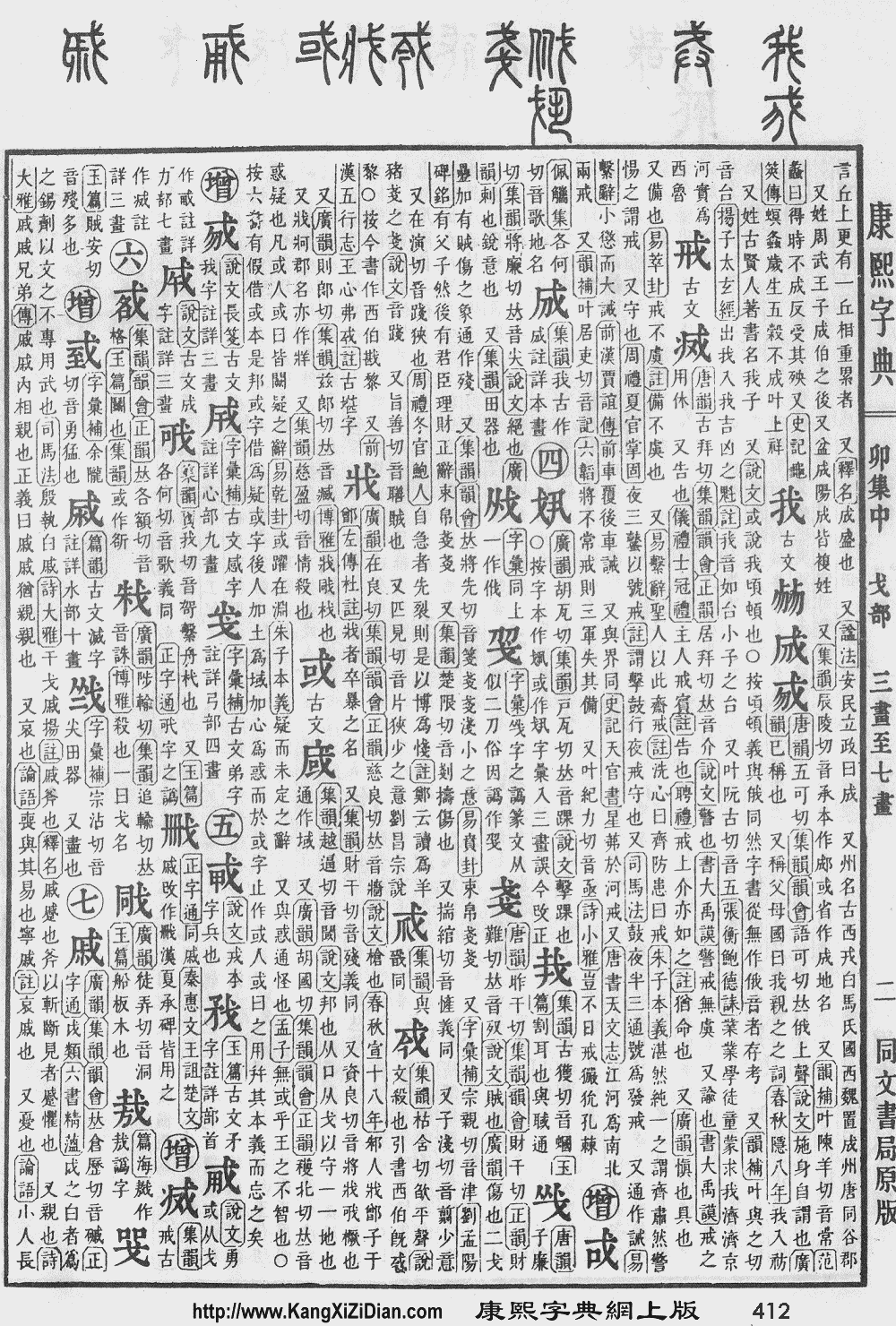
- Kangxi Dictionary: page 412, character 18
- Dai Kanwa Jiten: character 11563
- Dae Jaweon: page 754, character 17
- Hanyu Da Zidian (first edition): volume 2, page 1402, character 8
- Unihan data for U+6216
Chinese
| simp. and trad. |
或 | |
|---|---|---|
| alternative forms | 戓 ancient 𢈿 ancient | |
Glyph origin
| Historical forms of the character 或 | ||||||||
|---|---|---|---|---|---|---|---|---|
| Shang | Western Zhou | Spring and Autumn | Warring States | Shuowen Jiezi (compiled in Han) | Guwen Sishengyun (compiled in Song) | Jizhuan Guwen Yunhai (compiled in Song) | Liushutong (compiled in Ming) | |
| Oracle bone script | Bronze inscriptions | Bronze inscriptions | Chu slip and silk script | Qin slip script | Small seal script | Transcribed ancient scripts | Transcribed ancient scripts | Transcribed ancient scripts |
 |
 |
 |
 |
 |
 |
 |
 |
 |
Characters in the same phonetic series (或) (Zhengzhang, 2003)
| Old Chinese | |
|---|---|
| 幗 | *kʷɯːɡs, *kʷrɯːɡ |
| 慖 | *kʷɯːɡs, *kʷrɯːɡ |
| 簂 | *kʷɯːɡs |
| 蔮 | *kʷɯːɡs |
| 國 | *kʷɯːɡ |
| 或 | *ɡʷɯːɡ |
| 惑 | *ɡʷɯːɡ |
| 蜮 | *ɡʷɯːɡ, *ɢʷrɯɡ |
| 閾 | *qʰʷrɯɡ |
| 緎 | *qʰʷrɯɡ, *ɡʷrɯɡ |
| 淢 | *qʰʷrɯɡ, *ɡʷrɯɡ |
| 域 | *ɢʷrɯɡ |
| 罭 | *ɢʷrɯɡ |
| 棫 | *ɡʷrɯɡ |
| 琙 | *ɡʷrɯɡ |
| 魊 | *ɡʷrɯɡ |
| 馘 | *kʷrɯːɡ |
| 聝 | *kʷrɯːɡ |
| 膕 | *kʷrɯːɡ |
| 摑 | *kʷrɯːɡ |
| 漍 | *kʷrɯːɡ |
| 嘓 | *kʷrɯːɡ |
| 蟈 | *kʷrɯːɡ |
| 掝 | *qʰʷrɯːɡ |
| 彧 | *qʷrɯɡ |
| 稶 | *qʷɯɡ |
Ideogrammic compound (會意/会意) : 戈 (“dagger-axe (used to defend the territory)”) + 囗 (“city wall”) + 一, “territory”.
Borrowed for abstract meanings. The derivative 國 (OC *kʷɯːɡ) and 域 (OC *ɢʷrɯɡ) refer to the original word.
Etymology
或 (OC *ɡʷɯːɡ, “someone; some”) is the result of the distributive suffix *-k being added to 有 (OC *ɢʷɯʔ, “there is”).
Cognate with 又 (OC *ɢʷɯs, “again”) (Schuessler, 2007).
Pronunciation 1
Definitions
或
- or; either ... or ... (used to list alternatives)
- (chiefly in news headlines) perhaps; maybe
- 1046 October 17, 范仲淹 [Fan Zhongyan], 岳陽樓記 [Memorial to Yueyang Tower]:
- occasionally; sometimes
- if; assuming; should ...
- (logic, computing) OR; inclusive or
- particle used in negative sentences to reinforce the negative tone
- † some; someone; something
- 齊人伐燕,勝之。宣王問曰:「或謂寡人勿取,或謂寡人取之。」 [Classical Chinese, trad.]
- From: Mencius, c. 4th century BCE
- Qí rén fá yàn, shèng zhī. Xuān wáng wèn yuē: “Huò wèi guǎrén wù qǔ, huò wèi guǎrén qǔ zhī.” [Pinyin]
- Qi attacked Yan, conquering it. King Xuan said: "Some people tell me not to take it [Yan] for myself; some tell me to take it".
齐人伐燕,胜之。宣王问曰:「或谓寡人勿取,或谓寡人取之。」 [Classical Chinese, simp.]
- † doubt[1]
Compounds
Descendants
Pronunciation 2
Definitions
或
References
- Jing-Schmidt, Zhuo, Peng, Xinjia (2016 February 1) “The emergence of disjunction: A history of constructionalization in Chinese”, in Cognitive Linguistics, volume 27, number 1, , →ISSN, pages 101–136
Japanese
Korean
Hanja
或 • (hok) (hangeul 혹, revised hok, McCune–Reischauer hok, Yale hok)
- This term needs a translation to English. Please help out and add a translation, then remove the text
{{rfdef}}.
Vietnamese
This article is issued from Wiktionary. The text is licensed under Creative Commons - Attribution - Sharealike. Additional terms may apply for the media files.