鼎
| ||||||||
| ||||||||
Translingual
| Stroke order | |||
|---|---|---|---|
 | |||
Han character
鼎 (Kangxi radical 206, 鼎+0, 13 strokes in traditional Chinese and Japanese, 12 strokes in mainland China, cangjie input 月山女一中 (BUVML), four-corner 22221, composition ⿶𤕰目)
- Kangxi radical #206, ⿍.
Derived characters
Usage notes
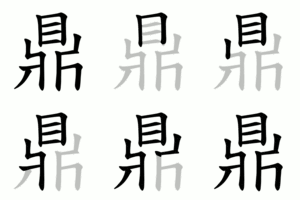
- There is regional variation in the stroke order of the character:
- In mainland China, Japan and Hong Kong, the sixth stroke is 豎折折.
- In Taiwan, the sixth stroke is 豎折 and the seventh stroke is 豎.
- In Japan and Hong Kong, the twelfth stroke is 橫 and the thirteenth stroke is 豎.
- In mainland China, the twelfth stroke is 橫折, corresponding to the thirteenth stroke in Taiwan.
References
- Kangxi Dictionary: page 1525, character 8
- Dai Kanwa Jiten: character 48315
- Dae Jaweon: page 2060, character 20
- Hanyu Da Zidian (first edition): volume 7, page 4740, character 1
- Unihan data for U+9F0E
Chinese
| simp. and trad. |
鼎 | |
|---|---|---|

Glyph origin
| Historical forms of the character 鼎 | |||
|---|---|---|---|
| Shang | Western Zhou | Shuowen Jiezi (compiled in Han) | Liushutong (compiled in Ming) |
| Oracle bone script | Bronze inscriptions | Small seal script | Transcribed ancient scripts |
 |
 |
 |
 |
Characters in the same phonetic series (鼎) (Zhengzhang, 2003)
Pictogram (象形) .
Etymology
From Proto-Sino-Tibetan *(m/ʔ)-di(k/ŋ) (“pot; cauldron”) (STEDT).
Pronunciation
Definitions
鼎
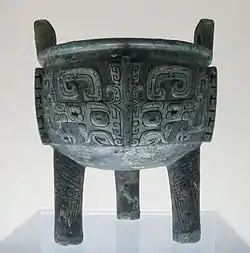
- ding (ancient large, three-legged bronze cauldron for cooking or sacrificial rituals)
- (figurative) throne; monarchy
- (figurative, historical) important figures in the government
- (figurative) big; great
- (figurative) tripartite balance of forces
- (historical) ancient instrument of torture
- (literary) just (at this time); meanwhile
- (Min) wok
- 鼎邊糊/鼎边糊 [Eastern Min] ― diāng-biĕng-gù / [tiaŋ³³⁻²¹ (p-)mieŋ⁵⁵ (k-)ŋu⁵³] [Bàng-uâ-cê / IPA] ― a kind of rice cake popular in Fuzhou area
- 50th hexagram of the I Ching
- a surname
Synonyms
Dialectal synonyms of 鍋 (“wok; cooking pot”) [map]
Compounds
- 一代鼎臣
- 一言九鼎 (yīyánjiǔdǐng)
- 三分鼎立
- 三分鼎足
- 三牲五鼎
- 三足鼎立 (sānzúdǐnglì)
- 三鼎甲
- 丹鼎
- 九鼎 (jiǔdǐng)
- 九鼎大呂/九鼎大吕
- 人聲鼎沸/人声鼎沸 (rénshēngdǐngfèi)
- 刀鋸鼎鑊/刀锯鼎镬
- 列鼎
- 刑鼎
- 列鼎而食
- 列鼎重裀
- 功銘鼎彝
- 問鼎/问鼎 (wèndǐng)
- 嘗鼎一臠/尝鼎一脔 (chángdǐngyīluán)
- 四海鼎沸
- 夏鼎
- 大名鼎鼎 (dàmíngdǐngdǐng)
- 大烹五鼎
- 天下鼎沸
- 定鼎
- 定鼎訏謨/定鼎𬣙谟
- 寶鼎/宝鼎
- 寶鼎勛章/宝鼎勋章
- 幕燕鼎魚/幕燕鼎鱼
- 庖鼎
- 扛鼎 (gāngdǐng)
- 扛鼎士
- 扛鼎拔山
- 折鼎覆餗/折鼎覆𫗧
- 拔山扛鼎
- 拔山舉鼎/拔山举鼎
- 擊鐘陳鼎/击钟陈鼎
- 擊鐘鼎食/击钟鼎食
- 方鼎
- 易順鼎/易顺鼎
- 春秋鼎盛 (chūnqiūdǐngshèng)
- 晉鑄刑鼎/晋铸刑鼎
- 曶鼎
- 染指於鼎/染指于鼎
- 楚莊問鼎/楚庄问鼎
- 槐鼎
- 毛公鼎
- 沸鼎
- 湯鼎/汤鼎
- 潛圖問鼎/潜图问鼎
- 烹飪鼎鼐/烹饪鼎鼐
- 牛鼎烹雞/牛鼎烹鸡 (niúdǐngpēngjī)
- 瓦棺篆鼎
- 移鼎
- 立鼎安爐/立鼎安炉
- 笙歌鼎沸
- 筆力扛鼎/笔力扛鼎
- 舉鼎拔山/举鼎拔山
- 舉鼎絕臏/举鼎绝膑
- 舉鼎觀畫/举鼎观画
- 茶鼎
- 藍蔭鼎/蓝荫鼎
- 覆鼎
- 觀鼎/观鼎
- 調和鼎鼐/调和鼎鼐
- 調鼎/调鼎
- 讒鼎/谗鼎
- 負鼎/负鼎
- 負鼎之願/负鼎之愿
- 贗鼎/赝鼎
- 身膏鼎鑊/身膏鼎镬
- 遷鼎/迁鼎
- 郜鼎
- 重裀列鼎
- 金鼎獎/金鼎奖
- 鐘鳴鼎食/钟鸣鼎食 (zhōngmíngdǐngshí)
- 鐘鼎/钟鼎
- 鐘鼎之家/钟鼎之家
- 鐘鼎文/钟鼎文 (zhōngdǐngwén)
- 鐘鼎款識/钟鼎款识
- 鐘鼎高門/钟鼎高门
- 鑄鼎象物/铸鼎象物
- 陳鼎擊鐘/陈鼎击钟
- 革故鼎新
- 革舊鼎新/革旧鼎新
- 香火鼎盛
- 鳴鐘列鼎/鸣钟列鼎
- 鼎位
- 鼎俎
- 鼎元
- 鼎元之分
- 鼎力 (dǐnglì)
- 鼎力玉成 (dǐnglìyùchéng)
- 鼎力相助 (dǐnglìxiāngzhù)
- 鼎命
- 鼎峙 (dǐngzhì)
- 鼎席
- 鼎彝
- 鼎折足 (dǐngzhézú)
- 鼎新 (dǐngxīn)
- 鼎新革故
- 鼎族
- 鼎棋
- 鼎沸 (dǐngfèi)
- 鼎沸不絕/鼎沸不绝
- 鼎湖 (dǐnghú)
- 鼎甲
- 鼎盛 (dǐngshèng)
- 鼎祚
- 鼎立 (dǐnglì)
- 鼎臣
- 鼎蓋/鼎盖 (tiáⁿ-kòa) (Min Nan)
- 鼎足 (dǐngzú)
- 鼎足三分
- 鼎足之勢/鼎足之势 (dǐngzú zhī shì)
- 鼎足而立
- 鼎輔/鼎辅
- 鼎邊糊/鼎边糊 (dǐngbiānhú)
- 鼎邊銼/鼎边锉
- 鼎鍾/鼎钟
- 鼎鑊/鼎镬
- 鼎鑊刀鋸/鼎镬刀锯
- 鼎革 (dǐnggé)
- 鼎食 (dǐngshí)
- 鼎食鳴鐘/鼎食鸣钟
- 鼎鼎 (dǐngdǐng)
- 鼎鼎大名 (dǐngdǐngdàmíng)
- 鼎鼎有名
- 鼎鼐 (dǐngnài)
- 鼎鼐臣
- 鼎鼐調和/鼎鼐调和
- 龜鼎/龟鼎
Further reading
- “Entry #10387”, in 臺灣閩南語常用詞辭典 [Dictionary of Frequently-Used Taiwan Minnan] (overall work in Mandarin and Hokkien), Ministry of Education, R.O.C., 2023.
Japanese
Readings
Compounds
Compounds
- 鼎革 (teikaku, “a state of transformation, especially a major politcal one”)
- 鼎座 (teiza, “a three-way seating arrangement with three people facing each other; to sit in such an arrangement”)
- 鼎足 (teisoku, “the legs of a tripod; a three-way opposition; a triumvirate in support of a superior”)
- 鼎峙 (teiji, “a three-way opposition; to stand in three-way opposition”)
- 鼎談 (teidan, “a three-way conversation; to have a three-way conversation”)
- 鼎部 (teibu, “that set of kanji that have the character 鼎 as the radical”)
- 鼎立 (teiritsu, “a three-way opposition; to stand in three-way opposition”)
Etymology 1
| Kanji in this term |
|---|
| 鼎 |
| かなえ Jinmeiyō |
| kun’yomi |
Originally a compound of 金 (kana, “metal”) + 瓮 (he, “a pot or pan for holding food or beverages”).[1][2]
Alternative forms
- 釜 (less common)
Noun
- a three-legged kettle, a tripod kettle, used for cooking and later for ceremonial purposes in ancient China, and often made of bronze
- a symbol of a king or other high authority
Idioms
- 鼎の軽重を問う (kanae no keijū o tō): "to ask about the weight of a kettle" ⇒ to question a person's ability
- 鼎の沸くが如し (kanae no waku ga gotoshi): "just like a boiling kettle" ⇒ a metaphor for a noisy busy situation
- 鼎の中の一切れの肉 (kanae no naka no hitokire no niku): "single slice of meat [from] in the kettle" ⇒ to get a read on the whole from a small sample
- 鼎を扛ぐ (kanae o agu): "to lift a kettle" ⇒ to be physically strong
- 鼎を定む (kanae o sadamu): "to settle the kettle" ⇒ to control the imperial capital, to ascend the throne
Etymology 2
| Kanji in this term |
|---|
| 鼎 |
| てい Jinmeiyō |
| on’yomi |
From Middle Chinese 鼎 (MC tengX). Compare modern Mandarin 鼎 (dǐng).
Noun
鼎 • (tei)
Derived terms
- 鐘鼎文 (shōteibun)
References
- Shōgaku Tosho (1988) 国語大辞典(新装版) [Unabridged Dictionary of Japanese (Revised Edition)] (in Japanese), Tōkyō: Shogakukan, →ISBN
- Matsumura, Akira, editor (2006), 大辞林 [Daijirin] (in Japanese), Third edition, Tōkyō: Sanseidō, →ISBN
- Kindaichi, Kyōsuke et al., editors (1997), 新明解国語辞典 [Shin Meikai Kokugo Jiten] (in Japanese), Fifth edition, Tōkyō: Sanseidō, →ISBN
Korean
Hanja
鼎 • (jeong) (hangeul 정, revised jeong, McCune–Reischauer chŏng, Yale ceng)
- This term needs a translation to English. Please help out and add a translation, then remove the text
{{rfdef}}.
Vietnamese
This article is issued from Wiktionary. The text is licensed under Creative Commons - Attribution - Sharealike. Additional terms may apply for the media files.