阜

See also: 阝 and 邑
阜 U+961C, 阜
CJK UNIFIED IDEOGRAPH-961C
← 阛
[U+961B]
CJK Unified Ideographs 阝 →
[U+961D]
⾩ U+2FA9, ⾩
KANGXI RADICAL MOUND
← ⾨
[U+2FA8]
Kangxi Radicals ⾪ →
[U+2FAA]

Translingual

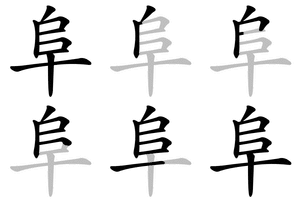
Stroke order

Alternative forms

  • 阝 (when used as a left Chinese Radical)

Han character

阜 (Kangxi radical 170, 阜+0, 8 strokes, cangjie input 竹口十 (HRJ), four-corner 27407, composition ⿱𠂤十)

  1. Kangxi radical #170, ⾩.

Derived characters

  • Appendix:Chinese radical/阜
  • 埠, 𢮒, 㷆, 𤦞, 𥓭, 𧌓, 𧨮, 𮢌, 𩣸
  • 𤭟, 顊(𬱪), 𧌛, 䘀, 𡸠, 𦰺, 𢈹, 𤷎

References

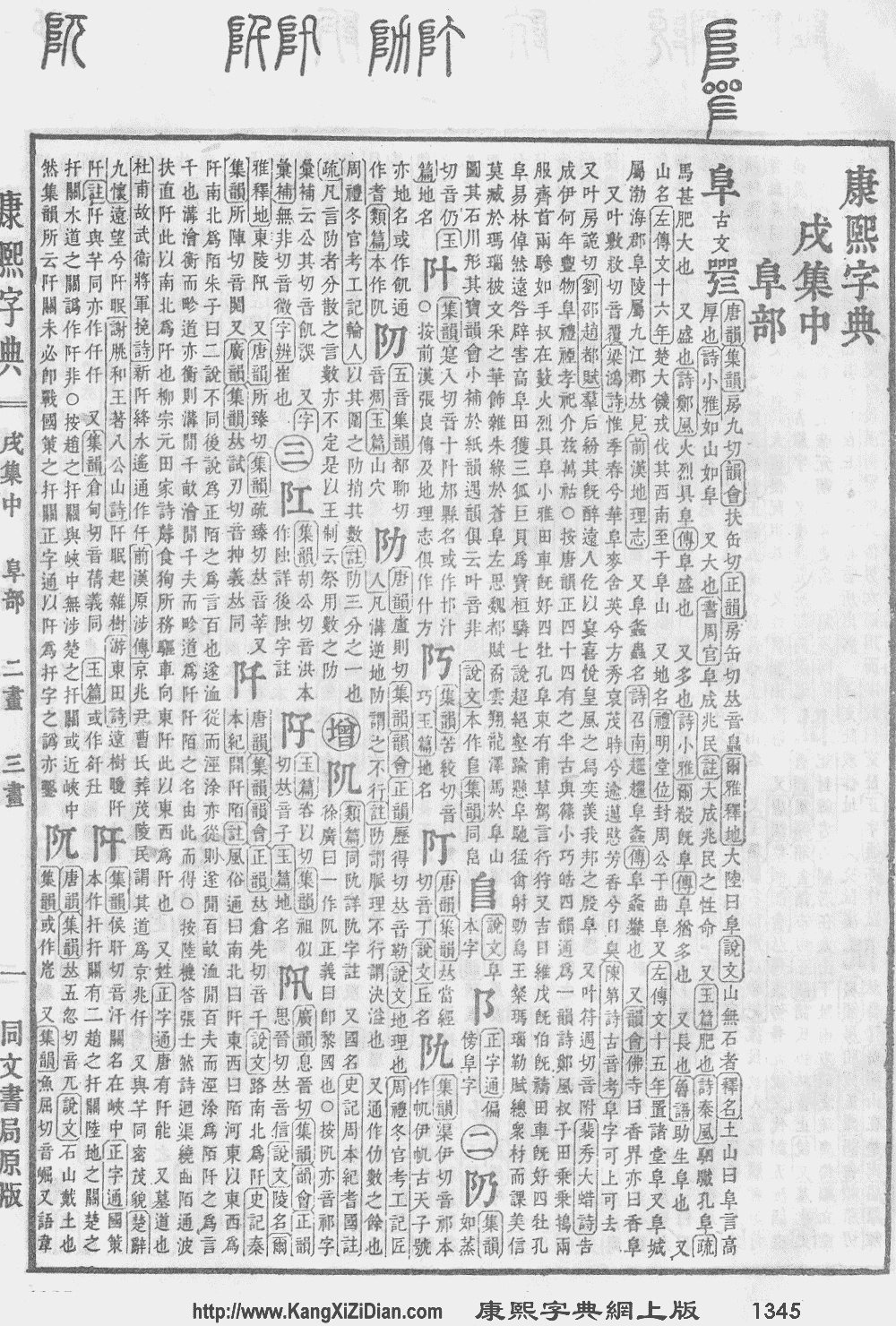
  • Kangxi Dictionary: page 1345, character 1
  • Dai Kanwa Jiten: character 41534
  • Dae Jaweon: page 1847, character 25
  • Hanyu Da Zidian (first edition): volume 6, page 4114, character 1
  • Unihan data for U+961C

Chinese

simp. and trad.
阜
alternative forms 𨸏
峊

Glyph origin

Historical forms of the character 阜
Shang Shuowen Jiezi (compiled in Han) Liushutong (compiled in Ming)
Oracle bone script Small seal script Transcribed ancient scripts

Pictogram (象形) , a row of hills.

Pronunciation


Rime
Character 阜
Reading # 1/1
Initial (聲) 並 (3)
Final (韻) 尤 (136)
Tone (調) Rising (X)
Openness (開合) Open
Division (等) III
Fanqie 房久切
Baxter bjuwX
Reconstructions
Zhengzhang
Shangfang
/bɨuX/
Pan
Wuyun
/biuX/
Shao
Rongfen
/biəuX/
Edwin
Pulleyblank
/buwX/
Li
Rong
/biuX/
Wang
Li
/bĭəuX/
Bernard
Karlgren
/bʱi̯ə̯uX/
Expected
Mandarin
Reflex
fòu
Expected
Cantonese
Reflex
fau6
Baxter–Sagart system 1.1 (2014)
Character 阜
Reading # 1/1
Modern
Beijing
(Pinyin)
fù
Middle
Chinese
‹ bjuwX ›
Old
Chinese
/*[b](r)uʔ/
English big mound

Notes for Old Chinese notations in the Baxter–Sagart system:

* Parentheses "()" indicate uncertain presence;
* Square brackets "[]" indicate uncertain identity, e.g. *[t] as coda may in fact be *-t or *-p;
* Angle brackets "<>" indicate infix;
* Hyphen "-" indicates morpheme boundary;

* Period "." indicates syllable boundary.
Zhengzhang system (2003)
Character 阜
Reading # 1/1
No. 3533
Phonetic
component
阜
Rime
group
幽
Rime
subdivision
1
Corresponding
MC rime
婦
Old
Chinese
/*buʔ/

Definitions

阜

  1. (literary) mound
  2. (literary) abundant; rich
  3. a surname

Compounds

  • 土阜
  • 岐阜 (Qífù)
  • 左阜右邑
  • 平阜
  • 康阜
  • 曲阜 (Qūfù)
  • 殷民阜利
  • 殷民阜財
  • 殷阜
  • 民安物阜
  • 民康物阜
  • 民殷財阜
  • 民熙物阜
  • 物阜民安
  • 物阜民熙
  • 物阜民豐/物阜民丰
  • 翠阜
  • 阜盛
  • 阜蕃
  • 阜螽
  • 阜財/阜财
  • 阜陽/阜阳 (Fùyáng)
  • 陰阜/阴阜 (yīnfù)

Descendants

  • → Lao: ພູ (phū)
  • → Thai: ภู (puu, “mound, mountain, hill”)

Japanese

Kanji

阜

(common “Jōyō” kanji)

  1. mound, dam

Readings

Usage notes

  • This kanji, when referencing as a radical, is usually called "Gifu-no-'fu'"

Noun

Kanji in this term
阜
つかさ
Grade: 4
kun’yomi
For pronunciation and definitions of 阜 – see the following entry.
【つかさ】
[noun] 阜, 司: a small hill
Alternative spelling
司
(This term, 阜, is an alternative spelling of the above term.)

Korean

Etymology

From Middle Chinese 阜 (MC bjuwX). Recorded as Middle Korean 부〯 (pwǔ) (Yale: pwu) in Hunmong Jahoe (訓蒙字會 / 훈몽자회), 1527.

Hanja

Wikisource 阜 (eumhun 언덕 부 (eondeok bu))

  1. Hanja form? of 부 (“hill”).

Compounds

References

  • 국제퇴계학회 대구경북지부 (國際退溪學會 大邱慶北支部) (2007). Digital Hanja Dictionary, 전자사전/電子字典.

Vietnamese

Han character

阜: Hán Nôm readings: phụ

  1. This term needs a translation to English. Please help out and add a translation, then remove the text {{rfdef}}.
This article is issued from Wiktionary. The text is licensed under Creative Commons - Attribution - Sharealike. Additional terms may apply for the media files.