久
| ||||||||
Translingual
| Stroke order | |||
|---|---|---|---|
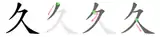 | |||
| Stroke order | |||
|---|---|---|---|
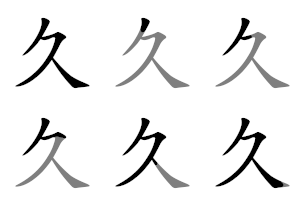 | |||
Han character
久 (Kangxi radical 4, 丿+2, 3 strokes, cangjie input 弓人 (NO) or 難弓人 (XNO), four-corner 27800, composition ⿸𠂊㇏)
Descendants
- く (Hiragana character derived from man'yōgana)
- ク (Katakana character derived from man'yōgana)
- 𛀫 (Hentaigana)
- 𛀬 (Hentaigana)
References
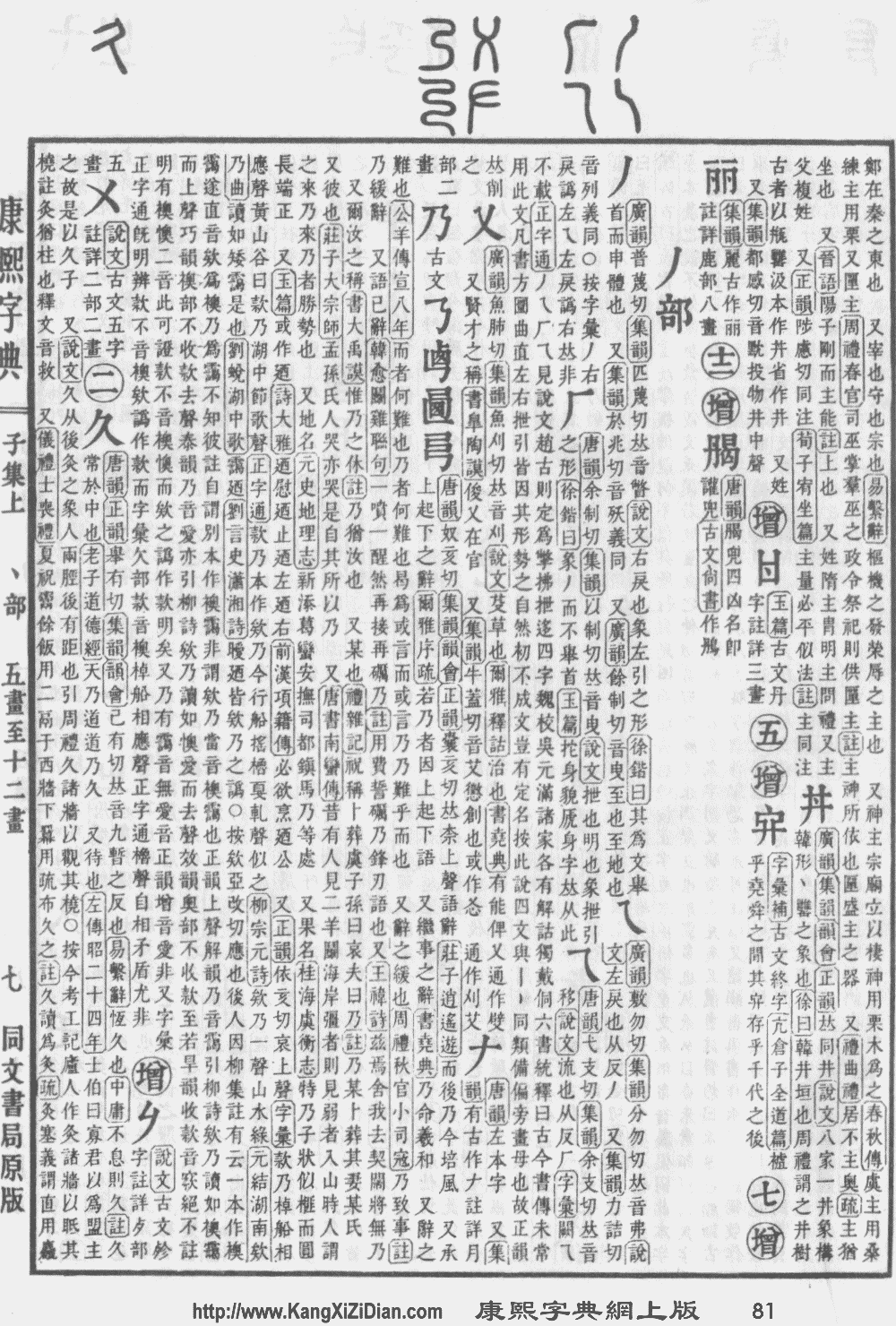
- Kangxi Dictionary: page 81, character 19
- Dai Kanwa Jiten: character 118
- Dae Jaweon: page 165, character 6
- Hanyu Da Zidian (first edition): volume 1, page 33, character 3
- Unihan data for U+4E45
Chinese
| simp. and trad. |
久 | |
|---|---|---|
| alternative forms | 乆 𫝄 | |
Glyph origin
| Historical forms of the character 久 | |||||||||||||||||
|---|---|---|---|---|---|---|---|---|---|---|---|---|---|---|---|---|---|
| |||||||||||||||||
|
References: Mostly from Richard Sears' Chinese Etymology site (authorisation),
|


Characters in the same phonetic series (久) (Zhengzhang, 2003)
Pictogram (象形) - a man receiving moxibustion. The derivative 灸 (OC *kʷlɯʔ, *kʷlɯs) refers to the original word.
Etymology
Possibly Sino-Tibetan. Compare Bantawa [script needed] (kʰokpa, “old man”) (Sagart, 2017d), which STEDT derives from Proto-Sino-Tibetan *kwak (“old”).
舊 (OC *N-kʷəʔ-s) may be a derivative (Baxter and Sagart, 2014). See there for more.
Pronunciation
Definitions
久
Synonyms
Dialectal synonyms of 久 (“long (time)”) [map]
Compounds
- 一勞久逸/一劳久逸
- 不久 (bùjiǔ)
- 不多久
- 久久 (jiǔjiǔ)
- 久之 (jiǔzhī)
- 久仰 (jiǔyǎng)
- 久仰大名 (jiǔyǎngdàmíng)
- 久仰山斗
- 久候
- 久假不歸/久假不归 (jiǔjiǎbùguī)
- 久停久住
- 久別/久别 (jiǔbié)
- 久別相逢/久别相逢
- 久別重逢/久别重逢
- 久合垸 (Jiǔhéyuàn)
- 久坐 (jiǔzuò)
- 久夢初醒/久梦初醒
- 久安長治/久安长治 (jiǔ'ānchángzhì)
- 久客
- 久居 (jiǔjū)
- 久待 (jiǔdài)
- 久慣牢成/久惯牢成
- 久慣老成/久惯老成
- 久戀/久恋 (jiǔliàn)
- 久旱不雨 (jiǔhànbùyǔ)
- 久有存心
- 久留 (jiǔliú)
- 久病成醫/久病成医 (jiǔbìngchéngyī)
- 久矣
- 久視/久视
- 久立 (jiǔlì)
- 久等 (jiǔděng)
- 久而久之 (jiǔ'érjiǔzhī)
- 久聞大名/久闻大名 (jiǔwéndàmíng)
- 久要 (jiǔyāo)
- 久見/久见 (kiú-kian)
- 久違/久违 (jiǔwéi)
- 久違顏範/久违颜范
- 久遠/久远 (jiǔyuǎn)
- 久錮/久锢
- 久長/久长 (jiǔcháng)
- 久闊/久阔 (jiǔkuò)
- 久音
- 保久乳
- 偌久 (gōa-kú)
- 地久天長/地久天长 (dìjiǔtiāncháng)
- 壙久/圹久
- 多久 (duōjiǔ)
- 天長地久/天长地久 (tiānchángdìjiǔ)
- 天長日久/天长日久 (tiānchángrìjiǔ)
- 好久 (hǎojiǔ)
- 常久 (chángjiǔ)
- 年久失修 (niánjiǔshīxiū)
- 年深日久
- 年深月久
- 恆久/恒久 (héngjiǔ)
- 恆久不渝/恒久不渝
- 悠久 (yōujiǔ)
- 持久 (chíjiǔ)
- 持久之計/持久之计
- 持久戰/持久战 (chíjiǔzhàn)
- 日久天長/日久天长
- 日久年深
- 日久彌新/日久弥新
- 日久月深
- 日久歲深/日久岁深
- 日久玩生
- 日久生情 (rìjiǔshēngqíng)
- 日長歲久/日长岁久
- 曠久/旷久
- 曠日引久/旷日引久
- 曠日彌久/旷日弥久
- 曠日持久/旷日持久 (kuàngrìchíjiǔ)
- 曠日經久/旷日经久
- 曠日長久/旷日长久
- 歷久/历久 (lìjiǔ)
- 歷久不衰/历久不衰 (lìjiǔbùshuāi)
- 歷久彌新/历久弥新 (lìjiǔmíxīn)
- 歷日曠久/历日旷久
- 永久 (yǒngjiǔ)
- 永久磁鐵/永久磁铁
- 永久齒/永久齿
- 牢成久慣/牢成久惯
- 積久/积久
- 積久弊生/积久弊生
- 終久/终久 (zhōngjiǔ)
- 經久/经久 (jīngjiǔ)
- 經久不息/经久不息 (jīngjiǔbùxī)
- 耐久 (nàijiǔ)
- 耐久品
- 耐久朋
- 耐久財/耐久财
- 良久 (liángjiǔ)
- 訂久要/订久要 (dìngjiǔyāo)
- 許久/许久 (xǔjiǔ)
- 迂久
- 長久/长久 (chángjiǔ)
- 長久之計/长久之计
- 長治久安/长治久安 (chángzhìjiǔ'ān)
- 長生久視/长生久视
- 雨久花
- 頃久/顷久
Japanese
Readings
Vietnamese
Han character
References
- Bonet (1899).
- Taberd & Pigneau de Béhaine (1838).
- Trần (2004).
- Génibrel (1898).
This article is issued from Wiktionary. The text is licensed under Creative Commons - Attribution - Sharealike. Additional terms may apply for the media files.