倚
See also: 徛
| ||||||||
Translingual
Han character
倚 (Kangxi radical 9, 人+8, 10 strokes, cangjie input 人大一口 (OKMR), four-corner 24221, composition ⿰亻奇)
References
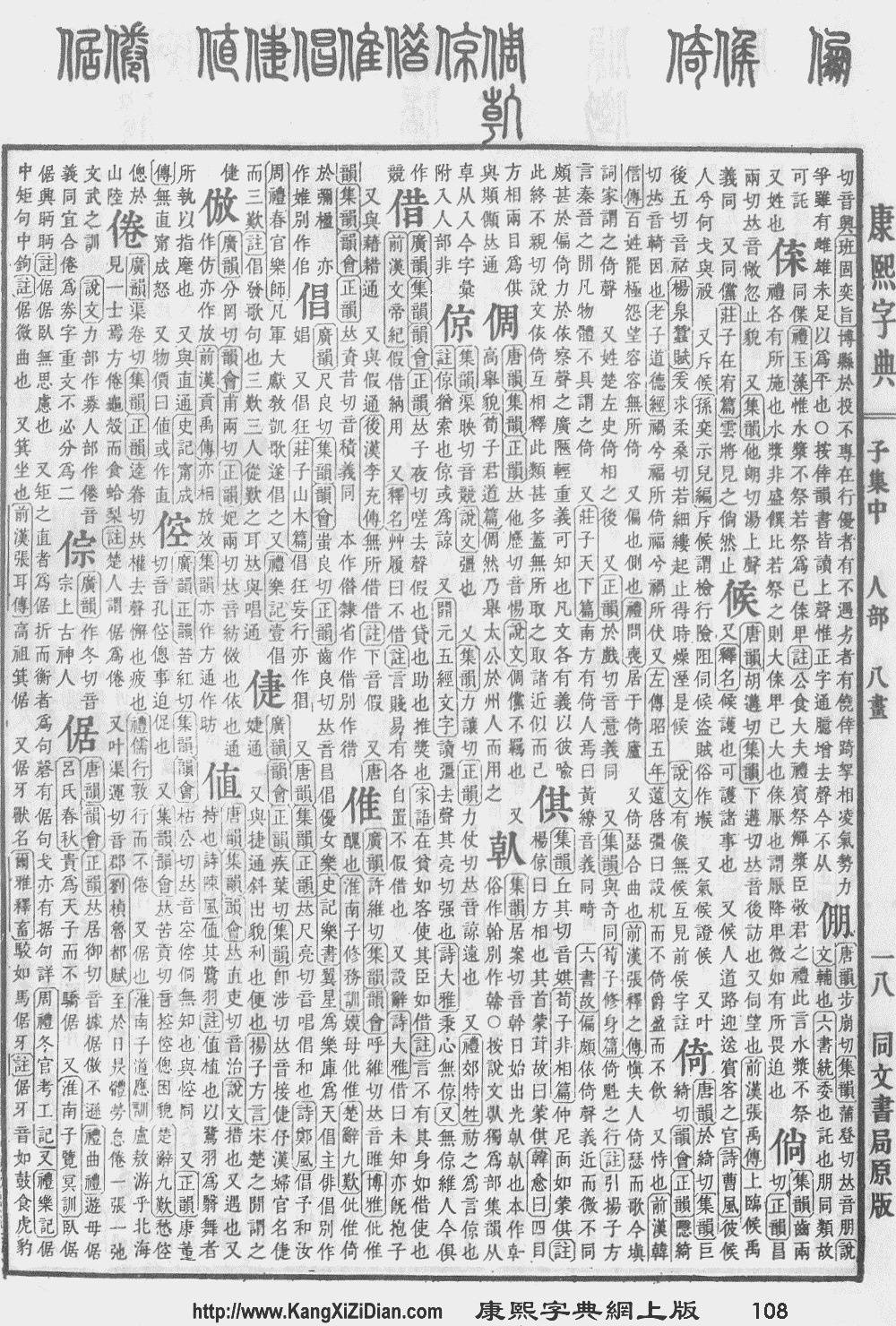
- Kangxi Dictionary: page 108, character 5
- Dai Kanwa Jiten: character 776
- Dae Jaweon: page 230, character 1
- Hanyu Da Zidian (first edition): volume 1, page 173, character 1
- Unihan data for U+501A
Chinese
| simp. and trad. |
倚 | |
|---|---|---|
Glyph origin
| Historical forms of the character 倚 | |||||||
|---|---|---|---|---|---|---|---|
| |||||||
|
References: Mostly from Richard Sears' Chinese Etymology site (authorisation),
|


Characters in the same phonetic series (奇) (Zhengzhang, 2003)
| Old Chinese | |
|---|---|
| 奇 | *kral, *ɡral |
| 畸 | *kral |
| 剞 | *kral, *kralʔ |
| 羇 | *kral |
| 掎 | *kral, *kralʔ, *kʰrals |
| 攲 | *kral, *kralʔ, *kʰral |
| 躸 | *kral |
| 踦 | *kralʔ, *kʰral |
| 寄 | *krals |
| 徛 | *krals, *ɡralʔ |
| 欹 | *kʰral, *qral |
| 崎 | *kʰral, *ɡɯl |
| 觭 | *kʰral, *kʰralʔ |
| 碕 | *kʰral, *kʰralʔ, *ɡral, *ɡɯl |
| 綺 | *kʰralʔ |
| 婍 | *kʰralʔ |
| 騎 | *ɡral, *ɡrals |
| 琦 | *ɡral |
| 鵸 | *ɡral |
| 錡 | *ɡral, *ɡralʔ, *ŋɡralʔ |
| 輢 | *ɡrals, *qralʔ, *qrals |
| 齮 | *ŋɡralʔ |
| 犄 | *qral |
| 猗 | *qral, *qralʔ |
| 椅 | *qral, *qralʔ |
| 旖 | *qral, *qralʔ |
| 陭 | *qral, *qrals |
| 檹 | *qral |
| 漪 | *qral |
| 倚 | *qralʔ, *qrals |
Pronunciation
Definitions
倚
Compounds
- 不偏不倚 (bùpiānbùyǐ)
- 中立不倚
- 倚仗 (yǐzhàng)
- 倚伏
- 倚傍 (yǐbàng)
- 倚兒不當/倚儿不当
- 倚勢/倚势 (yǐshì)
- 倚勢挾權/倚势挟权
- 倚多為勝/倚多为胜
- 倚天
- 倚官仗勢/倚官仗势
- 倚官託勢/倚官托势
- 倚富欺貧/倚富欺贫
- 倚廬/倚庐
- 倚強凌弱
- 倚強欺弱/倚强欺弱 (yǐqiáng qī ruò)
- 倚恃 (yǐshì)
- 倚扉而望
- 倚托
- 倚杖
- 倚歌
- 倚玉偎香
- 倚瑟
- 倚翠
- 倚翠偎紅/倚翠偎红
- 倚老賣老/倚老卖老 (yǐlǎomàilǎo)
- 倚聲/倚声
- 倚草附木
- 倚薄
- 倚負/倚负
- 倚財仗勢/倚财仗势
- 倚賴/倚赖 (yǐlài)
- 倚賴性/倚赖性
- 倚郭縣/倚郭县
- 倚重 (yǐzhòng)
- 倚門/倚门 (yǐmén)
- 倚門之娼/倚门之娼
- 倚門佇望/倚门伫望
- 倚門倚閭/倚门倚闾 (yǐményǐlǘ)
- 倚門傍戶/倚门傍户
- 倚門賣俏/倚门卖俏
- 倚門賣笑/倚门卖笑
- 倚閭/倚闾 (yǐlǘ)
- 倚閭之望/倚闾之望
- 倚靠 (yǐkào)
- 倚馬千言/倚马千言
- 倚馬可待/倚马可待 (yǐmǎkědài)
- 偏倚 (piānyǐ)
- 偎倚 (wēiyǐ)
- 偎紅倚翠/偎红倚翠
- 偎香倚玉
- 徙倚
- 憑倚/凭倚
- 拔地倚天
- 挾權倚勢/挟权倚势
- 挾貴倚勢/挟贵倚势
- 松蘿共倚/松萝共倚
- 毗倚
- 泰山可倚
- 無偏無倚/无偏无倚
- 狼狽相倚/狼狈相倚
- 相倚為命/相倚为命
- 相倚為彊/相倚为强
- 禍福倚伏/祸福倚伏
- 禍福相倚/祸福相倚
- 蒹葭倚玉
- 跛倚
Japanese
Kanji
倚
Readings
From Middle Chinese 倚 (MC 'jeX); compare Mandarin 倚 (yǐ):
- Go-on: い (i)←い (i, historical)
- Kan-on: い (i)←い (i, historical)
From Middle Chinese 倚 (MC kje); compare Mandarin 倚 (jī):
- Go-on: き (ki)←き (ki, historical)
- Kan-on: き (ki)←き (ki, historical)
From native Japanese roots:
Korean
Vietnamese
This article is issued from Wiktionary. The text is licensed under Creative Commons - Attribution - Sharealike. Additional terms may apply for the media files.