原
| ||||||||
Translingual
Han character
| Stroke order | |||
|---|---|---|---|
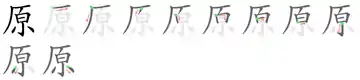 | |||
原 (Kangxi radical 27, 厂+8, 10 strokes, cangjie input 一竹日火 (MHAF), four-corner 71296, composition ⿸厂⿱白小)
Derived characters
References
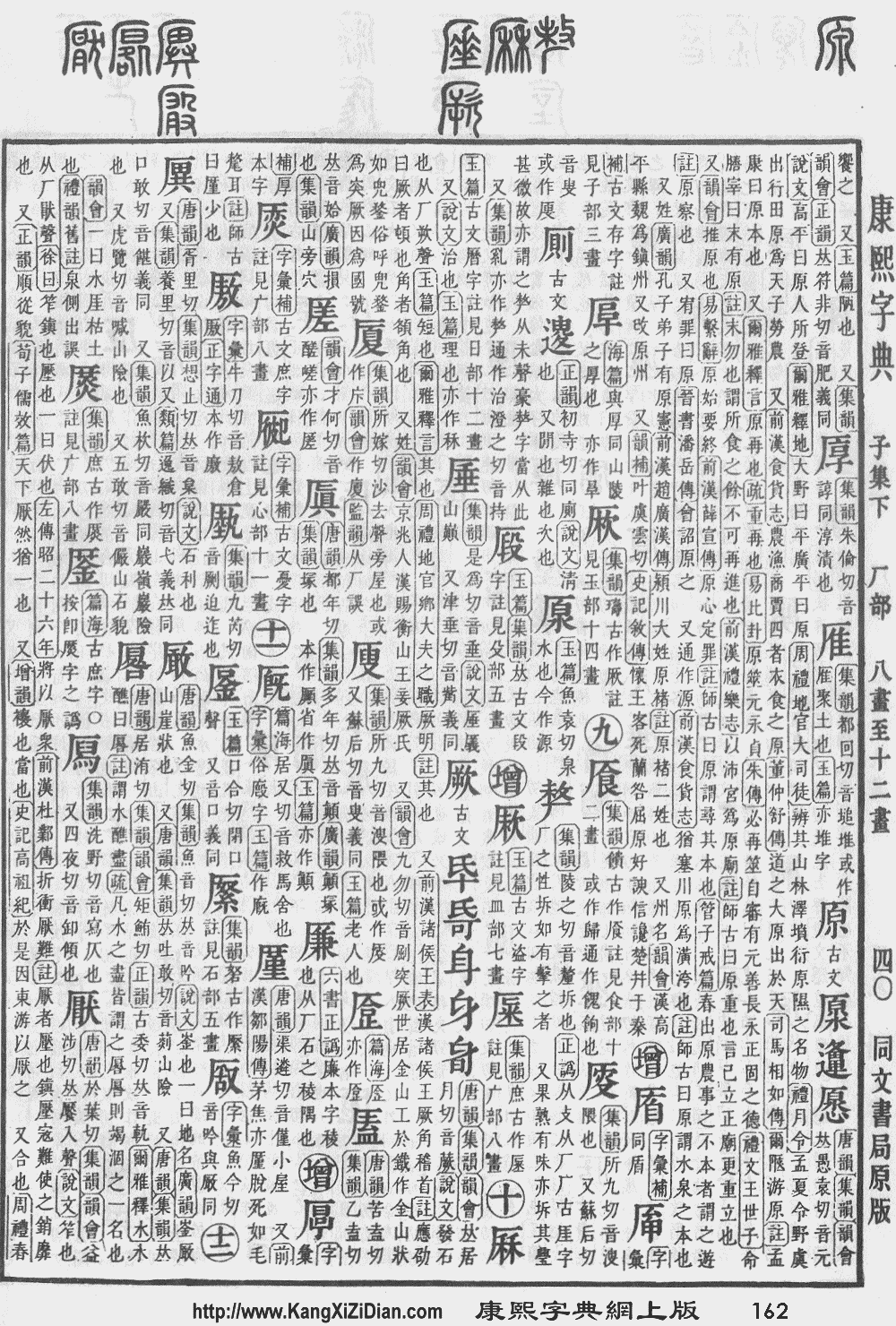
- Kangxi Dictionary: page 162, character 3
- Dai Kanwa Jiten: character 2973
- Dae Jaweon: page 368, character 23
- Hanyu Da Zidian (first edition): volume 1, page 74, character 9
- Unihan data for U+539F
Chinese
| simp. and trad. |
原 | |
|---|---|---|
| 2nd round simp. | 𰆖 | |
| alternative forms | 厡 邍 “plain” 𠫐 | |
Glyph origin
| Historical forms of the character 原 | |||
|---|---|---|---|
| Western Zhou | Warring States | Shuowen Jiezi (compiled in Han) | Liushutong (compiled in Ming) |
| Bronze inscriptions | Chu slip and silk script | Small seal script | Transcribed ancient scripts |
 |
 |
 |
 |
Ideogrammic compound (會意/会意) : 泉 (“spring”) + 厂 (“cliff”) – a spring bursting from a cliff-side – origin.
Etymology
The sense “source, origin; basic, primary” is perhaps related to 元 (OC *ŋon, “head; principal; first; great”) (Qiu, 1988). According to Schuessler (2007), in Shijing 原 meant "a plain" as well as "highland", thus perhaps also related to 元 (OC *ŋon) (see also Qiu, 2000).
元 and 原 had been used interchangeably in the sense "origin" until 原 became favoured in the early Ming dynasty to avoid the name of the Yuan dynasty. Confer 元由, 元來/元来 and 元配.[1]
Pronunciation
Definitions
原
- meadow; field; plain; prairie; tundra; wilderness
- source; origin; beginning
- Original form of 源 (yuán, “fountainhead; source”).
- basic; fundamental
- original; primary
- originally; at the beginning
- to originate; to arise
- to trace the source; to probe into
- (literary, or in compounds) to forgive; to pardon
- a surname: Yuan
Synonyms
- (originally):
- 一插手兒/一插手儿 (yīchāshǒur) (Beijing Mandarin)
- 一開始/一开始 (yīkāishǐ)
- 上頭仔/上头仔 (Hokkien)
- 乍出猛兒/乍出猛儿 (zhàchūměngr) (Beijing Mandarin)
- 先前 (1shi-zhi) (Wu)
- 先起頭/先起头 (Wu)
- 先頭/先头 (Wu)
- 最初 (zuìchū)
- 初初 (co1 co1) (Cantonese, Hakka, Hokkien)
- 劈頭/劈头 (pītóu)
- 原來/原来 (yuánlái)
- 原先 (yuánxiān)
- 原初 (yuánchū)
- 原底 (Hokkien, chiefly Cantonese, Teochew, chiefly Cantonese)
- 原旦 (Hakka)
- 原本 (yuánběn)
- 原本榻裡/原本榻里 (6gnioe-pen-thaq-li) (Wu)
- 在本 (Hokkien)
- 始初 (shǐchū) (literary)
- 寢頭/寝头 (Hokkien)
- 就跟兒/就跟儿 (jiùgēnr) (Beijing Mandarin)
- 早先 (5tsau-shi) (Wu)
- 本來/本来 (běnlái)
- 本則來/本则来 (5pen-tseq-le) (Wu)
- 本底 (Hokkien)
- 本底子 (5pen-ti-tsy) (Wu)
- 本成 (Hokkien)
- 本然 (Hokkien)
- 本生 (5pen-san) (Wu)
- 當初/当初 (dāngchū)
- 當初時/当初时 (Hokkien)
- 當原初/当原初 (Quanzhou Hokkien, Xiamen Hokkien)
- 自本 (Hokkien)
- 舊底/旧底 (Hokkien)
- 起先 (qǐxiān)
- 起初 (qǐchū)
- 起始 (qǐshǐ)
- 起手 (qǐshǒu)
- 起頭/起头 (qǐtóu)
- 起首 (qǐshǒu) (literary, or Guangzhou Cantonese)
- 開先/开先 (kai1 sienn1) (Xiang)
- 開初/开初 (kāichū)
- 頭仔/头仔 (Hokkien)
- 頭起先/头起先 (Hokkien)
- 頭頭/头头 (Cantonese, Eastern Min, Hokkien)
- (to forgive):
Compounds
- 一貫原理/一贯原理
- 三原色 (sānyuánsè)
- 不可勝原/不可胜原
- 中原 (Zhōngyuán)
- 中原大學/中原大学
- 中原板蕩/中原板荡
- 中原逐鹿
- 中原音韻/中原音韵 (Zhōngyuán Yīnyùn)
- 中質原油/中质原油
- 九九歸原/九九归原
- 九原
- 九原可作
- 事物紀原/事物纪原
- 互惠原則/互惠原则
- 依原
- 傳染原/传染原
- 冰原 (bīngyuán)
- 凍原/冻原 (dòngyuán)
- 北極凍原/北极冻原
- 原主 (yuánzhǔ)
- 原人 (yuánrén)
- 原件 (yuánjiàn)
- 原任
- 原作 (yuánzuò)
- 原住民 (yuánzhùmín)
- 原來/原来 (yuánlái)
- 原來如此/原来如此 (yuánláirúcǐ)
- 原像 (yuánxiàng)
- 原價/原价 (yuánjià)
- 原先 (yuánxiān)
- 原則/原则 (yuánzé)
- 原動力/原动力 (yuándònglì)
- 原原本本 (yuányuánběnběn)
- 原名 (yuánmíng)
- 原告 (yuángào)
- 原味 (yuánwèi)
- 原因 (yuányīn)
- 原因論/原因论
- 原圖卡/原图卡
- 原地 (yuándì)
- 原地踏步 (yuándìtàbù)
- 原型 (yuánxíng)
- 原始 (yuánshǐ)
- 原委 (yuánwěi)
- 原始主義/原始主义 (yuánshǐzhǔyì)
- 原始人 (yuánshǐrén)
- 原始佛教
- 原始反終/原始反终
- 原始林 (yuánshǐlín)
- 原始社會/原始社会 (yuánshǐ shèhuì)
- 原始程式 (yuánshǐ chéngshì)
- 原始藝術/原始艺术
- 原始要終/原始要终
- 原始見終/原始见终
- 原子 (yuánzǐ)
- 原定 (yuándìng)
- 原宥 (yuányòu)
- 原審/原审 (yuánshěn)
- 原封 (yuánfēng)
- 原封不動/原封不动 (yuánfēngbùdòng)
- 原廟/原庙
- 原形 (yuánxíng)
- 原形畢露/原形毕露 (yuánxíngbìlù)
- 原形質/原形质
- 原心
- 原恆星/原恒星 (yuánhéngxīng)
- 原意 (yuányì)
- 原憲貧/原宪贫
- 原擬/原拟
- 原故 (yuángù)
- 原文 (yuánwén)
- 原文書/原文书
- 原料 (yuánliào)
- 原是 (yuánshì)
- 原星系 (yuánxīngxì)
- 原有 (yuányǒu)
- 原木 (yuánmù)
- 原本 (yuánběn)
- 原板
- 原案 (yuán'àn)
- 原棉
- 原樣/原样 (yuányàng)
- 原水 (yuánshuǐ)
- 原汁 (yuánzhī)
- 原油 (yuányóu)
- 原煤 (yuánméi)
- 原版 (yuánbǎn)
- 原物 (yuánwù)
- 原犯
- 原狀/原状 (yuánzhuàng)
- 原班人馬/原班人马
- 原理 (yuánlǐ)
- 原璧歸趙/原璧归赵
- 原生代 (Yuánshēngdài)
- 原生動物/原生动物 (yuánshēng dòngwù)
- 原生林 (yuánshēnglín)
- 原生植物
- 原生海岸
- 原生礦物/原生矿物
- 原生質/原生质 (yuánshēngzhì)
- 原由 (yuányóu)
- 原田 (yuántián)
- 原畫/原画 (yuánhuà)
- 原禽 (yuánqín)
- 原種/原种 (yuánzhǒng)
- 原種場/原种场 (yuánzhǒngchǎng)
- 原稿 (yuángǎo)
- 原籍 (yuánjí)
- 原級/原级
- 原索動物/原索动物
- 原罪 (yuánzuì)
- 原聲帶/原声带 (yuán shēngdài)
- 原職/原职 (yuánzhí)
- 原舊/原旧
- 原舞者
- 原色 (yuánsè)
- 原著 (yuánzhù)
- 原處/原处 (yuánchù)
- 原裝/原装 (yuánzhuāng)
- 原訴/原诉 (yuánsù)
- 原話/原话 (yuánhuà)
- 原說/原说
- 原諒/原谅 (yuánliàng)
- 原貌 (yuánmào)
- 原質/原质 (yuánzhì)
- 原起
- 原道
- 原配 (yuánpèi)
- 原野 (yuányě)
- 原隰
- 原音帶/原音带
- 原頭/原头
- 原點/原点 (yuándiǎn)
- 反本還原/反本还原
- 名原
- 周原 (Zhōuyuán)
- 大原則/大原则
- 大草原
- 太原 (Tàiyuán)
- 如火燎原
- 小原流
- 屈原 (Qūyuán)
- 峻原
- 帶原者/带原者 (dàiyuánzhě)
- 平原 (píngyuán)
- 彭巴草原
- 復原/复原 (fùyuán)
- 情有可原 (qíngyǒukěyuán)
- 抗原 (kàngyuán)
- 拔本塞原
- 數學原理/数学原理
- 星火燎原 (xīnghuǒliáoyuán)
- 暴骨原野
- 有本有原
- 本原 (běnyuán)
- 柏原 (Bǎiyuán)
- 根原
- 樂遊原/乐游原
- 清原正本
- 深知原委
- 溥原
- 漠南草原
- 燎原
- 燎原之火
- 物歸原主/物归原主 (wùguīyuánzhǔ)
- 現出原身/现出原身
- 略跡原心/略迹原心
- 略跡原情/略迹原情 (lüèjìyuánqíng)
- 當原/当原
- 病原 (bìngyuán)
- 病原菌 (bìngyuánjūn)
- 病原蟲/病原虫 (bìngyuánchóng)
- 瘧原蟲/疟原虫 (nüèyuánchóng)
- 神經原/神经原
- 糖原 (tángyuán)
- 脊令在原
- 膠原/胶原 (jiāoyuán)
- 苔原 (táiyuán)
- 苔原氣候/苔原气候
- 草原 (cǎoyuán)
- 荒原 (huāngyuán)
- 草原氣候/草原气候
- 莽原
- 菌原體/菌原体
- 葉原/叶原
- 蠟原型/蜡原型
- 衣原體/衣原体 (yīyuántǐ)
- 西原借款
- 見原/见原 (jiànyuán)
- 誠信原則/诚信原则
- 豐原/丰原 (Fēngyuán)
- 起原
- 返本還原/返本还原
- 逢原
- 逐鹿中原 (zhúlùzhōngyuán)
- 過敏原/过敏原
- 還原/还原 (huányuán)
- 還原劑/还原剂 (huányuánjì)
- 還原反應/还原反应
- 還原焰/还原焰
- 郊原
- 重質原油/重质原油
- 露原形
- 非病原菌
- 顯露原形/显露原形
- 高原 (gāoyuán)
- 鴒原/鸰原
- 鶺鴒在原/鹡鸰在原
References
- “原”, in 漢語多功能字庫 (Multi-function Chinese Character Database), 香港中文大學 (the Chinese University of Hong Kong), 2014–
- 清·郝懿行《晉宋書故·元由》:“今人爲書元俱作原字……葢起於前明初造事涉元朝文字簿書率皆易元爲原沿至今日”
Japanese
Readings
Compounds
- 原料 (genryō)
- 草原 (sōgen), 草原 (kusahara)
- 原語 (gengo)
- 笹原 (sasawara), 笹原 (sasahara)
- 砂原 (sunahara)
- 原稿 (genkō)
- 原理 (genri)
- 原産 (gensan)
- 原素 (genso)
- 原始 (genshi)
- 原油 (gen'yu)
- 原因 (gen'in)
- 原子 (genshi)
- 原作 (gensaku)
- 原則 (gensoku)
- 原子番号 (genshi bangō): atomic number
- 原潜 (gensen)
- 原価計算 (genka keisan)
- 医原性疾患 (igensei shikkan)
- 広原 (kōgen)
- 雪原 (setsugen)
- 原動機 (gendōki)
- 原名 (genmei)
- 医原病 (igenbyō)
- 原爆 (genbaku)
- 原水爆 (gensuibaku)
- 高原 (kōgen)
- 高天原 (takāmahara)
- 医原 (igen)
- 海原 (unabara)
- 原子序数 (genshi josū)
- 原子序 (genshijo)
- 原液 (gen'eki)
- 原義 (gengi)
- 原本 (genpon)
- 原状 (genjō)
- 原文 (genbun)
- 原子核 (genshikaku)
- 原発 (genpatsu)
- 原形質 (genkeishitsu): protoplasm
- 関ヶ原 (Sekigahara)
- 与那原 (yonabaru)
Etymology 1
| Kanji in this term |
|---|
| 原 |
| はら Grade: 2 |
| kun’yomi |
From Old Japanese. Found in the Man'yōshū, finished some time after 759 CE. Compare Korean 벌 (beol, “plain, field”).
Usage notes
Specifically refers to a field that is not cultivated.
Etymology 2
| Kanji in this term |
|---|
| 原 |
| げん Grade: 2 |
| on’yomi |
From Middle Chinese 原 (MC ngjwon, “source; origin; beginning”).
References
- Matsumura, Akira, editor (2006), 大辞林 [Daijirin] (in Japanese), Third edition, Tōkyō: Sanseidō, →ISBN
Korean
Etymology
From Middle Chinese 原 (MC ngjwon).
| Historical Readings | ||
|---|---|---|
| Dongguk Jeongun Reading | ||
| Dongguk Jeongun, 1448 | ᅌᅯᆫ (Yale: ngwèn) | |
| Middle Korean | ||
| Text | Eumhun | |
| Gloss (hun) | Reading | |
| Hunmong Jahoe, 1527 | 두던〮 (Yale: twùtén) | 원 (Yale: wèn) |
Pronunciation
- (SK Standard/Seoul) IPA(key): [wʌ̹n]
- Phonetic hangul: [원]