叱
 | ||||||||
 | ||||||||
Translingual
Alternative forms
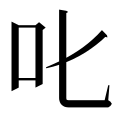
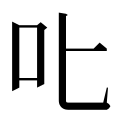
Note that the right side component of this character (U+53F1) is written 𠤎 and not 匕. In Japan, as of the latest 2010 reform the correct form of the character is 𠮟 (U+20B9F) with 七 as the right side component.
Han character
叱 (Kangxi radical 30, 口+2, 5 strokes, cangjie input 口心 (RP), four-corner 64010, composition ⿰口𠤎)
References
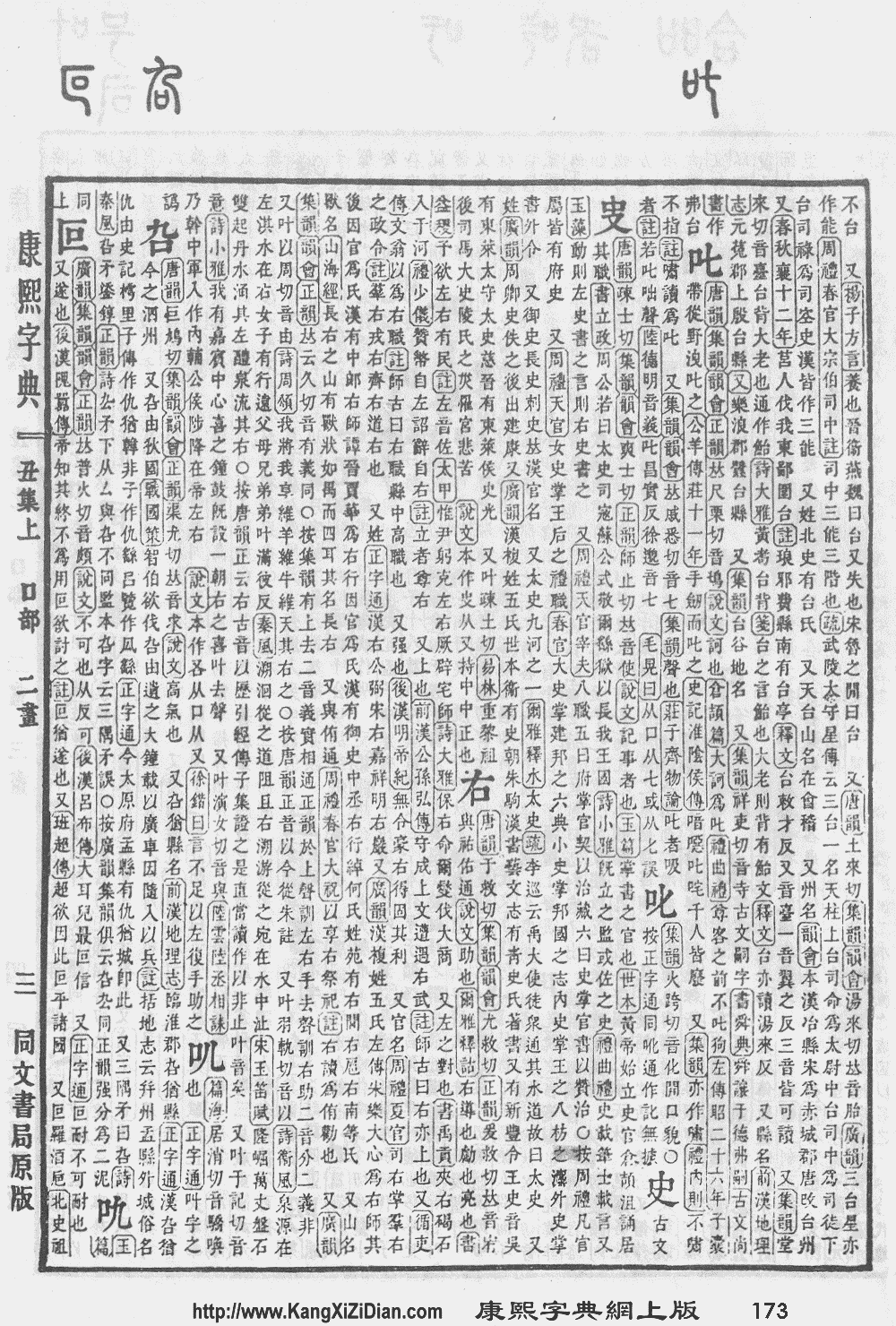
- Kangxi Dictionary: page 173, character 2
- Dai Kanwa Jiten: character 3248
- Dae Jaweon: page 384, character 2
- Hanyu Da Zidian (first edition): volume 1, page 572, character 6
- Unihan data for U+53F1
- Unihan data for U+2F83A
Chinese
| simp. and trad. |
叱 | |
|---|---|---|
| alternative forms | 咜 𠮟 | |
Glyph origin
| Historical forms of the character 叱 |
|---|
| Shuowen Jiezi (compiled in Han) |
| Small seal script |
 |
Phono-semantic compound (形聲/形声, OC *n̥ʰjid) : semantic 口 (“mouth”) + phonetic 七 (OC *sn̥ʰid).
Pronunciation
Synonyms
Korean
Old Korean
Pronunciation
Conventionally reconstructed as *-s, after the Middle Korean reflexes.
Etymology 1
Generally thought to be from an otherwise unattested Old Chinese dialectal pronunciation of the character that began with *s-.
Minority views include that it is a graphic simplification of a different Chinese character, or that it is a gukja invented in Korea with 𠤎 representing the shape of the tongue while pronouncing /s/ and 口 being a radical that denotes a non-standard character.
Alternative forms
- 之 (logographic form, in Idu texts)
Particle
叱 (*-s)
- Genitive case marker, chiefly for inanimate nouns.
Usage notes
In Middle Korean, the genitive case marker ㅅ (Yale: -s) was used for both inanimate nouns and honored animate nouns, while the other genitive marker 의〮 (Yale: -úy) was reserved for non-honored animate nouns.
In the limited Old Korean corpus, 叱 (*-s) appears to be used chiefly for inanimate nouns. Meanwhile, many texts use the genitive 尸 (*-lq), with no evident Middle Korean reflex, for honored nouns such as the Buddha. There is a strong argument that 尸 (*-lq) is an allomorphic variant of 叱 (*-s), representing a phenomenon ancestral to the tensing of the subsequent obstruent that occurred in Middle Korean when ㅅ (-s) occurred between a sonorant and an obstruent. If true, there was no distinction between Old and Middle Korean in the use of the genitive -s.
Unlike the other Old Korean genitive marker 衣 (*-uy), 叱 (*-s) could follow other case markers.
Descendants
See also
References
- 조은주 (Jo Eun-ju) (2002) “석독구결 자료에 나타난 속격조사에 대하여 [Seokdok gugyeol jaryo-e natanan sokgyeok josa-e daehayeo, On the genitive case markers in interpretive gugyeol texts]”, in Gungmunhak Nonjip, volume 18, pages 61–90
- 장윤희 (Jang Yun-hui) (2011) “석독구결의 속격 "시(尸)"의 문제 해결을 위하여 [Seokdok gugyeol 'si'-ui munje haegyeor-eul wihayeo, For a solution to the problem of genitive 尸 in interpretive gugyeol]”, in Gugyeol Yeon'gu, volume 27, pages 117–144
- Nam Pung-hyun (2012) “Old Korean”, in Tranter, Nicolas, editor, The Languages of Japan and Korea, Routledge, →ISBN, pages 41–72