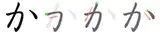
か

See also: が, か゚, and ゕ

か U+304B, か
HIRAGANA LETTER KA
← お
[U+304A]
Hiragana が →
[U+304C]

Japanese

Stroke order
3 strokes

Etymology 1

Derived in the Heian period from writing the man'yōgana kanji 加 in the cursive sōsho style.

Pronunciation

  • IPA(key): [ka̠]
  • (file)

Syllable

か • (ka) 

  1. The hiragana syllable か (ka). Its equivalent in katakana is カ (ka). It is the sixth syllable in the gojūon order; its position is か行あ段 (ka-gyō a-dan, “row ka, section a”).
Derived terms
See also

Etymology 2

Alternative spellings
乎 (literary, obsolete)
歟 (literary, obsolete)

From Proto-Japonic *ka.

Particle

か • (ka) 

  1. final interrogative particle, similar to a question mark ("?").
    お元(げん)気(き)ですか。
    O-genki desu ka.
    How are you?
    (literally, “Are you well?”)
    どうすればいいかわからない。
    Dō sureba ii ka wakaranai.
    I don't know what I should do.
  2. particle marking alternatives in a list; "or"
    これか、それか、どっちか選(えら)んでよ。
    Kore ka, sore ka, dotchika erande yo.
    This or that, choose one of them.
  3. whether (or not)
    行(い)くか知(し)らない。
    Iku ka shiranai.
    I don't know whether he'll go.
  4. indication of doubt
    行(い)くかと思(おも)いますが……
    Iku ka to omoimasu ga……
    I think he'll go (but I'm not sure)....
Usage notes
  • In Classical Japanese, attaches to the rentaikei:
    誰(だれ)が天(てん)地(ち)を造(つく)りしか。
    Dare ga tenchi o tsukurishi ka.
    Who made the heaven and the earth?
  • The Japanese full stop is traditionally used in place of a question mark after this particle.
Alternative forms
See also

Etymology 3

First cited to The Tale of Genji (c. 1001-1014).[1]

Prefix

か • (ka-) 

  1. (emphatic, before an adjective, non-productive) very
    ‎か + ‎弱い (yowai) → ‎か弱い (kayowai)
    ‎か + ‎細い (hosoi) → ‎か細い (kabosoi)

Etymology 4

From Old Japanese. Only persists in stems. No longer productive in Modern Japanese.

Suffix

か • (-ka) 

  1. forms 形容動詞 (keiyō dōshi, “-na adjectives”) from stems, indicating the state or feeling of an object
Usage notes
  • May attach directly to a root.
    • ‎静 (shizu-) + ‎か (-ka) → ‎静か (shizuka, “quiet”)
    • ‎愚 (oro-) + ‎か (-ka) → ‎愚か (oroka, “foolish”)
    • ‎細 (koma-) + ‎か (-ka) → ‎細か (komaka, “tiny; detailed”)
  • May be followed in turn by -i adjective-forming suffix しい (-shii).
    • ‎愚 (oro-) + ‎か (-ka) + ‎しい (-shii) → ‎愚かしい (orokashii, “foolish”)
    • ‎細 (koma-) + ‎か (-ka) + ‎しい (-shii) → ‎細かしい (komakashii, “tiny”, archaic)
  • More rarely, may be followed by -i adjective-forming suffix い (-i).
    • ‎細 (koma-) + ‎か (-ka) + ‎い (-i) → ‎細かい (komakai, “tiny; detailed”)
    • ‎暖 (atata-) + ‎か (-ka) + ‎い (-i) → ‎暖かい (atatakai, “warm”)
  • Often follows -na adjective-forming suffixes や (ya) or ら (ra); see also やか (-yaka) and らか (-raka)
    • ‎爽 (sawa-) + ‎や (-ya) + ‎か (-ka) → ‎爽やか (sawayaka, “refreshing; clear; eloquent”)
    • ‎明 (aki-) + ‎ら (-ra) + ‎か (-ka) → ‎明らか (akiraka, “apparent; clear”)

Etymology 5

For pronunciation and definitions of か – see the following entries.
【日】1
[counter] daytimes
[counter] number of days
【香】4
[noun] a pleasant smell; a scent, a fragrance, an aroma
【蚊】S
[noun] mosquito
【鹿】4
[noun] (archaic) deer
【彼】S
[pronoun] distal demonstrative, something far off removed from both speaker and listener: that, yon
(This term, か, is the hiragana spelling of the above terms.)
For a list of all kanji read as か, see Category:Japanese kanji read as か.)

Etymology 6

For pronunciation and definitions of か – see the following entries.
【下】1
[affix] down; below; beneath
[suffix] under a situation
【火】1
[noun] a fire
[noun] one of the five classical elements in traditional Chinese philosophy and medicine: see Wu Xing on Wikipedia.Wikipedia
[noun] (historical) under the old 律令 (Ritsuryō) system of ancient Japan, a military grouping, consisting of 10 soldiers: a squad
[noun] Short for 火曜日 (kayōbi): Tuesday
[affix] fire
[affix] light
[affix] burning
[affix] passion
[affix] imminently
[affix] explosive
[proper noun] Antares, in the constellation Scorpio
【花】1
[affix] flower
[affix] red-light district
【科】2
[suffix] department, section
[suffix] (taxonomy) family
【夏】2
[proper noun] the Xia dynasty (first dynasty of China)
[proper noun] Short for 大夏 (Daika): Xia, one of the Sixteen Kingdoms
[proper noun] Short for 西夏 (Seika): Western Xia, an empire during the Song dynasty
[proper noun] a surname
[proper noun] a male or female given name
【家】2
[suffix] an expert, professional, performer
【歌】2
[affix] a song; to sing
[affix] Japanese poetry; waka
【化】3
[affix] to change; to take the form of
[affix] to influence
[suffix] -ization, -ification; action of making something that way
【荷】3
[counter] loads that can be carried on one's shoulders
【加】4
[noun] addition
[affix] addition
[affix] Short for カナダ (“Canada (a country)”).
[affix] (US) Short for 加州 (“California (a state of the United States)”).
【果】4
[counter] pieces of fruit
[noun] fruit
[noun] (Buddhism) phala, attained state, result
[noun] (Buddhism) enlightenment (as the fruits of one's Buddhist practice)
【貨】4
[affix] currency
[affix] goods
[affix] treasure
【課】4
[counter] lessons
[counter] chapters of a book
[noun] lesson
[suffix] section, department
[suffix] lesson
【可】5
[noun] C (academic letter grade); passable
[noun] allowed
[suffix] permitted, allowed, licensed
[suffix] -able; can be done
【仮】5
[prefix] temporary
[prefix] unreal, fake, imaginary
【価】5
[affix] price
[affix] value
【河】5
[affix] river
【過】5
[noun] fault; error; mistake
[noun] the past
[noun] excess
[prefix] (chemistry) super-, over-; per
【佳】S
[affix] beautiful, good
[affix] excellent
【架】S
[noun] a rack; a mount; a stand
[counter] flat framed items
【華】S
[noun] flashiness, showiness
[proper noun] a surname
[proper noun] a male or female given name
【菓】S
[counter] fruit
【渦】S
[affix] eddy, swirl, whirlpool, vortex
【寡】S
[noun] minority
【箇】S
[counter] used with numbers in the ichi-ni-san counting system
【瑕】H
[affix] blemish, flaw
[noun] a flaw
【顆】H
[counter] indicates small round things, such as gemstones, fruit, stones, tears
[noun] a condyle
【ヶ】H
[counter] 箇: Counter for months, places or provisions of Classical Chinese origin.
Alternative spelling
箇
(This term, か, is the hiragana spelling of the above terms.)
For a list of all kanji read as か, see Category:Japanese kanji read as か.)

(The following entries are uncreated: 何, 苛, 嫁, 暇, 禍, 靴, 稼, 瓜, 禾, 伽, 迦, 嘉, 霞, 戈, 卦, 呵, 訛, 訶, 窩.)

References

  1. “か”, in 日本国語大辞典 (Nihon Kokugo Daijiten, “Nihon Kokugo Daijiten”)‎ (in Japanese), concise edition, Tōkyō: Shogakukan, 2000
This article is issued from Wiktionary. The text is licensed under Creative Commons - Attribution - Sharealike. Additional terms may apply for the media files.