嘩

See also: 哗 and 譁
嘩 U+5629, 嘩
CJK UNIFIED IDEOGRAPH-5629
← 嘨
[U+5628]
CJK Unified Ideographs 嘪 →
[U+562A]

Translingual

Han character

嘩 (Kangxi radical 30, 口+12, 15 strokes, cangjie input 口廿一十 (RTMJ), four-corner 64054, composition ⿰口華)

References

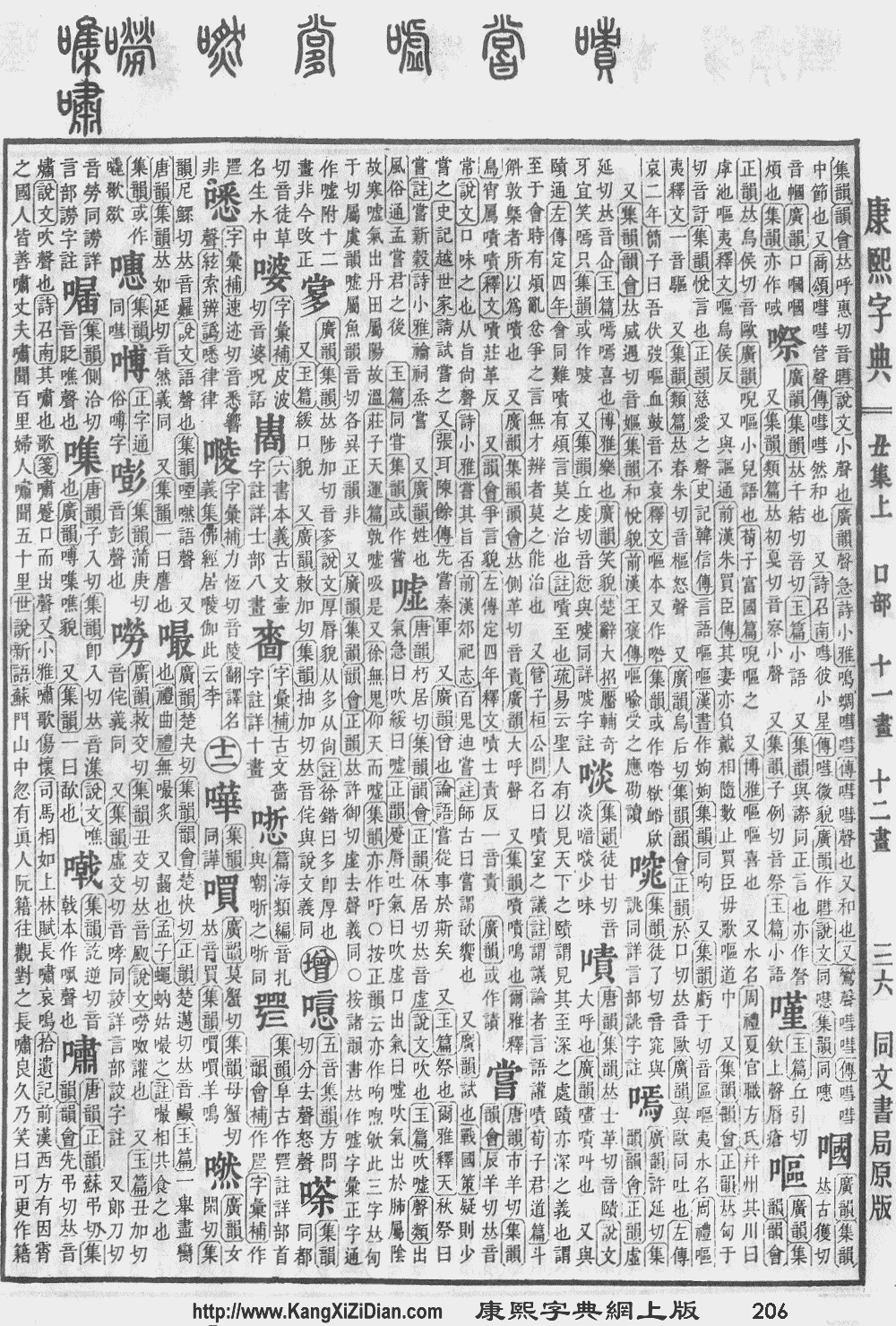
  • Kangxi Dictionary: page 206, character 21
  • Dai Kanwa Jiten: character 4235
  • Hanyu Da Zidian (first edition): volume 1, page 665, character 5
  • Unihan data for U+5629

Chinese

Glyph origin

Phono-semantic compound (形聲/形声, OC *ɡʷraː) : semantic 口 (“mouth”) + phonetic 華 (OC *qʰʷraː, *ɡʷraː, *ɡʷraːs).

Pronunciation 1

trad. 嘩/譁
simp. 哗*
nonstandard simp. 𲂊


Note: jip6 - rare.

Rime
Character 嘩
Reading # 1/1
Initial (聲) 曉 (32)
Final (韻) 麻 (99)
Tone (調) Level (Ø)
Openness (開合) Closed
Division (等) II
Fanqie 呼瓜切
Baxter xwae
Reconstructions
Zhengzhang
Shangfang
/hˠua/
Pan
Wuyun
/hʷᵚa/
Shao
Rongfen
/xua/
Edwin
Pulleyblank
/hwaɨ/
Li
Rong
/xua/
Wang
Li
/xwa/
Bernard
Karlgren
/xwa/
Expected
Mandarin
Reflex
huā
Expected
Cantonese
Reflex
faa1
Baxter–Sagart system 1.1 (2014)
Character 嘩
Reading # 1/1
Modern
Beijing
(Pinyin)
huá
Middle
Chinese
‹ xwae ›
Old
Chinese
/*qʷʰˁra/
English shout

Notes for Old Chinese notations in the Baxter–Sagart system:

* Parentheses "()" indicate uncertain presence;
* Square brackets "[]" indicate uncertain identity, e.g. *[t] as coda may in fact be *-t or *-p;
* Angle brackets "<>" indicate infix;
* Hyphen "-" indicates morpheme boundary;

* Period "." indicates syllable boundary.
Zhengzhang system (2003)
Character 嘩
Reading # 1/1
No. 5311
Phonetic
component
華
Rime
group
魚
Rime
subdivision
0
Corresponding
MC rime
華
Old
Chinese
/*ɡʷraː/
Notes 譁或體

Definitions

嘩

  1. to make noise; to be noisy; to be uproarious

Compounds

Pronunciation 2

trad. 嘩
simp. 哗*


Note: faa1, jip6 - rare.
Note:
  • Xiamen:
    • khôa - vernacular;
    • hôa - literary.

Definitions

嘩

  1. (onomatopoeia) sound of flowing or gurgling water
  2. (onomatopoeia) thump; clang; sound of crashing

Compounds

Pronunciation 3

trad. 嘩
simp. 哗*


Definitions

嘩

  1. (Southern Min) to joke around; to laugh and play
  2. (Southern Min) to make noise; to bustle

Synonyms

Compounds

  • 反嘩/反哗
  • 喊嘩/喊哗
  • 嘩嘩叫/哗哗叫
  • 嘩嘩吼/哗哗吼
  • 嘻嘻嘩嘩 (hi-hi-hōa-hōa) (Min Nan)
  • 嘩嘩嚷/哗哗嚷
  • 嘩嘩滾/哗哗滚
  • 嘩滾/哗滚
  • 嘩酒/哗酒
  • 摽嘩/摽哗
  • 摽滾嘩/摽滚哗
  • 滾嘩/滚哗
  • 講嘩/讲哗

Pronunciation 4

trad. 嘩
simp. 哗*
alternative forms 哇

Definitions

嘩

  1. (Cantonese) wow!; whoa! (used to express surprise or admiration)
    嘩,咁多人嘅? [Cantonese, trad.]
    哗,咁多人嘅? [Cantonese, simp.]
    waa3, gam3 do1 jan4 ge2? [Jyutping]
    Whoa, why are there so many people?
    嘩,好靚呀! [Cantonese, trad.]
    哗,好靓呀! [Cantonese, simp.]
    waa3, hou2 leng3 aa3! [Jyutping]
    Wow, it's so pretty!

References

Japanese

Kanji

嘩

(“Jinmeiyō” kanji used for names)

  1. noisy

Readings

Compounds

Korean

Hanja

嘩 • (hwa) (hangeul 화, revised hwa, McCune–Reischauer hwa)

  1. This term needs a translation to English. Please help out and add a translation, then remove the text {{rfdef}}.

Vietnamese

Han character

嘩: Hán Nôm readings: hoa

  1. This term needs a translation to English. Please help out and add a translation, then remove the text {{rfdef}}.

References

This article is issued from Wiktionary. The text is licensed under Creative Commons - Attribution - Sharealike. Additional terms may apply for the media files.