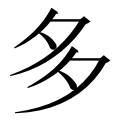
多
| ||||||||
 | ||||||||
Translingual
| Stroke order | |||
|---|---|---|---|
 | |||
| Stroke order | |||
|---|---|---|---|
 | |||
Han character
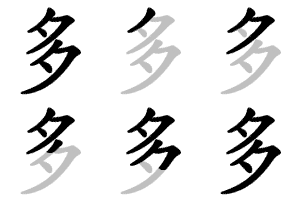
多 (Kangxi radical 36, 夕+3, 6 strokes, cangjie input 弓戈弓戈 (NINI), four-corner 27207, composition ⿱夕夕)
Derived characters
Descendants
- タ (Katakana character derived from Man'yōgana)
References
- Kangxi Dictionary: page 246, character 11
- Dai Kanwa Jiten: character 5756
- Dae Jaweon: page 489, character 6
- Hanyu Da Zidian (first edition): volume 2, page 862, character 2
- Unihan data for U+591A
- Unihan data for U+2F85D

Chinese
Glyph origin
| Historical forms of the character 多 | |||
|---|---|---|---|
| Shang | Western Zhou | Shuowen Jiezi (compiled in Han) | Liushutong (compiled in Ming) |
| Oracle bone script | Bronze inscriptions | Small seal script | Transcribed ancient scripts |
 |
 |
 |
 |
| Old Chinese | |
|---|---|
| 多 | *ʔl'aːl |
| 哆 | *ʔl'aːlʔ, *ʔl'aːls, *ʔr'aːls, *hr'aːl, *l̥ʰjaːlʔ, *l̥ʰjalʔ, *l̥ʰjɯs |
| 跢 | *ʔl'aːls, *ʔl'aːds |
| 痑 | *ʔl'aːls, *l̥ʰaːl, *l̥ʰaːn |
| 爹 | *daːʔ, *tjaː |
| 陊 | *l'aːlʔ, *l'alʔ |
| 橠 | *naːlʔ |
| 袲 | *naːlʔ, *l̥ʰjalʔ, *lal |
| 奓 | *ʔr'aːl, *ʔr'aːls |
| 栘 | *ɦljeːl, *lal |
| 黟 | *ʔleːl, *ʔlil |
| 趍 | *sʰlo, *l'al |
| 誃 | *l'al, *l̥ʰjalʔ |
| 簃 | *l'al, *lal |
| 眵 | *ʔljjal, *l̥ʰjal |
| 恀 | *ʔljalʔ, *l̥ʰjalʔ, *ɦljalʔ |
| 侈 | *l̥ʰjalʔ |
| 姼 | *l̥ʰjalʔ, *ɦljal, *ɦljalʔ |
| 鉹 | *l̥ʰjalʔ, *lal |
| 垑 | *l̥ʰjalʔ |
| 袳 | *l̥ʰjalʔ |
| 卶 | *l̥ʰjals, *hljals |
| 宜 | *ŋral |
| 誼 | *ŋrals |
| 竩 | *ŋrals |
| 移 | *lal |
| 迻 | *lal |
| 扅 | *lal |
| 拸 | *lal, *lalʔ |
| 熪 | *lal |
| 謻 | *lal |
| 蛥 | *ɢljad |
Ideogrammic compound (會意/会意) – two pieces of meat (肉). In the bronze script, 肉 was corrupted into 夕 due to visual similarity, making 多 into a duplication of 夕. The form with 夕 was inherited in later scripts.
Chi (2010) suggests that meat is scarce in ancient times, so two pieces of meat is a lot, citing a passage from Mencius:
Chang Ping-chuan suggests that it is the duplicative nature of the character that gives the meaning of "many", just like in 林 (“forest”), from 木 (“tree; wood”).
Etymology 1
| trad. | 多 | |
|---|---|---|
| simp. # | 多 | |
| alternative forms | 𡖈 𢑑 夛 | |
Etymology unclear. Schuessler (2007) suggests that it is in the same word family as 諸 (OC *tjaː, *tja, “many; all”) and 庶 (OC *hljaɡs, “many”).
Hill (2014, 2019) compares it to Tibetan ཆེ (che, “big”), མཐེ་བོ (mthe bo, “thumb”), Burmese တယ် (tai, “very”). STEDT derives the latter two from Proto-Sino-Tibetan *ta-j (“big”), whose Chinese comparandum is 大 (OC *daːds, “large”) instead; Baxter (1992) has also compared it to this etymon.
Baxter and Sagart (1998) propose that there may be a prefix *t- in this word that gives a mass noun reading, which may nullify the connection to Proto-Sino-Tibetan *ta-j (“big”). However, Baxter and Sagart (2014) may have withdrawn from this theory since they no longer indicate the *t as a prefix.
Also compare Proto-Tai *ʰlaːjᴬ (“many, much”), whence Thai หลาย (lǎai, “many”) and Zhuang lai (“many”), and Proto-Hlai *hləːy (“many”) (Gong Qunhu, 2002; Schuessler, 2007; Baxter and Sagart, 2014). Schuessler (2007) considers the Chinese word to be from Kra-Dai, but others suggest that the direction of borrowing may have been the other way (Li, 1977; Baxter and Sagart, 1998; Norquest, 2007).
Pronunciation
Definitions
多
- many; much; a lot of; numerous
- 永叔謂為文有三多:看多、做多、商量多也。 [Classical Chinese, trad.]
- From: 11th century, 陳師道 (Chen Shidao), 《後山詩話》
- Yǒngshū wèi wèi wén yǒu sānduō: kàn duō, zuò duō, shāngliàng duō yě. [Pinyin]
- Yongshu said that in writing, there are three things to do much of. These are reading much, writing much, and revising much.
永叔谓为文有三多:看多、做多、商量多也。 [Classical Chinese, simp.]
- Antonym: 少
- (after an amount) over; and more; more than
- (after an amount but before the classifier) as much as
- (before a classifier) multiple
- (used in comparison structure 得多, 多了) much more; a lot more; far more
- more
- extra; in excess
- (used in question) how; how much; what
- (emphasis in exclamations) so; how; what
- to have a lot
- to have more; to have too much; to have too many
- (Cantonese) few; little
- 咁多多 [Cantonese] ― gam3 doe1 doe1 [Jyutping] ― just this much (meaning “just very few”)
Usage notes
- (over, more than): When the number is smaller or equal to 10, 多 can be put after the measure word. If it is bigger than ten, 多 has to be put before the measure word.
- (more): In Mandarin, 多 is usually placed before the verb, but in Cantonese, it is usually placed after the verb.
Synonyms
| Variety | Location | Words |
|---|---|---|
| Formal (Written Standard Chinese) | 多 | |
| Mandarin | Taiwan | 多 |
| Yantai (Muping) | 多 | |
| Jinan | 多, 多麼 | |
| Wanrong | 多 | |
| Xi'an | 多 | |
| Yinchuan | 多 | |
| Lanzhou | 多 | |
| Xining | 多 | |
| Ürümqi | 多 | |
| Wuhan | 幾, 幾樣, 好 | |
| Chengdu | 好 | |
| Guiyang | 好 | |
| Liuzhou | 幾 | |
| Xuzhou | 多 | |
| Yangzhou | 多 | |
| Nanjing | 多 | |
| Malaysia | 多 | |
| Cantonese | Guangzhou | 幾 |
| Hong Kong | 幾 | |
| Dongguan | 幾 | |
| Gan | Nanchang | 幾 |
| Lichuan | 幾 | |
| Pingxiang | 幾 | |
| Hakka | Meixian | 幾 |
| Yudu | 幾 | |
| Miaoli (N. Sixian) | 幾 | |
| Pingtung (Neipu; S. Sixian) | 幾 | |
| Hsinchu County (Zhudong; Hailu) | 幾 | |
| Taichung (Dongshi; Dabu) | 幾 | |
| Hsinchu County (Qionglin; Raoping) | 幾 | |
| Yunlin (Lunbei; Zhao'an) | 幾 | |
| Huizhou | Jixi | 多少 |
| Jin | Taiyuan | 多來 |
| Xinzhou | 多麼, 多啦 | |
| Northern Min | Jian'ou | 幾多 |
| Eastern Min | Fuzhou | 若夥 |
| Southern Min | Xiamen | 偌 |
| Quanzhou | 偌 | |
| Zhangzhou | 偌 | |
| Penang (Hokkien) | 偌 | |
| Singapore (Hokkien) | 偌 | |
| Jieyang | 若 | |
| Singapore (Teochew) | 若 | |
| Leizhou | 偌 | |
| Haikou | 偌 | |
| Zhongshan Min | Shaxi (Longdu) | 幾 |
| Southern Pinghua | Nanning (Tingzi) | 幾 |
| Wu | Shanghai | 多少, 幾化 |
| Shanghai (Chongming) | 多下 | |
| Suzhou | 幾化 | |
| Danyang | 多 | |
| Hangzhou | 多少 | |
| Wenzhou | 幾倈 | |
| Jinhua | 幾很 | |
| Xiang | Changsha | 好 |
| Loudi | 好 | |
| Variety | Location | Words |
|---|---|---|
| Classical Chinese | 何等, 何其, 一何, 何哉, 何等也, 何則 | |
| Formal (Written Standard Chinese) | 多麼, 何等, 何其 | |
| Mandarin | Beijing | 多麼, 多 |
| Taiwan | 多麼, 多 | |
| Jinan | 多麼, 多 | |
| Xi'an | 多 | |
| Wuhan | 幾, 幾樣, 好 | |
| Chengdu | 好, 多 | |
| Guilin | 好 | |
| Yangzhou | 多 | |
| Hefei | 好 | |
| Malaysia | 多 | |
| Singapore | 多麼, 多 | |
| Cantonese | Guangzhou | 幾, 幾咁 |
| Hong Kong | 幾, 幾咁 | |
| Yangjiang | 幾 | |
| Gan | Nanchang | 幾 |
| Hakka | Meixian | 幾 |
| Jin | Taiyuan | 多麼, 多來 |
| Northern Min | Jian'ou | 幾多 |
| Eastern Min | Fuzhou | 若夥, 若 |
| Southern Min | Xiamen | 偌, 偌爾仔, 活, 活欲 |
| Quanzhou | 偌, 活, 活欲 | |
| Zhangzhou | 偌, 偌爾仔, 偌仔爾, 活, 活欲 | |
| Taipei | 偌爾, 偌仔爾 | |
| Kaohsiung | 偌爾, 偌仔爾 | |
| Penang (Hokkien) | 偌 | |
| Singapore (Hokkien) | 偌 | |
| Manila (Hokkien) | 偌 | |
| Chaozhou | 若 | |
| Singapore (Teochew) | 若 | |
| Zhongshan Min | Shaxi (Longdu) | 幾 |
| Wu | Shanghai | 多少, 幾化 |
| Suzhou | 幾化 | |
| Wenzhou | 幾倈, 幾恁 | |
| Xiang | Changsha | 幾, 幾多, 好 |
| Shuangfeng | 幾, 好 | |
Compounds
- 一專多能/一专多能 (yīzhuānduōnéng)
- 三多
- 不可多得 (bùkěduōdé)
- 不多 (bùduō)
- 不多不少
- 不多久
- 不多工夫
- 不多幾日/不多几日
- 不多時/不多时 (bùduōshí)
- 不爭多/不争多
- 不足多
- 不遑多讓/不遑多让 (bùhuángduōràng)
- 人多勢眾/人多势众 (rénduōshìzhòng)
- 人多口雜/人多口杂 (rénduōkǒuzá)
- 人多嘴雜/人多嘴杂 (rénduōzuǐzá)
- 人多成王
- 人多手亂/人多手乱
- 人多手雜/人多手杂
- 介許多/介许多
- 伊多語/伊多语 (Yīduōyǔ)
- 伯多祿/伯多禄 (Bóduōlù)
- 作惡多端/作恶多端 (zuò'èduōduān)
- 倚多為勝/倚多为胜
- 偌多
- 傲卒多敗/傲卒多败
- 僧多粥少 (sēngduōzhōushǎo)
- 兒女情多/儿女情多
- 兵多將廣/兵多将广
- 凶多吉少 (xiōngduōjíshǎo)
- 分金多與/分金多与
- 利多 (lìduō)
- 利多出盡/利多出尽
- 利多於弊/利多于弊
- 加多 (jiāduō)
- 勇動多怨/勇动多怨
- 博學多才/博学多才 (bóxuéduōcái)
- 博學多聞/博学多闻 (bóxuéduōwén)
- 博物多聞/博物多闻
- 博聞多見/博闻多见
- 博聞多識/博闻多识
- 厄瓜多 (Èguāduō)
- 命途多舛 (mìngtúduōchuǎn)
- 四郊多壘/四郊多垒
- 基多 (Jīduō)
- 增多 (zēngduō)
- 士多啤梨 (shìduōpílí)
- 多不勝數/多不胜数 (duōbùshèngshǔ)
- 多久 (duōjiǔ)
- 多事 (duōshì)
- 多事之秋 (duōshìzhīqiū)
- 多事逞才
- 多來特巴格/多来特巴格 (Duōláitè Bāgé)
- 多倫/多伦 (Duōlún)
- 多倫多/多伦多 (Duōlúnduō)
- 多元化 (duōyuánhuà)
- 多元性
- 多元論/多元论 (duōyuánlùn)
- 多共少
- 多凶少吉
- 多分 (duōfēn)
- 多則/多则
- 多功能廳/多功能厅 (duōgōngnéngtīng)
- 多半 (duōbàn)
- 多半日
- 多口
- 多可
- 多嘴 (duōzuǐ)
- 多嘴多舌
- 多嘴擦舌
- 多嘴饒舌/多嘴饶舌
- 多因
- 多國企業/多国企业
- 多士 (duōshì)
- 多多 (duōduō)
- 多多少少 (duōduōshǎoshǎo)
- 多多益善 (duōduōyìshàn)
- 多多益辦/多多益办
- 多大
- 多大小
- 多如牛毛 (duōrúniúmáo)
- 多姿多采
- 多婪
- 多媒體/多媒体 (duōméitǐ)
- 多媒體卡/多媒体卡
- 多嫌
- 多嬌/多娇
- 多子
- 多子多孫/多子多孙
- 多定
- 多寡 (duōguǎ)
- 多寶塔/多宝塔
- 多寶槅/多宝槅
- 多少
- 多少是好
- 多幕劇/多幕剧
- 多年 (duōnián)
- 多幸 (duōxìng)
- 多彩多姿 (duōcǎiduōzī)
- 多得 (duōdé)
- 多心 (duōxīn)
- 多忌
- 多情 (duōqíng)
- 多愁善感 (duōchóushàngǎn)
- 多愁多病
- 多慮/多虑 (duōlǜ)
- 多慢
- 多才 (duōcái)
- 多才多藝/多才多艺 (duōcáiduōyì)
- 多承
- 多指症
- 多故
- 多數/多数 (duōshù)
- 多數決/多数决
- 多文
- 多文為富/多文为富
- 多方 (duōfāng)
- 多方招撫/多方招抚
- 多早晚
- 多明尼加 (Duōmíngníjiā)
- 多是
- 多時/多时 (duōshí)
- 多會兒/多会儿
- 多材多藝/多材多艺
- 多梭
- 多樣化/多样化 (duōyànghuà)
- 多樣性/多样性 (duōyàngxìng)
- 多次曝光
- 多欲
- 多此一舉/多此一举 (duōcǐyījǔ)
- 多歧亡羊
- 多歧援喻
- 多歪多妒
- 多歷年代/多历年代
- 多歷年所/多历年所 (duō lì niánsuǒ)
- 多氯聯苯/多氯联苯 (duōlǜliánběn)
- 多浪 (Duōlàng)
- 多災多難/多灾多难 (duōzāiduōnàn)
- 多爾袞/多尔衮 (Duō'ěrgǔn)
- 多瑙河 (Duōnǎo Hé)
- 多瑪/多玛 (Duōmǎ)
- 多生
- 多疑 (duōyí)
- 多病 (duōbìng)
- 多病多災/多病多灾
- 多發性/多发性 (duōfāxìng)
- 多神教 (duōshénjiào)
- 多福多壽/多福多寿
- 多禮/多礼
- 多空交戰/多空交战
- 多端 (duōduān)
- 多端寡要
- 多管
- 多管是
- 多管閒事/多管闲事 (duōguǎnxiánshì)
- 多米尼克 (Duōmǐníkè)
- 多糖 (duōtáng)
- 多累
- 多維/多维 (duōwéi)
- 多羅/多罗 (duōluó)
- 多羅貝勒/多罗贝勒 (duōluó bèilè)
- 多羅麻/多罗麻
- 多義/多义 (duōyì)
- 多義詞/多义词
- 多耳麻鞋
- 多聞/多闻
- 多聞強記/多闻强记
- 多聞闕疑/多闻阙疑
- 多胞胎 (duōbāotāi)
- 多能
- 多般
- 多花
- 多蒙寄聲/多蒙寄声
- 多蒙推轂/多蒙推毂
- 多蒙藥石/多蒙药石
- 多藏厚亡
- 多虧/多亏 (duōkuī)
- 多行不義必自斃/多行不义必自毙 (duō xíng bùyì bì zìbì)
- 多角化
- 多角形 (duōjiǎoxíng)
- 多角經營/多角经营
- 多言 (duōyán)
- 多言或中
- 多言招悔
- 多言數窮/多言数穷
- 多言繁稱/多言繁称
- 多話/多话
- 多語教育/多语教育
- 多謀善斷/多谋善断
- 多謝/多谢 (duōxiè)
- 多謝費心/多谢费心
- 多謝關照/多谢关照
- 多變/多变 (duōbiàn)
- 多財善賈/多财善贾
- 多賤寡貴/多贱寡贵
- 多軌錄音/多轨录音 (duōguǐ lùyīn)
- 多退少補/多退少补
- 多違/多违
- 多道散說/多道散说
- 多邊/多边 (duōbiān)
- 多邊形/多边形 (duōbiānxíng)
- 多邊貿易/多边贸易
- 多醣體/多糖体
- 多采多姿 (duōcǎi-duōzī)
- 多重 (duōchóng)
- 多重人格
- 多重國籍/多重国籍 (duōchóng guójí)
- 多重性格
- 多量 (duōliàng)
- 多錢善賈/多钱善贾
- 多難/多难
- 多難興邦/多难兴邦 (duōnànxīngbāng)
- 多雨 (duōyǔ)
- 多露
- 多面手 (duōmiànshǒu)
- 多音字 (duōyīnzì)
- 多頭/多头 (duōtóu)
- 多頭市場/多头市场
- 多頭馬車/多头马车
- 多餘/多余 (duōyú)
- 多魯/多鲁 (Duōlǔ)
- 多麼/多么 (duōme)
- 多黨制/多党制 (duōdǎngzhì)
- 夜長夢多/夜长梦多 (yèchángmèngduō)
- 大多 (dàduō)
- 大多數/大多数 (dàduōshù)
- 天下多故
- 好事多妨
- 好事多慳/好事多悭
- 好事多磨 (hǎoshìduōmó)
- 好事多魔 (hǎoshìduōmó)
- 好多 (hǎoduō)
- 婀娜多姿 (ēnuóduōzī)
- 孔多 (kǒngduō)
- 安多尼
- 少見多怪/少见多怪 (shǎojiànduōguài)
- 居多 (jūduō)
- 差不多 (chàbuduō)
- 巴多尼
- 巴貝多/巴贝多 (Bābèiduō)
- 幾多/几多 (jǐduō)
- 得道多助 (dédàoduōzhù)
- 悉達多/悉达多 (Xīdáduō)
- 懶人多屎尿/懒人多屎尿
- 所在多有
- 拉多加湖 (Lāduōjiā Hú)
- 抵多少
- 提婆達多/提婆达多 (Típódáduō)
- 政出多門/政出多门
- 時日無多/时日无多 (shírìwúduō)
- 智多星 (zhìduōxīng)
- 晴時多雲/晴时多云
- 會少離多/会少离多
- 正多邊形/正多边形 (zhèngduōbiānxíng)
- 正多面體/正多面体 (zhèng duōmiàntǐ)
- 水大魚多/水大鱼多
- 沒多少/没多少
- 沒多時/没多时
- 法出多門/法出多门
- 泥多佛大
- 波多黎各 (Bōduōlígè)
- 波爾多/波尔多 (Bō'ěrduō)
- 濟濟多士/济济多士
- 無多子/无多子
- 特多龍/特多龙 (tèduōlóng)
- 狡猾多詐/狡猾多诈
- 狼多肉少 (lángduōròushǎo)
- 猶豫多疑/犹豫多疑
- 獲益良多/获益良多 (huòyìliángduō)
- 直諒多聞/直谅多闻
- 相對多數/相对多数 (xiāngduì duōshù)
- 眾多/众多 (zhòngduō)
- 眾少成多/众少成多
- 科布多 (Kēbùduō)
- 科布多河
- 積少成多/积少成多 (jīshǎochéngduō)
- 空翻多
- 粥少僧多
- 糧多草廣/粮多草广
- 絕大多數/绝大多数 (juédàduōshù)
- 絕對多數/绝对多数 (juéduì duōshù)
- 絢麗多姿/绚丽多姿
- 維多米/维多米
- 綽約多姿/绰约多姿
- 繁多 (fánduō)
- 繁禮多儀/繁礼多仪
- 聖多斯/圣多斯
- 聞一多/闻一多
- 背多分
- 能者多勞/能者多劳 (néngzhěduōláo)
- 自作多情 (zìzuòduōqíng)
- 自多
- 自求多福 (zìqiúduōfú)
- 至多 (zhìduō)
- 良多 (liángduō)
- 花多實少/花多实少
- 芬多精 (fēnduōjīng)
- 苦多
- 萊克多巴胺/莱克多巴胺 (láikèduōbā'àn)
- 華祝三多/华祝三多
- 薄利多銷/薄利多销 (bólìduōxiāo)
- 薩爾瓦多/萨尔瓦多 (Sà'ěrwǎduō)
- 虛多實少/虚多实少
- 裒多益寡
- 見多識廣/见多识广 (jiànduōshíguǎng)
- 言多傷行/言多伤行
- 言多失實/言多失实
- 言多必失 (yánduōbìshī)
- 言多語失/言多语失
- 許多/许多 (xǔduō)
- 許許多多/许许多多 (xǔxǔduōduō)
- 誇多鬥靡/夸多斗靡
- 詭計多端/诡计多端 (guǐjìduōduān)
- 詭譎多變/诡谲多变 (guǐjuéduōbiàn)
- 詭變多端/诡变多端
- 諸多/诸多 (zhūduō)
- 謀夫孔多/谋夫孔多
- 識多才廣/识多才广
- 變化多端/变化多端 (biànhuàduōduān)
- 貝多/贝多 (bèiduō)
- 貝多樹/贝多树
- 貝多芬/贝多芬 (Bèiduōfēn)
- 財多勢重/财多势重
- 財多命殆/财多命殆
- 貪多務得/贪多务得
- 貴人多忘/贵人多忘
- 貽誚多方/贻诮多方
- 足智多謀/足智多谋 (zúzhìduōmóu)
- 躁人辭多/躁人辞多
- 軍多將廣/军多将广
- 轉盼多情/转盼多情
- 辭多受少/辞多受少
- 錢多多/钱多多
- 阿多尼斯 (Āduōnísī)
- 阿耨多羅/阿耨多罗 (ānòuduōluó)
- 雷多公路
- 頂多/顶多 (dǐngduō)
- 鬼計多端/鬼计多端
Descendants
Others:
- →? Proto-Hlai: *hləːy
- →? Proto-Tai: *ʰlaːjᴬ