好
| ||||||||
Translingual
| Stroke order | |||
|---|---|---|---|
 | |||
| Stroke order | |||
|---|---|---|---|
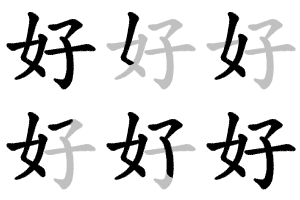 | |||
Han character
好 (Kangxi radical 38, 女+3, 6 strokes, cangjie input 女弓木 (VND), four-corner 47447, composition ⿰女子)
References
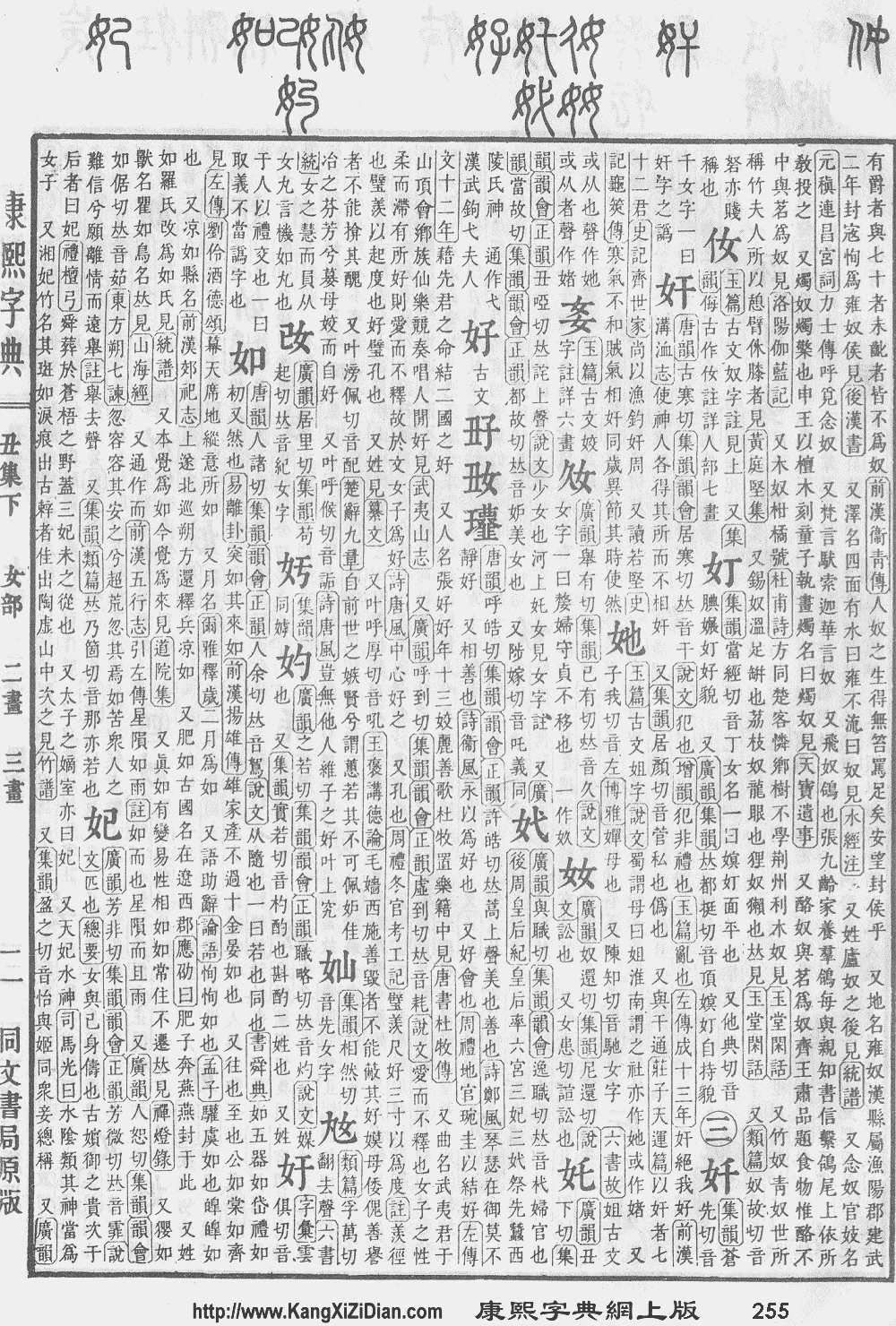
- Kangxi Dictionary: page 255, character 11
- Dai Kanwa Jiten: character 6053
- Dae Jaweon: page 518, character 12
- Hanyu Da Zidian (first edition): volume 2, page 1028, character 1
- Unihan data for U+597D
Chinese
| trad. | 好 | |
|---|---|---|
| simp. # | 好 | |
| alternative forms | ||
Glyph origin
| Historical forms of the character 好 | |||
|---|---|---|---|
| Shang | Western Zhou | Shuowen Jiezi (compiled in Han) | Liushutong (compiled in Ming) |
| Oracle bone script | Bronze inscriptions | Small seal script | Transcribed ancient scripts |
 |
 |
 |
 |
Ideogrammic compound (會意/会意) : 女 (“woman”) + 子 (“child”).
The widely accepted meaning of this character is that the characters for “female” (女) and “child” (子) were put together to form a compound because it was good for a woman to have a child. Similarly, it has been proposed that the compound originally refers to the mutual affection between the mother and child, which then extended to mean “good”. These theories are supported by the smaller 子 found in some oracle bones and bronze inscriptions.
However, broader interpretations of the second character 子 could lead to other theories. 子 could also mean “son”, so it may have meant two children, a boy and a girl next to each other, which is a good fortune to have a boy and a girl. 子 could also mean “man”, so it may have referred to the love between a man and a woman, which is good. Duan Yucai, in his annotated version of Shuowen, interpreted it as originally referring to the beauty of woman. Lastly, it could mean that the “attitude” of a girl was considered good.
Etymology
The two pronunciations are cognate – pronunciation 2 is the *-s suffixed form, or exoactive/putative of pronunciation 1, literally “to consider good”. Compare 惡 (OC *qaːɡ, “bad; evil”) > 惡 (OC *qaːɡs, “to consider bad; to hate”).
This word has been compared with Proto-Sino-Tibetan *hu (“to raise; to rear; to nourish”): Proto-Lolo-Burmese *hu³, Abor-Miri (Tani) u, Mawo Northern Qiang χu, which is only attested in a limited number of languages. If this is correct, it may be related to 畜 (OC *l̥ʰuɡs, *l̥ʰuɡ, *hluɡ, “to raise; to rear; domesticated animal”). Alternatively, compare Tibetan མཁོ (mkho, “necessary, important”).
Cognate with Central Bai hux (“good”), which may be a loanword from Chinese.
Pronunciation 1
Definitions
好
- good; well
- Used as an interjection.
- friendly; close; acquainted
- 就是姊妹弟兄跟前,誰和我好,我就和誰好。 [Written Vernacular Chinese, trad.]
- From: Cao Xueqin, Dream of the Red Chamber, mid-18th century CE
- Jiù shì zǐmèi dìxiōng gēnqián, shéi hé wǒ hǎo, wǒ jiù hé shéi hǎo. [Pinyin]
- Indeed, just among us brothers and sisters, whoever is kind to me, I'll be kind to them also.
就是姊妹弟兄跟前,谁和我好,我就和谁好。 [Written Vernacular Chinese, simp.]
- (specifically) to start dating; to become romantic partners
- done; ready
- to be good to; easy to
- (making it) convenient; easy for
- to recover from an illness
- (somewhat dialectal) very; quite; rather; so
- a pleasure to (do something); good for (doing something)
- properly; carefully
- 記得帶好雨具!/记得带好雨具! ― Jìdé dài hǎo yǔjù! ― Remember to bring along rain gear! / Make sure your rain gear is on you!
- 聽好了!/听好了! ― Tīng hǎo le! ― Now listen carefully!
- 食好瞓好/食好𰥛好 [Cantonese] ― sik6 hou2 fan3 hou2 [Jyutping] ― eat well and sleep well
- 做好功課/做好功课 [Cantonese] ― zou6 hou2 gung1 fo3 [Jyutping] ― to do one's homework (as one should)
- Particle used after verbs to denote the completion or near-completion of an action.
- Used after a noun or pronoun as a greeting.
- greeting
- Particle denoting agreement, support or wish to terminate a conversation.
- Particle denoting dissatisfaction in ironical sentences.
- (Hokkien) Particle denoting that the listener is still listening or is still interested with what the speaker is saying. (backchanneling)
- such; what
- (dialectal) can; should
- (Southwestern Mandarin, Xiang) how (to what degree)
- (rail transport) cleared
Synonyms
| Variety | Location | Words |
|---|---|---|
| Classical Chinese | 好, 良, 善, 佳 | |
| Formal (Written Standard Chinese) | 好, 良好, 美好, 佳 | |
| Mandarin | Beijing | 好, 強 |
| Taiwan | 好 | |
| Jinan | 好, 賽, 強 | |
| Xi'an | 好, 嫽 | |
| Wuhan | 好, 傲 | |
| Chengdu | 好 | |
| Yangzhou | 好 | |
| Hefei | 好, 㜺 | |
| Singapore | 好 | |
| Cantonese | Guangzhou | 好, 㜺 |
| Hong Kong | 好 | |
| Taishan | 好 | |
| Yangjiang | 好 | |
| Singapore (Guangfu) | 好 | |
| Gan | Nanchang | 好 |
| Hakka | Meixian | 好, 㜺 |
| Miaoli (N. Sixian) | 好 | |
| Pingtung (Neipu; S. Sixian) | 好 | |
| Hsinchu County (Zhudong; Hailu) | 好 | |
| Taichung (Dongshi; Dabu) | 好 | |
| Hsinchu County (Qionglin; Raoping) | 好 | |
| Yunlin (Lunbei; Zhao'an) | 好 | |
| Jin | Taiyuan | 好 |
| Northern Min | Jian'ou | 好 |
| Eastern Min | Fuzhou | 好 |
| Southern Min | Xiamen | 好 |
| Tainan | 好 | |
| Penang (Hokkien) | 好 | |
| Singapore (Hokkien) | 好 | |
| Manila (Hokkien) | 好 | |
| Chaozhou | 好 | |
| Singapore (Teochew) | 好 | |
| Singapore (Hainanese) | 好 | |
| Zhongshan Min | Shaxi (Longdu) | 好 |
| Wu | Shanghai | 好, 㜺, 靈, 嗲 |
| Suzhou | 好, 㜺 | |
| Wenzhou | 好 | |
| Xiang | Changsha | 好 |
| Shuangfeng | 好 | |
| Variety | Location | Words |
|---|---|---|
| Formal (Written Standard Chinese) | 多 | |
| Mandarin | Taiwan | 多 |
| Yantai (Muping) | 多 | |
| Jinan | 多, 多麼 | |
| Wanrong | 多 | |
| Xi'an | 多 | |
| Yinchuan | 多 | |
| Lanzhou | 多 | |
| Xining | 多 | |
| Ürümqi | 多 | |
| Wuhan | 幾, 幾樣, 好 | |
| Chengdu | 好 | |
| Guiyang | 好 | |
| Liuzhou | 幾 | |
| Xuzhou | 多 | |
| Yangzhou | 多 | |
| Nanjing | 多 | |
| Malaysia | 多 | |
| Cantonese | Guangzhou | 幾 |
| Hong Kong | 幾 | |
| Dongguan | 幾 | |
| Gan | Nanchang | 幾 |
| Lichuan | 幾 | |
| Pingxiang | 幾 | |
| Hakka | Meixian | 幾 |
| Yudu | 幾 | |
| Miaoli (N. Sixian) | 幾 | |
| Pingtung (Neipu; S. Sixian) | 幾 | |
| Hsinchu County (Zhudong; Hailu) | 幾 | |
| Taichung (Dongshi; Dabu) | 幾 | |
| Hsinchu County (Qionglin; Raoping) | 幾 | |
| Yunlin (Lunbei; Zhao'an) | 幾 | |
| Huizhou | Jixi | 多少 |
| Jin | Taiyuan | 多來 |
| Xinzhou | 多麼, 多啦 | |
| Northern Min | Jian'ou | 幾多 |
| Eastern Min | Fuzhou | 若夥 |
| Southern Min | Xiamen | 偌 |
| Quanzhou | 偌 | |
| Zhangzhou | 偌 | |
| Penang (Hokkien) | 偌 | |
| Singapore (Hokkien) | 偌 | |
| Jieyang | 若 | |
| Singapore (Teochew) | 若 | |
| Leizhou | 偌 | |
| Haikou | 偌 | |
| Zhongshan Min | Shaxi (Longdu) | 幾 |
| Southern Pinghua | Nanning (Tingzi) | 幾 |
| Wu | Shanghai | 多少, 幾化 |
| Shanghai (Chongming) | 多下 | |
| Suzhou | 幾化 | |
| Danyang | 多 | |
| Hangzhou | 多少 | |
| Wenzhou | 幾倈 | |
| Jinhua | 幾很 | |
| Xiang | Changsha | 好 |
| Loudi | 好 | |
| Variety | Location | Words |
|---|---|---|
| Classical Chinese | 何等, 何其, 一何, 何哉, 何等也, 何則 | |
| Formal (Written Standard Chinese) | 多麼, 何等, 何其 | |
| Mandarin | Beijing | 多麼, 多 |
| Taiwan | 多麼, 多 | |
| Jinan | 多麼, 多 | |
| Xi'an | 多 | |
| Wuhan | 幾, 幾樣, 好 | |
| Chengdu | 好, 多 | |
| Guilin | 好 | |
| Yangzhou | 多 | |
| Hefei | 好 | |
| Malaysia | 多 | |
| Singapore | 多麼, 多 | |
| Cantonese | Guangzhou | 幾, 幾咁 |
| Hong Kong | 幾, 幾咁 | |
| Yangjiang | 幾 | |
| Gan | Nanchang | 幾 |
| Hakka | Meixian | 幾 |
| Jin | Taiyuan | 多麼, 多來 |
| Northern Min | Jian'ou | 幾多 |
| Eastern Min | Fuzhou | 若夥, 若 |
| Southern Min | Xiamen | 偌, 偌爾仔, 活, 活欲 |
| Quanzhou | 偌, 活, 活欲 | |
| Zhangzhou | 偌, 偌爾仔, 偌仔爾, 活, 活欲 | |
| Taipei | 偌爾, 偌仔爾 | |
| Kaohsiung | 偌爾, 偌仔爾 | |
| Penang (Hokkien) | 偌 | |
| Singapore (Hokkien) | 偌 | |
| Manila (Hokkien) | 偌 | |
| Chaozhou | 若 | |
| Singapore (Teochew) | 若 | |
| Zhongshan Min | Shaxi (Longdu) | 幾 |
| Wu | Shanghai | 多少, 幾化 |
| Suzhou | 幾化 | |
| Wenzhou | 幾倈, 幾恁 | |
| Xiang | Changsha | 幾, 幾多, 好 |
| Shuangfeng | 幾, 好 | |
| Variety | Location | Words |
|---|---|---|
| Classical Chinese | 能 | |
| Formal (Written Standard Chinese) | 能, 能夠, 可以 | |
| Mandarin | Taiwan | 能, 能夠, 可以 |
| Malaysia | 能 | |
| Singapore | 能, 能夠, 可以 | |
| Cantonese | Hong Kong | 可以 |
| Hakka | Kuching (Hepo) | 得 |
| Eastern Min | Singapore (Fuqing) | 會 |
| Southern Min | Penang (Hokkien) | 會, 會使 |
| Singapore (Hokkien) | 會, 會使 | |
| Manila (Hokkien) | 會, 會通 | |
| Zhongshan Min | Shaxi (Longdu) | 得, 可以 |
| Wu | Shanghai | 好 |
| Suzhou | 好 | |
| Ningbo | 好 | |
Compounds
- 一床兩好/一床两好
- 一雙兩好/一双两好
- 三五好友
- 上好 (shànghǎo)
- 三好兩怯/三好两怯
- 三好兩歉/三好两歉
- 三好兩歹/三好两歹
- 不分好歹
- 不好了
- 不好受
- 不好弄
- 不好惹
- 不好意思 (bùhǎoyìsi)
- 不好啟齒/不好启齿
- 不好看
- 不好過/不好过
- 不得好死 (bùdéhǎosǐ)
- 不恰好
- 不懷好意/不怀好意 (bùhuáihǎoyì)
- 不知好歉
- 不知好歹 (bùzhīhǎodǎi)
- 不論好壞/不论好坏
- 不識好歹/不识好歹 (bùshíhǎodǎi)
- 也好 (yěhǎo)
- 交好 (jiāohǎo)
- 便好
- 便好道
- 倒好
- 修好 (xiūhǎo)
- 做好事
- 做好做惡/做好做恶
- 做好做歉
- 做好做歹
- 做好看
- 做歉做好
- 備受好評/备受好评
- 兩姓之好/两姓之好
- 兩相好/两相好
- 最好 (zuìhǎo)
- 剛好/刚好 (gānghǎo)
- 友好 (yǒuhǎo)
- 友好條約/友好条约
- 可不好
- 只好 (zhǐhǎo)
- 叫好 (jiàohǎo)
- 可好 (kěhǎo)
- 可知是好
- 和好 (héhǎo)
- 和好如初
- 哥倆好/哥俩好
- 問好/问好 (wènhǎo)
- 唱好
- 嘖嘖稱好/啧啧称好
- 嘴不好
- 多少是好
- 大事不好
- 大好 (dàhǎo)
- 大好河山 (dàhǎohéshān)
- 大好老
- 夫婦好合/夫妇好合
- 天道好還/天道好还
- 好一日兒/好一日儿
- 好一會/好一会
- 好一陣/好一阵 (hǎoyīzhèn)
- 好上加好
- 好不 (hǎobù)
- 好不好 (hǎobùhǎo)
- 好不容易 (hǎobùróngyì)
- 好不自在
- 好主兒/好主儿
- 好主意
- 好久 (hǎojiǔ)
- 好了傷疤忘了痛/好了伤疤忘了痛
- 好了歌
- 好事
- 好事不出門,惡事傳千里/好事不出门,恶事传千里
- 好事不宜遲/好事不宜迟
- 好事多妨
- 好事多慳/好事多悭
- 好事多磨 (hǎoshìduōmó)
- 好事多魔 (hǎoshìduōmó)
- 好事天慳/好事天悭
- 好些 (hǎoxiē)
- 好些時/好些时
- 好人 (hǎorén)
- 好人好事 (hǎorénhǎoshì)
- 好人家 (hǎorénjiā)
- 好人物
- 好人難做/好人难做
- 好似 (hǎosì)
- 好使 (hǎoshǐ)
- 好來寶/好来宝
- 好個/好个
- 好傢伙
- 好像 (hǎoxiàng)
- 好兄弟 (hǎoxiōngdì)
- 好兆頭/好兆头
- 好兒/好儿
- 好剛口/好刚口
- 好力寶/好力宝
- 好勢/好势 (hó-sè)
- 好半天
- 好友 (hǎoyǒu)
- 好受 (hǎoshòu)
- 好吃
- 好合 (hǎohé)
- 好名
- 好喬/好乔
- 好喝 (hǎohē)
- 好在 (hǎozài)
- 好報/好报 (hǎobào)
- 好壞/好坏 (hǎohuài)
- 好多 (hǎoduō)
- 好夢/好梦 (hǎomèng)
- 好夢難圓/好梦难圆
- 好夢難成/好梦难成
- 好大膽/好大胆
- 好天 (hǎotiān)
- 好好
- 好好先生
- 好姻緣/好姻缘
- 好孬
- 好學/好学
- 好官
- 好家伙 (hǎojiāhuo)
- 好容易 (hǎoróngyì)
- 好小子
- 好幾/好几 (hǎojǐ)
- 好康 (hǎokāng)
- 好弱
- 好彩 (hǎocǎi)
- 好彩頭/好彩头
- 好心 (hǎoxīn)
- 好心不得好報/好心不得好报
- 好心好意 (hǎoxīnhǎoyì)
- 好心腸/好心肠
- 好性
- 好性子
- 好性氣/好性气
- 好情 (hǎoqíng)
- 好感 (hǎogǎn)
- 好意 (hǎoyì)
- 好惹 (hǎorě)
- 好意思
- 好愻/好𢙏
- 好戲/好戏 (hǎoxì)
- 好手 (hǎoshǒu)
- 好手好腳/好手好脚
- 好手如雲/好手如云
- 好找
- 好把式
- 好搭檔/好搭档
- 好收場/好收场
- 好日 (hǎorì)
- 好日子 (hǎorìzi)
- 好早晚
- 好是 (hǎoshì)
- 好時好日/好时好日
- 好景 (hǎojǐng)
- 好景不常 (hǎojǐngbùcháng)
- 好景不長/好景不长 (hǎojǐngbùcháng)
- 好書/好书
- 好朋友
- 好望角 (Hǎowàngjiǎo)
- 好本領/好本领
- 好東西/好东西
- 好樣/好样
- 好樣兒的/好样儿的 (hǎoyàngrde)
- 好模好樣/好模好样
- 好樣子/好样子
- 好欺負/好欺负
- 好歹 (hǎodǎi)
- 好死 (hǎosǐ)
- 好死不死
- 好比 (hǎobǐ)
- 好氣/好气
- 好沒意思/好没意思
- 好沒生/好没生
- 好法
- 好法子
- 好消息
- 好漢/好汉 (hǎohàn)
- 好爵
- 好物 (hǎowù)
- 好獃
- 好玩
- 好球 (hǎoqiú)
- 好球帶/好球带 (hǎoqiúdài)
- 好生
- 好生意
- 好用 (hǎoyòng)
- 好癩/好癞
- 好的 (hǎo de)
- 好看 (hǎokàn)
- 好相識/好相识
- 好看錢/好看钱
- 好眼力
- 好空:hó-khang
- 好端端 (hǎoduānduān)
- 好笑 (hǎoxiào)
- 好籤/好签
- 好絕/好绝
- 好纏/好缠
- 好缺
- 好聞/好闻
- 好聚好散 (hǎojùhǎosàn)
- 好聲好氣/好声好气 (hǎoshēnghǎoqì)
- 好聽/好听 (hǎotīng)
- 好臉/好脸
- 好自在
- 好自為之/好自为之
- 好花
- 好若
- 好菜
- 好萊塢/好莱坞
- 好處/好处
- 好處費/好处费 (hǎochùfèi)
- 好言 (hǎoyán)
- 好言好語/好言好语
- 好言相勸/好言相劝 (hǎoyán xiāngquàn)
- 好評/好评 (hǎopíng)
- 好話/好话 (hǎohuà)
- 好話兒/好话儿
- 好說/好说 (hǎoshuō)
- 好語似珠/好语似珠
- 好說歹說/好说歹说
- 好說話/好说话 (hǎoshuōhuà)
- 好貨/好货
- 好買賣/好买卖
- 好賴/好赖 (hǎolài)
- 好走 (hǎozǒu)
- 好身手
- 好轉/好转 (hǎozhuǎn)
- 好辦/好办
- 好逑 (hǎoqiú)
- 好造化
- 好運/好运 (hǎoyùn)
- 好道
- 好過/好过 (hǎoguò)
- 好酒
- 好酒好肉
- 好醜/好丑
- 好險/好险 (hǎoxiǎn)
- 好離好散/好离好散
- 好頭腦/好头脑
- 好食
- 好馬不吃回頭草/好马不吃回头草 (hǎo mǎ bù chī huítóu cǎo)
- 好體面/好体面
- 好鳥/好鸟 (hǎoniǎo)
- 好麼/好么
- 好鼻獅/好鼻狮 (hó-phīⁿ-sai) (Min Nan)
- 姣好 (jiāohǎo)
- 娟好
- 嫌好道惡/嫌好道恶
- 嫌好道醜/嫌好道丑
- 學好/学好
- 安好 (ānhǎo)
- 完好 (wánhǎo)
- 完好如初 (wánhǎorúchū)
- 完好無缺/完好无缺 (wánhǎowúquē)
- 帶個好/带个好
- 幸好 (xìnghǎo)
- 廣受好評/广受好评
- 弄好 (nònghǎo)
- 待好
- 忘年之好
- 恰到好處/恰到好处 (qiàdàohǎochù)
- 恰好 (qiàhǎo)
- 愛好兒/爱好儿
- 拄好 (tú-hó)
- 拍手叫好
- 拉相好
- 拿手好戲/拿手好戏
- 搞不好 (gǎobùhǎo)
- 攀相好
- 新好女人
- 新好男人
- 昆弟之好
- 暢好/畅好
- 月圓花好/月圆花好
- 有個好歹/有个好歹
- 有好兒/有好儿
- 有好有壞/有好有坏
- 有話好說/有话好说 (yǒuhuàhǎoshuō)
- 朱陳之好/朱陈之好
- 欠好
- 正好 (zhènghǎo)
- 歪喙雞食好米/歪喙鸡食好米 (oai chhùi ke chia̍h hó bí) (Min Nan)
- 歹竹出好筍/歹竹出好笋 (dǎi zhú chū hǎo sǔn)
- 求好心切
- 汝好 (lí hó)
- 江湖好漢/江湖好汉
- 沒好意思/没好意思
- 沒好氣/没好气
- 滿好/满好
- 滿好個/满好个
- 濫好人/滥好人 (lànhǎorén)
- 為好成歉/为好成歉
- 燕好
- 爛好人/烂好人 (lànhǎorén)
- 琴瑟之好
- 琴瑟和好
- 甘言好辭/甘言好辞
- 病好 (bìnghǎo)
- 瘡好忘痛/疮好忘痛
- 百年之好
- 百年好合 (bǎiniánhǎohé)
- 百歲之好/百岁之好
- 相好 (xiānghǎo)
- 看好 (kànhǎo)
- 碰頭好兒/碰头好儿
- 示好 (shìhǎo)
- 秦晉之好/秦晋之好
- 竹馬之好/竹马之好
- 結好/结好 (jiéhǎo)
- 絕妙好辭/绝妙好辞
- 綠林好漢/绿林好汉
- 總角之好/总角之好
- 美好 (měihǎo)
- 老好人 (lǎohǎorén)
- 老相好
- 至好 (zhìhǎo)
- 至親好友/至亲好友
- 舊好/旧好
- 良好 (liánghǎo)
- 花好月圓/花好月圆 (huāhǎoyuèyuán)
- 英雄好漢/英雄好汉 (yīngxiónghǎohàn)
- 行好積德/行好积德
- 要人好看
- 要好 (yàohǎo)
- 要好成歉
- 見好/见好
- 見好就收/见好就收 (jiàn hǎo jiù shōu)
- 親朋好友/亲朋好友 (qīnpénghǎoyǒu)
- 言歸于好
- 言歸和好/言归和好
- 言歸於好/言归于好 (yánguīyúhǎo)
- 討好/讨好 (tǎohǎo)
- 討好賣乖/讨好卖乖
- 說好/说好 (shuōhǎo)
- 說好說歹/说好说歹
- 買好/买好
- 賣好/卖好
- 轉看轉好/转看转好
- 辦好/办好
- 通好
- 通家之好
- 逐家好 (ta̍k-ke-hó)
- 還好/还好 (háihǎo)
- 重修舊好/重修旧好 (chóngxiūjiùhǎo)
- 隳好
- 頂好/顶好 (dǐnghǎo)
- 頂尖好手/顶尖好手
- 食好鬥相報/食好斗相报 (chia̍h hó tàu sio-pò)
Descendants
Others:
- → Vietnamese: hẩu (“kind, good, delicious”)
Pronunciation 2
Definitions
好
- to be fond of; to like
- 耶穌教訓衆人之時又話、提防個的讀書人呀、佢地好著長衫行遊、歡喜喺市上人地請佢安 [Cantonese, trad.]
- From: 1872, 《馬可傳福音書(廣東土白)》 (The Gospel of Mark: Cantonese Vernacular) 12:38
- je4 sou1 gaau3 fan3 zung3 jan4 zi1 si4 jau6 waa6, tai4 fong4 go3 dik1 duk6 syu1 jan4 aa3, keoi5 dei6 hou3 zoek3 coeng4 saam1 hang4 jau4, fun1 hei2 hai2 si5 soeng6 jan4 dei6 cing2 keoi5 on1 [Jyutping]
- And he said unto them in his doctrine, Beware of the scribes, which love to go in long clothing, and love salutations in the marketplaces
耶稣教训众人之时又话、提防个的读书人呀、佢地好着长衫行游、欢喜喺市上人地请佢安 [Cantonese, simp.]- 世人哪,耶和華已指示你何為善。他向你所要的是甚麼呢?只要你行公義,好憐憫,存謙卑的心,與你的神同行。 [MSC, trad.]
- From: 新標點和合本 (Chinese Union Version with New Punctuation), 彌迦書 (Micah) 6:8
- Shìrén na, Yēhéhuá yǐ zhǐshì nǐ hé wéi shàn. Tā xiàng nǐ suǒ yào de shì shénme ne? Zhǐyào nǐ xíng gōngyì, hào liánmǐn, cún qiānbēi de xīn, yǔ nǐ de shén tóngxíng. [Pinyin]
- He hath shewed thee, O man, what is good; and what doth the Lord require of thee, but to do justly, and to love mercy, and to walk humbly with thy God?
世人哪,耶和华已指示你何为善。他向你所要的是什么呢?只要你行公义,好怜悯,存谦卑的心,与你的神同行。 [MSC, simp.]
- to have a tendency to; to be prone to; good to; easy to
- (dialectal Mandarin, Wu) can; to be able to
- a surname

Synonyms
Compounds
- 一無所好/一无所好
- 不好
- 不好言笑
- 不好說話/不好说话
- 世好
- 人之患在好為人師/人之患在好为人师 (rén zhī huàn zài hàowéirénshī)
- 偏好
- 公諸同好/公诸同好
- 同好 (tónghào)
- 喜好 (xǐhào)
- 嗜好 (shìhào)
- 好丹非素
- 好事
- 好事之徒
- 好事者 (hàoshìzhě)
- 好事貪功/好事贪功
- 好內/好内
- 好利 (hàolì)
- 好利忘義/好利忘义 (hàolì wàng yì)
- 好勇鬥狠/好勇斗狠 (hàoyǒngdòuhěn)
- 好動/好动 (hàodòng)
- 好勝/好胜 (hàoshèng)
- 好口
- 好古 (hàogǔ)
- 好吃
- 好吃懶做/好吃懒做 (hàochīlǎnzuò)
- 好問/好问 (hàowèn)
- 好善嫉惡/好善嫉恶
- 好善惡惡/好善恶恶
- 好善樂施/好善乐施
- 好大喜功 (hàodàxǐgōng)
- 好奇 (hàoqí)
- 好奇心 (hàoqíxīn)
- 好學/好学
- 好學不倦/好学不倦 (hàoxuébùjuàn)
- 好學專輯/好学专辑
- 好學深思/好学深思
- 好客 (hàokè)
- 好尚
- 好弄玄虛/好弄玄虚
- 好強/好强 (hàoqiáng)
- 好惡/好恶 (hàowù)
- 好戰/好战 (hàozhàn)
- 好整以暇 (hàozhěngyǐxiá)
- 好施小惠
- 好施樂善/好施乐善
- 好為人師/好为人师 (hàowéirénshī)
- 好生
- 好生之德 (hàoshēngzhīdé)
- 好生惡殺/好生恶杀
- 好管閒事/好管闲事 (hào guǎn xiánshì)
- 好義/好义
- 好自矜誇/好自矜夸
- 好色
- 好色之徒 (hàosèzhītú)
- 好行小惠
- 好行小慧
- 好謀/好谋 (hàomóu)
- 好謀善斷/好谋善断
- 好諛惡直/好谀恶直
- 好謀無斷/好谋无断 (hàomóu wú duàn)
- 好謀而成/好谋而成
- 好財/好财
- 好貨/好货
- 好賢禮士/好贤礼士 (hàoxiánlǐshì)
- 好賭/好赌 (hàodǔ)
- 好辯/好辩
- 好逸惡勞/好逸恶劳 (hàoyìwùláo)
- 好音
- 好高騖遠/好高骛远 (hàogāowùyuǎn)
- 好鬥/好斗 (hàodòu)
- 嫉惡好善/嫉恶好善
- 宿好
- 富而好施
- 富而好禮/富而好礼
- 急公好義/急公好义
- 愛人好士/爱人好士
- 愛好/爱好 (àihào)
- 愛才好士/爱才好士
- 投其所好 (tóuqísuǒhào)
- 樂善好施/乐善好施 (lèshànhàoshī)
- 樂善好義/乐善好义
- 欽賢好士/钦贤好士
- 游手好閒/游手好闲 (yóushǒuhàoxián)
- 潔身自好/洁身自好
- 爭強好勝/争强好胜
- 玩好 (wánhào)
- 疾惡好善/疾恶好善
- 癖好 (pǐhào)
- 禮賢好士/礼贤好士
- 篤信好古/笃信好古 (dǔxìnhàogǔ)
- 篤學好古/笃学好古
- 篤志好學/笃志好学
- 自好
- 荒功好頑/荒功好顽
- 葉公好龍/叶公好龙
- 豪俠好義/豪侠好义
- 貪安好逸/贪安好逸
- 貪財好色/贪财好色 (tāncáihàosè)
- 貪財好賄/贪财好贿
- 輕財好士/轻财好士
- 輕財好施/轻财好施
- 輕財好義/轻财好义
- 遊手好閒/游手好闲 (yóushǒuhàoxián)
- 酷好 (kùhào)
- 阿其所好
- 阿好
References
- “好”, in 漢語多功能字庫 (Multi-function Chinese Character Database), 香港中文大學 (the Chinese University of Hong Kong), 2014–
- Dictionary of Chinese Character Variants (教育部異體字字典), A00883
- “Entry #2272”, in 臺灣閩南語常用詞辭典 [Dictionary of Frequently-Used Taiwan Minnan] (overall work in Mandarin and Hokkien), Ministry of Education, R.O.C., 2023.
Japanese
Readings
Compounds
Vietnamese
Han character
好: Hán Việt readings: hiếu (
好: Nôm readings: hiếu[1][2][4], háu[1][3][4], háo[1][3], hảo[2][4], hẩu[1][3], hấu[3], hão[4], hếu[4]
References
- Nguyễn (2014).
- Nguyễn et al. (2009).
- Trần (2004).
- Hồ (1976).