噎

噎 U+564E, 噎
CJK UNIFIED IDEOGRAPH-564E
← 噍
[U+564D]
CJK Unified Ideographs 噏 →
[U+564F]

Translingual

Han character

噎 (Kangxi radical 30, 口+12, 15 strokes, cangjie input 口土月廿 (RGBT), four-corner 64018, composition ⿰口壹)

References

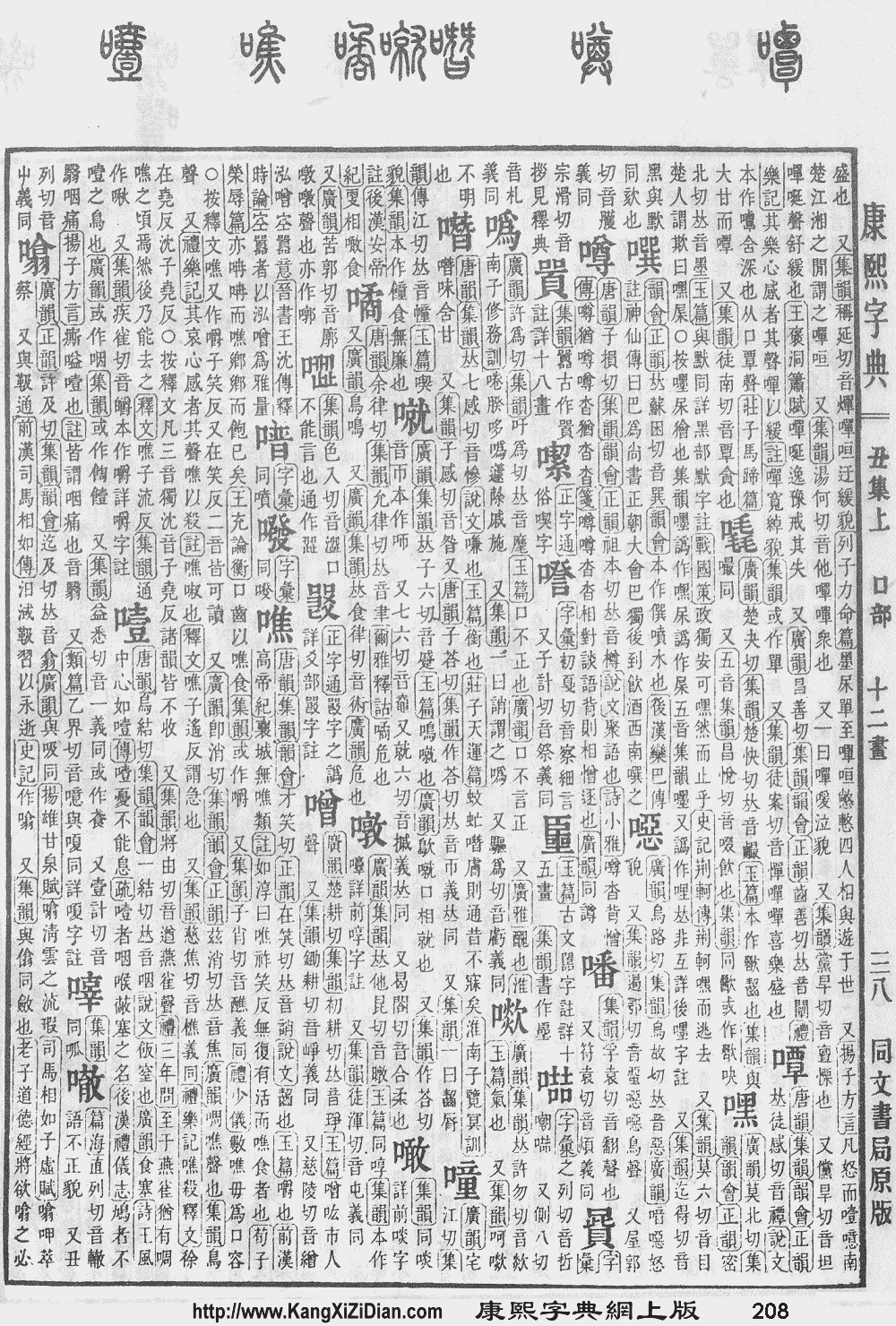
  • Kangxi Dictionary: page 208, character 28
  • Dai Kanwa Jiten: character 4307
  • Dae Jaweon: page 431, character 20
  • Hanyu Da Zidian (first edition): volume 1, page 681, character 3
  • Unihan data for U+564E

Chinese

simp. and trad.
噎

Glyph origin

Phono-semantic compound (形聲/形声, OC *qiːɡ) : semantic 口 + phonetic 壹 (OC *qlid).

Pronunciation


  • Dialectal data
Variety Location 噎
Mandarin Beijing /iɛ⁵⁵/
Harbin /iɛ⁴⁴/
Tianjin /ie²¹/
Jinan /iə²¹³/
Qingdao /iə⁵⁵/
Zhengzhou /iɛ²⁴/
Xi'an /iɛ²¹/
Xining /i⁴⁴/
Yinchuan /ie¹³/
Lanzhou /iə¹³/
Ürümqi /iɤ²¹³/
Wuhan /ie²¹³/
Chengdu /ie³¹/
Guiyang
Kunming /iɛ³¹/
Nanjing /ieʔ⁵/
Hefei /iɐʔ⁵/
Jin Taiyuan /iəʔ²/
Pingyao /iʌʔ¹³/
Hohhot /iaʔ⁴³/
Wu Shanghai /iɪʔ⁵/
Suzhou /iəʔ⁵/
Hangzhou /ʔiəʔ⁵/
Wenzhou /i²¹³/
Hui Shexian /ieʔ²¹/
Tunxi
Xiang Changsha /ie²⁴/
Xiangtan /i²⁴/
Gan Nanchang
Hakka Meixian /et̚⁵/
Taoyuan
Cantonese Guangzhou /jit̚⁵/
Nanning /jit̚³³/
Hong Kong /jit̚⁵/
Min Xiamen (Hokkien) /iat̚³²/
Fuzhou (Eastern Min) /iɛʔ²³/
Jian'ou (Northern Min) /i²⁴/
Shantou (Teochew) /ik̚²/
Haikou (Hainanese) /zi³⁵/ 俗
/i⁵⁵/

Rime
Character 噎
Reading # 1/1
Initial (聲) 影 (34)
Final (韻) 屑 (87)
Tone (調) Checked (Ø)
Openness (開合) Open
Division (等) IV
Fanqie 烏結切
Baxter 'et
Reconstructions
Zhengzhang
Shangfang
/ʔet̚/
Pan
Wuyun
/ʔet̚/
Shao
Rongfen
/ʔɛt̚/
Edwin
Pulleyblank
/ʔɛt̚/
Li
Rong
/ʔet̚/
Wang
Li
/iet̚/
Bernard
Karlgren
/ʔiet̚/
Expected
Mandarin
Reflex
ye
Expected
Cantonese
Reflex
jit3
Baxter–Sagart system 1.1 (2014)
Character 噎
Reading # 1/1
Modern
Beijing
(Pinyin)
yē
Middle
Chinese
‹ ʔet ›
Old
Chinese
/*qˁik/
English choke

Notes for Old Chinese notations in the Baxter–Sagart system:

* Parentheses "()" indicate uncertain presence;
* Square brackets "[]" indicate uncertain identity, e.g. *[t] as coda may in fact be *-t or *-p;
* Angle brackets "<>" indicate infix;
* Hyphen "-" indicates morpheme boundary;

* Period "." indicates syllable boundary.
Zhengzhang system (2003)
Character 噎
Reading # 1/1
No. 14851
Phonetic
component
壹
Rime
group
質
Rime
subdivision
2
Corresponding
MC rime
噎
Old
Chinese
/*qiːɡ/

Definitions

噎

  1. to choke
    噎死  ―  yē sǐ  ―  to die from choking
    不小心噎到了  ―  bù xiǎoxīn yē dào le  ―  to accidentally choke
  2. to breathe against the wind with difficulty
  3. burp; belch
  4. (dialectal) to render somebody speechless by saying something blunt or rule
  5. (literary) to block; to obstruct

Compounds

  • 以噎廢飧/以噎废飧
  • 吃飯防噎/吃饭防噎
  • 哽噎
  • 哽噎難言/哽噎难言
  • 嗚噎/呜噎
  • 噎人
  • 噎嘔/噎呕
  • 噎膈
  • 噎饑/噎饥
  • 因噎廢食/因噎废食 (yīnyēfèishí)
  • 打噎 (dǎyē)
  • 抽噎 (chōuyē)
  • 抽抽噎噎
  • 氣噎/气噎
  • 臉白氣噎/脸白气噎
  • 臨噎掘井/临噎掘井
  • 見噎廢食/见噎废食

Japanese

Kanji

噎

(uncommon “Hyōgai” kanji)

  1. choke
  2. smother

Readings

Korean

Hanja

噎 • (yeol) (hangeul 열, revised yeol, McCune–Reischauer yŏl)

  1. This term needs a translation to English. Please help out and add a translation, then remove the text {{rfdef}}.

Vietnamese

Han character

噎: Hán Nôm readings: ế, nhắc, nhắt, nhốt

  1. This term needs a translation to English. Please help out and add a translation, then remove the text {{rfdef}}.

References

This article is issued from Wiktionary. The text is licensed under Creative Commons - Attribution - Sharealike. Additional terms may apply for the media files.