到
| ||||||||
Translingual
| Stroke order | |||
|---|---|---|---|
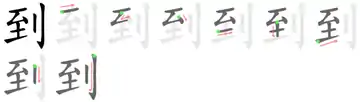 | |||
| Stroke order | |||
|---|---|---|---|
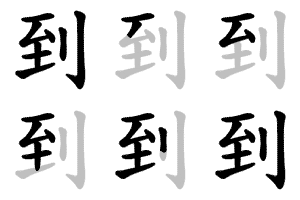 | |||
Han character
到 (Kangxi radical 18, 刀+6, 8 strokes, cangjie input 一土中弓 (MGLN), four-corner 12100, composition ⿰至刂)
References
- Kangxi Dictionary: page 138, character 36
- Dai Kanwa Jiten: character 1950
- Dae Jaweon: page 314, character 13
- Hanyu Da Zidian (first edition): volume 1, page 334, character 3
- Unihan data for U+5230

Chinese
Glyph origin
| Historical forms of the character 到 | ||
|---|---|---|
| Western Zhou | Shuowen Jiezi (compiled in Han) | Liushutong (compiled in Ming) |
| Bronze inscriptions | Small seal script | Transcribed ancient scripts |
 |
 |
 |
Characters in the same phonetic series (刀) (Zhengzhang, 2003)
| Old Chinese | |
|---|---|
| 刀 | *taːw |
| 忉 | *taːw |
| 魛 | *taːw |
| 舠 | *taːw |
| 朷 | *taːw, *moːɡ |
| 叨 | *tuːw, *l̥ʰaːw |
| 倒 | *taːwʔ, *taːws |
| 到 | *taːws |
| 菿 | *taːws, *rtaːwɢ |
| 鞀 | *deːw |
| 鳭 | *rteːw, *teːw |
| 灱 | *hreːw |
| 菬 | *sdew, *tjewʔ |
| 超 | *tʰew |
| 怊 | *tʰew, *tʰjew |
| 欩 | *tʰew |
| 召 | *dews, *djews |
| 昭 | *tjew |
| 招 | *tjew |
| 鉊 | *tjew |
| 沼 | *tjewʔ |
| 照 | *tjews |
| 詔 | *tjews |
| 炤 | *tjews |
| 弨 | *tʰjew, *tʰjewʔ |
| 眧 | *tʰjewʔ |
| 韶 | *djew |
| 佋 | *djew, *djewʔ |
| 軺 | *djew, *lew |
| 玿 | *djew |
| 柖 | *djew |
| 紹 | *djewʔ |
| 袑 | *djewʔ |
| 綤 | *djewʔ |
| 邵 | *djews |
| 劭 | *djews |
| 卲 | *djews |
| 刁 | *teːw |
| 芀 | *teːw, *deːw |
| 貂 | *teːw |
| 蛁 | *teːw |
| 迢 | *deːw |
| 苕 | *deːw |
| 髫 | *deːw |
| 岧 | *deːw |
Phono-semantic compound (形聲/形声, OC *taːws) : semantic 至 (“to arrive”) + phonetic 刀 (OC *taːw).
Pronunciation
Definitions
到
- to arrive at a destination; to reach a destination; to get to
- to go to; to leave for
- used as a verbal complement to indicate the (successful) completion of an action
- (Cantonese) used as a verbal complement to indicate the completion of an action, with negative sentiment
- (dialectal) used after a verb to indicate a continued action or state
- (chiefly in the negative) to reach
- to the extent that
- to
- (Siyi Yue, Northern Min) at; in
- thoughtful; considerate
Synonyms
- (verbal complement indicating completion):
Dialectal synonyms of 到 (“verbal complement indicating completion”) [map]
| Variety | Location | Words |
|---|---|---|
| Formal (Written Standard Chinese) | 到 | |
| Mandarin | Taiwan | 到 |
| Malaysia | 到 | |
| Singapore | 到 | |
| Cantonese | Hong Kong | 到 |
| Singapore (Guangfu) | 到 | |
| Southern Min | Xiamen | 著 |
| Quanzhou | 著 | |
| Jinjiang | 著 | |
| Zhangzhou | 著 | |
| Taipei | 著 GT | |
| Singapore (Hokkien) | 著 | |
| Manila (Hokkien) | 著 | |
| Singapore (Teochew) | 著 | |
| Note | GT - General Taiwanese (no specific region identified) | |
- (at):
Dialectal synonyms of 在 (“at, in”) [map]
Compounds
- 一到處/一到处
- 一天到晚 (yītiāndàowǎn)
- 一年到頭/一年到头 (yīniándàotóu)
- 三到
- 不到
- 不到家
- 不到得
- 不到的
- 不到頭/不到头
- 不周到
- 乍到
- 事到如今 (shìdàorújīn)
- 事到臨頭/事到临头
- 便做到
- 先來後到/先来后到
- 到不的
- 到任 (dàorèn)
- 到場/到场 (dàochǎng)
- 到大來/到大来
- 到家 (dàojiā)
- 到岸價格/到岸价格
- 到差
- 到底 (dàodǐ)
- 到庭 (dàotíng)
- 到得 (dàodé)
- 到手 (dàoshǒu)
- 到敢
- 到時/到时 (dàoshí)
- 到期 (dàoqī)
- 到案 (dào'àn)
- 到此一遊/到此一游 (dàocǐyīyóu)
- 到省
- 到眼
- 到職/到职 (dàozhí)
- 到臨/到临
- 到處/到处 (dàochù)
- 到處奔走/到处奔走
- 到處為家/到处为家
- 到達/到达 (dàodá)
- 到達簽證/到达签证
- 到頭/到头 (dàotóu)
- 到頭來/到头来 (dàotóulái)
- 到齊/到齐 (dàoqí)
- 吃到飽/吃到饱 (chīdàobǎo)
- 周到 (zhōudào)
- 周旋到底
- 堅持到底/坚持到底
- 報到/报到 (bàodào)
- 巴到
- 待到
- 得到 (dédào)
- 從頭到尾/从头到尾 (cóngtóudàowěi)
- 從頭到腳/从头到脚
- 心到神知
- 恰到好處/恰到好处 (qiàdàohǎochù)
- 想不到 (xiǎngbùdào)
- 意到筆隨/意到笔随
- 意想不到 (yìxiǎngbùdào)
- 懇到/恳到
- 手到回春
- 手到拿來/手到拿来 (shǒudàonálái)
- 手到擒來/手到擒来 (shǒudàoqínlái)
- 手到病除
- 打到 (dǎdào)
- 把不到
- 投到
- 抬到天上
- 掄不到/抡不到
- 損到家/损到家
- 搔到癢處/搔到痒处
- 料不到
- 料到 (liàodào)
- 新來乍到/新来乍到 (xīnláizhàdào)
- 旗開馬到/旗开马到
- 更做到
- 木雞養到/木鸡养到
- 水到渠成 (shuǐdàoqúchéng)
- 沒想到/没想到 (méixiǎngdào)
- 獨到/独到 (dúdào)
- 獨到之處/独到之处
- 獨到之見/独到之见
- 白頭到老/白头到老
- 百年到老
- 直到 (zhídào)
- 碰到 (pèngdào)
- 禍到臨頭/祸到临头
- 禮數周到/礼数周到
- 窮到骨/穷到骨
- 等到 (děngdào)
- 簽到/签到 (qiāndào)
- 精到 (jīngdào)
- 老到 (lǎodào)
- 老成見到/老成见到
- 臨到/临到 (líndào)
- 藥到回春/药到回春
- 藥到病除/药到病除 (yàodàobìngchú)
- 見到/见到 (jiàndào)
- 說到做到/说到做到 (shuōdàozuòdào)
- 說曹操,曹操到/说曹操,曹操到 (shuō Cáo Cāo, Cáo Cāo dào)
- 讀書三到/读书三到
- 走馬到任/走马到任
- 趕到/赶到
- 踢到鐵板/踢到铁板
- 辦不到/办不到 (bànbúdào)
- 辦到/办到
- 逕到/迳到 (jìngdào)
- 過到/过到
- 遇到 (yùdào)
- 達到/达到 (dádào)
- 遲到/迟到 (chídào)
- 門到戶說/门到户说
- 面面俱到 (miànmiànjùdào)
- 頭到/头到
- 馬到成功/马到成功 (mǎdào-chénggōng)
- 點到為止/点到为止 (diǎndàowéizhǐ)
Pronunciation
Definitions
到
- (Min) to arrive
- (Eastern Min) used as a verbal complement to indicate the (successful) completion of an action
- (Taiwanese and Singapore Hokkien, mahjong, playing cards) to complete a winning hand
References
- “到”, in 漢語多功能字庫 (Multi-function Chinese Character Database), 香港中文大學 (the Chinese University of Hong Kong), 2014–
- 台灣話的語源與理據:到˙各(kauʟ)──到、來到
Japanese
Readings
Synonyms
Vietnamese
This article is issued from Wiktionary. The text is licensed under Creative Commons - Attribution - Sharealike. Additional terms may apply for the media files.