壴
| ||||||||
Translingual
Han character
壴 (Kangxi radical 33, 士+6, 9 strokes, cangjie input 土口廿 (GRT), four-corner 40108, composition ⿱十豆)
References
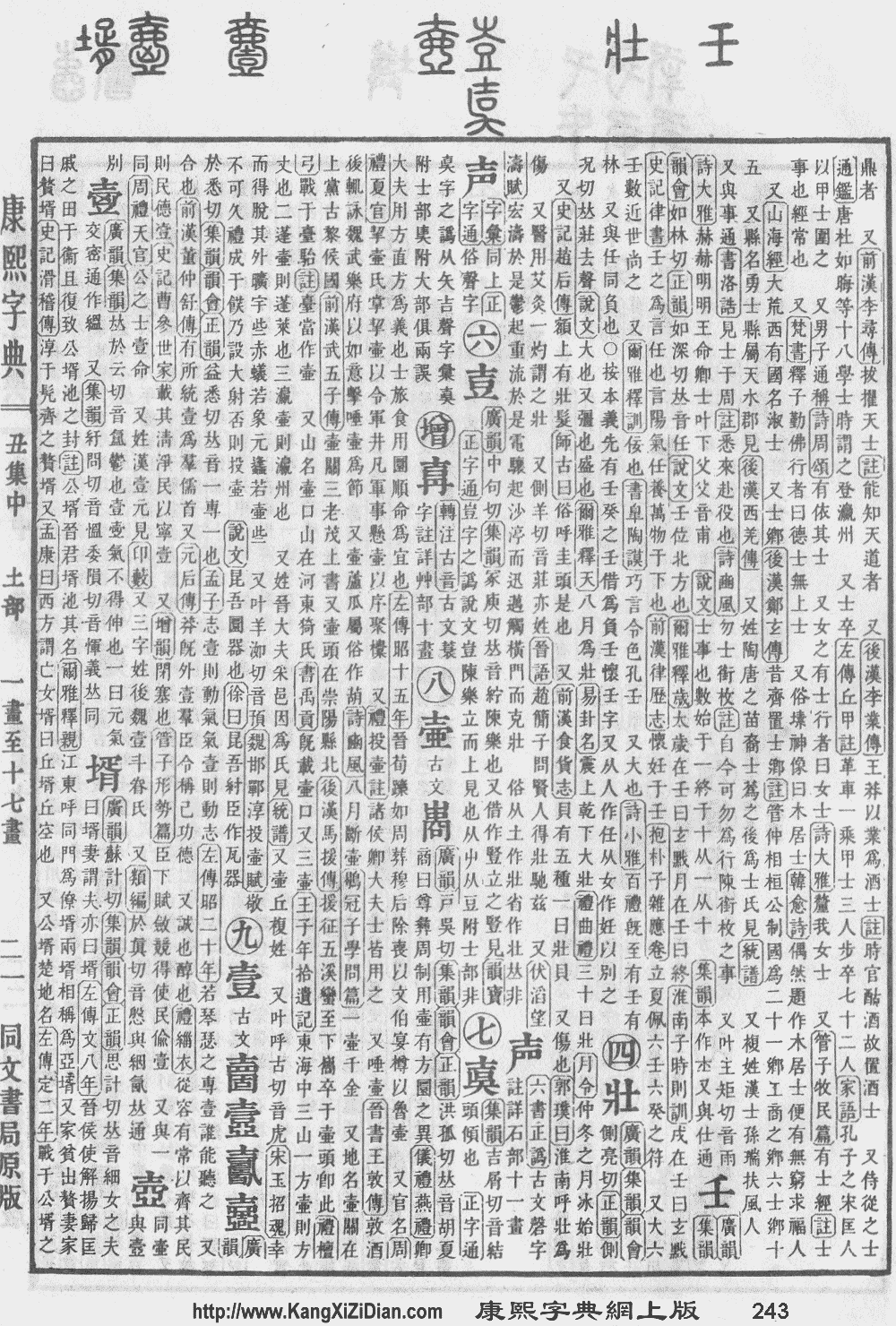
- Kangxi Dictionary: page 243, character 5
- Dai Kanwa Jiten: character 5649
- Dae Jaweon: page 483, character 11
- Hanyu Da Zidian (first edition): volume 1, page 439, character 6
- Unihan data for U+58F4
Chinese
| simp. and trad. |
壴 | |
|---|---|---|
Glyph origin
| Historical forms of the character 壴 | |||
|---|---|---|---|
| Shang | Western Zhou | Shuowen Jiezi (compiled in Han) | Liushutong (compiled in Ming) |
| Oracle bone script | Bronze inscriptions | Small seal script | Transcribed ancient scripts |
 |
 |
 |
 |
Characters in the same phonetic series (壴) (Zhengzhang, 2003)
Pictogram (象形) .
A drum 口 with two ends, a base and feathers 土 on top.
Pronunciation
Etymology 2
| For pronunciation and definitions of 壴 – see 鼓 (“drum; to drum; to beat a drum; etc.”). (This character is the second-round simplified form of 鼓). |
Notes:
|
Etymology 3
| For pronunciation and definitions of 壴 – see 臌. (This character is the second-round simplified form of 臌). |
Notes:
|
Japanese
Kanji
壴
- This term needs a translation to English. Please help out and add a translation, then remove the text
{{rfdef}}.
Korean
This article is issued from Wiktionary. The text is licensed under Creative Commons - Attribution - Sharealike. Additional terms may apply for the media files.