句
| ||||||||
| ||||||||
Translingual
| Stroke order | |||
|---|---|---|---|
 | |||
Han character
句 (Kangxi radical 30, 口+2, 5 strokes, cangjie input 心口 (PR), four-corner 27620, composition ⿹勹口)
- Shuowen Jiezi radical №51
Derived characters
References
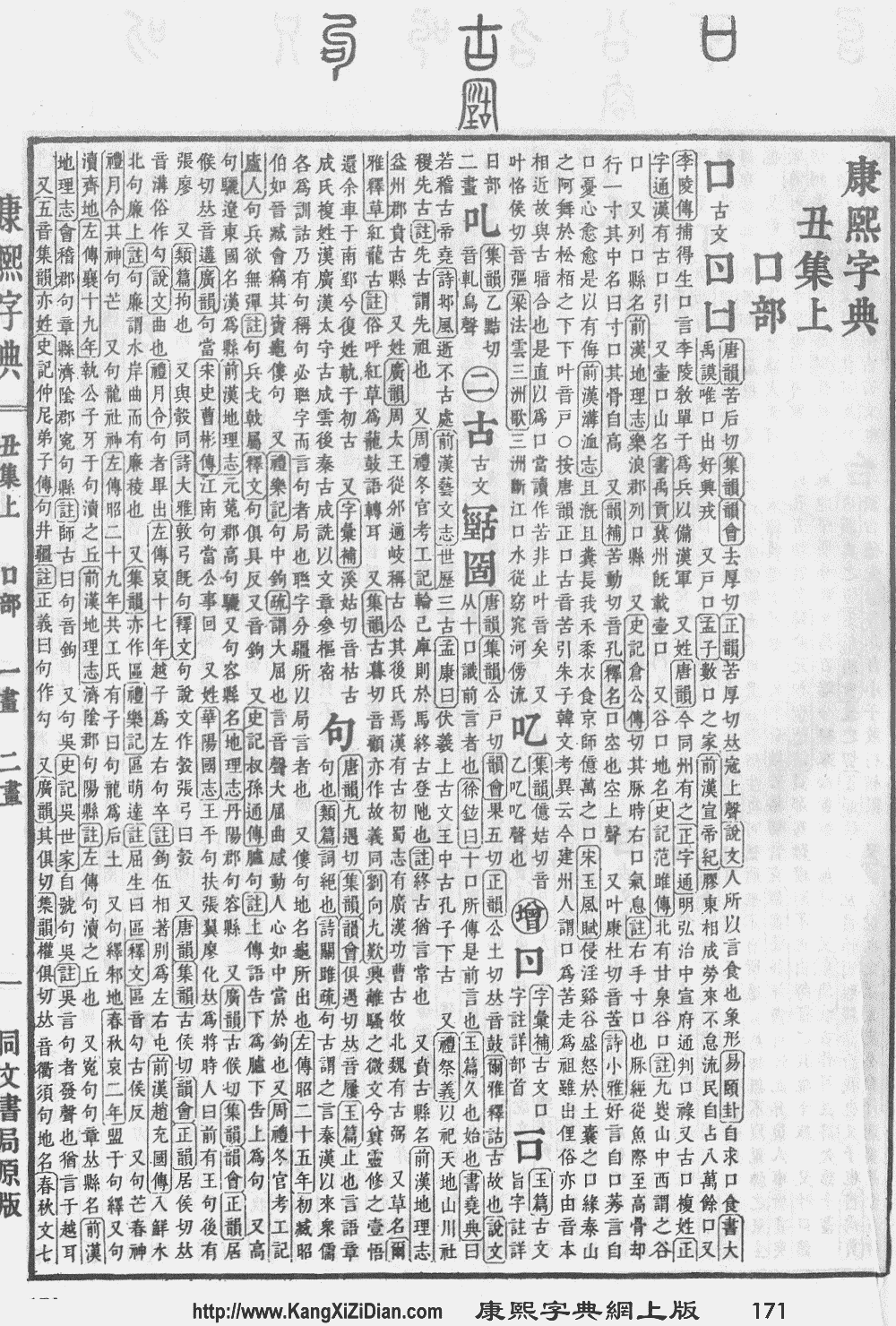
- Kangxi Dictionary: page 171, character 11
- Dai Kanwa Jiten: character 3234
- Dae Jaweon: page 382, character 1
- Hanyu Da Zidian (first edition): volume 1, page 571, character 3
- Unihan data for U+53E5
- Unihan data for U+F906
Chinese
| simp. and trad. |
句 | |
|---|---|---|
| alternative forms | 勾 𠯶 𤖮 | |
Glyph origin
| Historical forms of the character 句 | ||||
|---|---|---|---|---|
| Shang | Western Zhou | Warring States | Shuowen Jiezi (compiled in Han) | Liushutong (compiled in Ming) |
| Oracle bone script | Bronze inscriptions | Chu slip and silk script | Small seal script | Transcribed ancient scripts |
 |
 |
 |
 |
 |
Characters in the same phonetic series (句) (Zhengzhang, 2003)
| Old Chinese | |
|---|---|
| 勾 | *koː, *koːs |
| 鉤 | *koː |
| 鴝 | *koː, *ɡo |
| 句 | *koː, *koːs, *kos, *ɡo |
| 夠 | *koː, *koːs, *kʰoː |
| 枸 | *koː, *koːʔ, *koʔ |
| 軥 | *koː, *koːs, *ɡo |
| 狗 | *koːʔ |
| 苟 | *koːʔ |
| 岣 | *koːʔ, *ko |
| 笱 | *koːʔ |
| 玽 | *koːʔ |
| 耇 | *koːʔ |
| 豿 | *koːʔ, *qʰroːɡ |
| 敂 | *koːʔ |
| 怐 | *koːs, *kʰoːs, *qʰoːs, *kos |
| 雊 | *koːs |
| 竘 | *kʰoːʔ, *kʰoʔ |
| 齁 | *qʰoː |
| 呴 | *qʰoːʔ, *qʰos |
| 蚼 | *qʰoːʔ, *ɡo |
| 豞 | *qʰoːs |
| 訽 | *qʰoːs, *ɡoːs |
| 佝 | *qʰoːs |
| 拘 | *ko |
| 駒 | *ko |
| 眗 | *ko |
| 跔 | *ko |
| 鮈 | *ko |
| 痀 | *ko |
| 蒟 | *koʔ, *kos |
| 絇 | *kos, *ɡo |
| 邭 | *kos |
| 劬 | *ɡo |
| 朐 | *ɡo |
| 鼩 | *ɡo |
| 斪 | *ɡo |
| 翑 | *ɡo |
| 葋 | *ɡo |
| 姁 | *ɡo, *qʰo, *qʰoʔ, *qʰos |
| 欨 | *qʰo, *qʰoʔ |
| 喣 | *qʰoʔ |
| 煦 | *qʰoʔ, *qʰos |
| 昫 | *qʰos |
Phono-semantic compound (形聲/形声, OC *koː, *koːs, *kos, *ɡo) : semantic 丩 (“to entangle”) + phonetic 口 (OC *kʰoːʔ), which may represent the tip of a big nail.
The 丩 component, originally two entangled ropes, now resembles the unrelated 勹.
Pronunciation 1
Definitions
句
Synonyms
- (sentence): 句子 (jùzi)
Compounds
- 一句起,兩句止/一句起,两句止 (jat1 geoi3 hei2 loeng5 geoi3 zi2) (Cantonese)
- 一字半句
- 一替一句
- 一言半句 (yīyánbànjù)
- 三言兩句/三言两句
- 例句 (lìjù)
- 佳句 (jiājù)
- 俳句 (páijù)
- 倒句
- 倒裝句/倒装句 (dàozhuāngjù)
- 偶句對/偶句对
- 兩句半/两句半
- 冗詞贅句/冗词赘句
- 分句 (fēnjù)
- 判斷句/判断句
- 包孕句
- 句型 (jùxíng)
- 句子 (jùzi)
- 句子成分
- 句字頭/句字头
- 句度
- 句式 (jùshì)
- 句斷/句断
- 句格 (jùgé)
- 句法 (jùfǎ)
- 句群
- 句脈/句脉
- 句號/句号 (jùhào)
- 句讀/句读 (jùdòu)
- 句重音
- 句點/句点 (jùdiǎn)
- 名句 (míngjù)
- 命令句 (mìnglìngjù)
- 單句/单句 (dānjù)
- 單句對/单句对
- 單部句/单部句
- 垛句
- 奇文瑰句
- 字句 (zìjù)
- 字斟句酌
- 尋章摘句/寻章摘句 (xúnzhāngzhāijù)
- 對句/对句 (duìjù)
- 形容句
- 彫章鏤句/雕章镂句
- 感嘆句/感叹句
- 意謂繁句/意谓繁句
- 拗句
- 排句
- 換句話說/换句话说 (huànjùhuàshuō)
- 描寫句/描写句
- 搜章擿句
- 摘句尋章/摘句寻章 (zhāijùxúnzhāng)
- 摛章繪句/摛章绘句
- 敘事句/叙事句
- 敘述句/叙述句
- 文句 (wénjù)
- 新句
- 斷句/断句 (duànjù)
- 斷章截句/断章截句
- 斷章摘句/断章摘句
- 有無句/有无句
- 條件句/条件句
- 概念句
- 樂句/乐句 (yuèjù)
- 死句
- 沉吟章句
- 法句經/法句经 (Fǎjùjīng)
- 法華文句/法华文句
- 活句
- 清詞麗句/清词丽句
- 琢句
- 當句對/当句对
- 疊句/叠句 (diéjù)
- 疑問句/疑问句
- 短句
- 破句 (pòjù)
- 祈使句 (qíshǐjù)
- 竄句/窜句
- 累句
- 絕句/绝句 (juéjù)
- 繁句
- 聯句/联句 (liánjù)
- 表態句/表态句
- 複句/复句 (fùjù)
- 覓句/觅句
- 詞句/词句 (cíjù)
- 詩句/诗句 (shījù)
- 語句/语句 (yǔjù)
- 警句 (jǐngjù)
- 費句/费句 (fèijù)
- 起句 (qǐjù)
- 辭句/辞句 (cíjù)
- 造句 (zàojù)
- 連句/连句
- 逐字逐句 (zhúzìzhújù)
- 遣辭用句/遣辞用句
- 鄙言累句
- 金句 (jīnjù)
- 鉤章棘句/钩章棘句
- 錦囊佳句/锦囊佳句
- 鍊句/炼句
- 長句/长句 (chángjù)
- 長短句/长短句 (chángduǎnjù)
- 閉門覓句/闭门觅句
- 陳述句/陈述句
- 險句/险句
- 集句
- 雕章繢句/雕章缋句
- 雕章鏤句/雕章镂句
- 雙部句/双部句
- 章句
- 章句之徒
- 章句儒
- 章決句斷/章决句断
Pronunciation 2
Definitions
句
Coordinate terms
- (geometry): 股 (gǔ)
Pronunciation 3
Definitions
句
Pronunciation 4
References
- "冤句音义考" ["Yuānqú Yīnyì Kǎo", "An Inquiry into the Sound and Meaning of Yuanqu"], 《山东方志》 [Shāndōng Fāngzhì, Shandong Local Records], 山东省情网 [Shāndōng Shěng Qíng Wǎng, Shandong Provincial Network], Jinan: Shandong Provincial Archives, 2006. (in Chinese)
- Tian Miao's "A Formal System of the Gougu Method" in The History of Mathematical Proof in Ancient Traditions, pp. 386–7.
- Dictionary of Chinese Character Variants (教育部異體字字典), A00497
- “句”, in 漢語多功能字庫 (Multi-function Chinese Character Database), 香港中文大學 (the Chinese University of Hong Kong), 2014–
Japanese
Noun
句 • (ku)
References
- Matsumura, Akira, editor (2006), 大辞林 [Daijirin] (in Japanese), Third edition, Tōkyō: Sanseidō, →ISBN
Korean
Etymology
(This etymology is missing or incomplete. Please add to it, or discuss it at the Etymology scriptorium. Particularly: “Middle Korean readings, if any”)
Pronunciation
- (SK Standard/Seoul) IPA(key): [ku]
- Phonetic hangul: [구]
Vietnamese
Han character
句: Hán Việt readings: câu[1][2][3], cú[1][2][4][3], cấu[1][2]
- chữ Hán form of câu (“sentence, expression, line”).
- chữ Hán form of cú (“sentence, expression, line”).
Compounds
References
- Thiều Chửu (1942).
- Nguyễn (1974).
- Trần (1999).
- Hồ (1976).
This article is issued from Wiktionary. The text is licensed under Creative Commons - Attribution - Sharealike. Additional terms may apply for the media files.