屎
| ||||||||
Translingual
Han character
屎 (Kangxi radical 44, 尸+6, 9 strokes, cangjie input 尸火木 (SFD), four-corner 77294, composition ⿸尸米)
Derived characters
- 䐖 𡳁 𡳛
References
- Kangxi Dictionary: page 301, character 25
- Dai Kanwa Jiten: character 7689
- Dae Jaweon: page 598, character 15
- Hanyu Da Zidian (first edition): volume 2, page 973, character 6
- Unihan data for U+5C4E
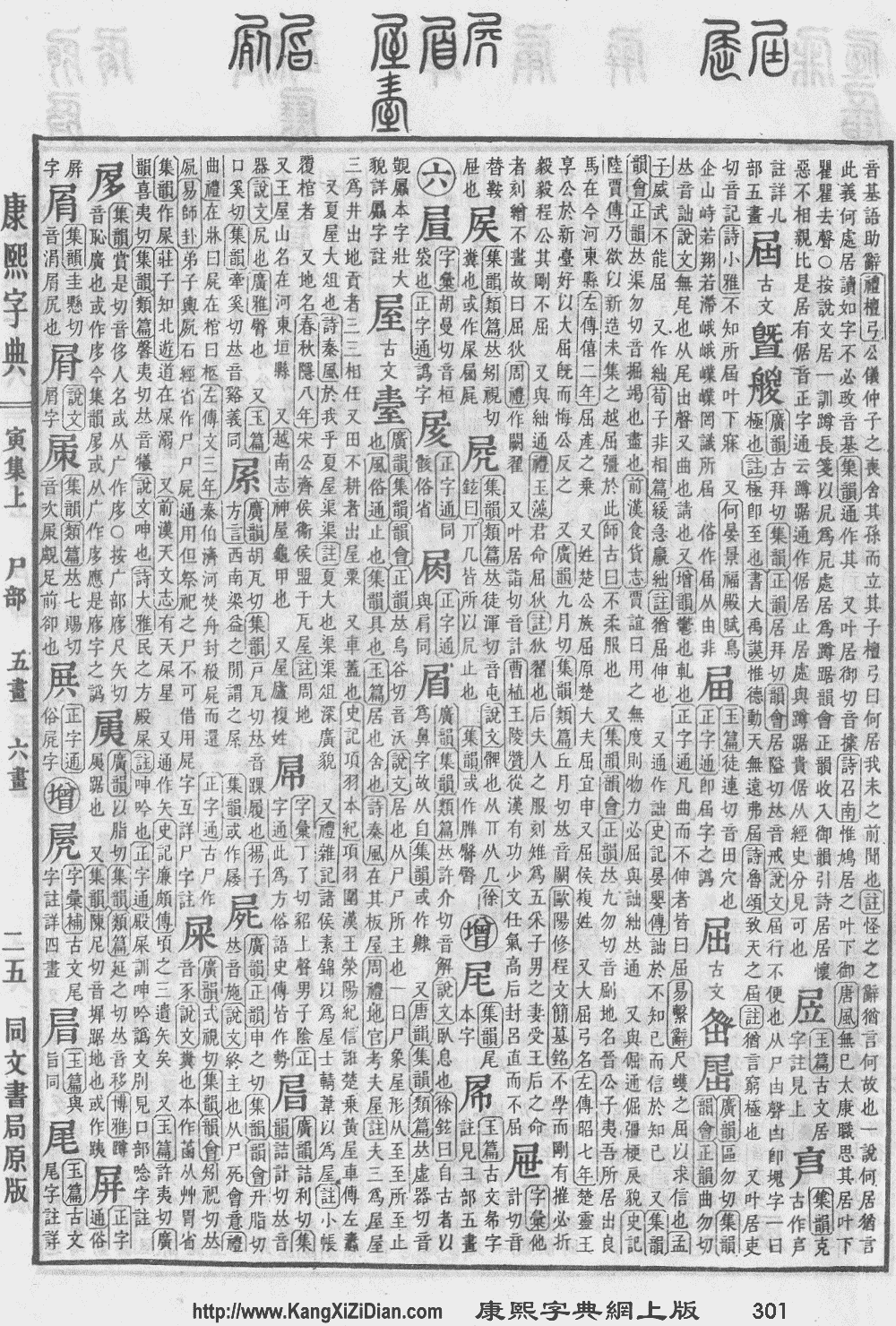
Chinese
| trad. | 屎 | |
|---|---|---|
| simp. # | 屎 | |
| alternative forms | ||
Glyph origin
| Historical forms of the character 屎 | |||
|---|---|---|---|
| Shang | Western Zhou | Warring States | Shuowen Jiezi (compiled in Han) |
| Oracle bone script | Bronze inscriptions | Bronze inscriptions | Small seal script |
 |
 |
 |
 |
Ideogrammic compound (會意/会意) and phono-semantic compound (形聲/形声, OC *hliʔ, *hri) : phonetic 尸 (OC *hli, “body”) + semantic 米 (“rice”). The 米 component was originally three ( , representing 小, as seen in
 ), four (
 , representing 少) or five dots (as seen in
 ) forming a ideogrammic representation of faeces in the oracle bone script, with four dots being the most common variant, thus representing a man defecating with faeces coming out of the backside. The Shang dynasty variants saw the 尸 ("body") component interchangeable with 人 ("human"); later, by the Western Zhou dynasty, 尸 variants with four dots became the dominant and sole-surviving form, however examples from this time period also exist where the 尸 component is mistaken for 尾 ("tail"), as seen in
 . During the Warring States period, the 少 component became corrupted[1] into 米.
Shuowen Jiezi does not feature the 屎 character, however it does contain 𦳊 and 𡕝. 𦳊 is listed in Shuowen as deriving from 艸 ("grass") and 胃 ("stomach"), while 𡲴 is listed as the ancient form of 徙 (“migration”), however in reality this is not the case; 𡲴 is an erroneous form of the 屎 variant containing 尾, where the tail portion of the 尾 component is mistakenly written as 火. During the Zhou dynasty, 屎 was often used as a phonetic borrowing for 徙 (OC *selʔ); moreover, during the Warring States period, the Chu script character for 徙 consisted of 屎 with an additional 辵 (modern radical form 辶) added[1] to represent the meaning of walking.
Following transition to the clerical script, a variety of alternative forms emerged:
- The 米 component was replaced with phonetic component 矢 (OC *hliʔ) thus creating the variant form 𡱁;
- Some variants added another 米 radical to create 𥻐 and 𥺶;
- Existing variants containing the 尾 component became 𡲔 and 𡱵;
- The body portion of 𡲴 also became further corrupted into 夂 (zhǐ), creating 𡕝;
- The tail portion of 尾-based variants became corrupted into 巛, creating 𡲑;
- The 尸 component corrupted into 广, creating 𢈍;
- Even the variant form 𢈍 became corrupted, where the 广 was simplified into 宀, creating 宩.
All of these variant forms failed to gain widespread usage, and eventually faded into obscurity while 屎 remained the dominant character variant.
Etymology 1
From Proto-Sino-Tibetan *kləj (“excrement”).
Pronunciation
Definitions
屎
Synonyms
- (excrement):
Compounds
- 一啖砂糖一啖屎
- 一垺屎
- 一把屎,一把尿
- 一礐屎/一𬒈屎
- 一粒老鼠屎,壞了一鍋粥/一粒老鼠屎,坏了一锅粥 (yī lì lǎoshǔshǐ, huài le yī guō zhōu)
- 不拉屎的
- 乾屎橛/干屎橛 (gānshǐjué)
- 半桶屎
- 占著茅坑不拉屎
- 厚屎
- 厚屎尿
- 厚話屎/厚话屎
- 吃了蜜蜂兒屎似的/吃了蜜蜂儿屎似的
- 嘴吃屎
- 好好鱟刣甲屎那流/好好鲎刣甲屎那流
- 好鞋不踏臭屎
- 家己捧屎抹面
- 屎堆
- 屎塔
- 屎尾
- 屎尿 (shǐniào)
- 屎㞎㞎 (shǐbǎba)
- 屎忽
- 屎忽鬼
- 屎桶
- 屎桮齒/屎桮齿
- 屎棋
- 屎橋/屎桥
- 屎殼郎/屎壳郎
- 屎滾尿流/屎滚尿流 (shǐgǔnniàoliú)
- 屎盆子 (shǐpénzi)
- 屎盎
- 屎礐仔/屎𬒈仔
- 屎礐仔蟲/屎𬒈仔虫
- 屎窟
- 屎缸蟲/屎缸虫
- 屎蛋 (shǐdàn)
- 屎蚵蜋
- 屎頭巾/屎头巾
- 屙屎 (ēshǐ)
- 慢牛厚屎尿
- 懶人多屎尿/懒人多屎尿
- 拉屎 (lāshǐ)
- 拖屎連/拖屎连
- 拉硬屎
- 搦屎搦尿
- 搞屎棍 (jiǎoshǐgùn)
- 擔屎/担屎
- 擔屎唔偷食/担屎唔偷食
- 攝屎/摄屎
- 攪屎棍/搅屎棍 (jiǎoshǐgùn)
- 攬狗屎/揽狗屎
- 放屎
- 桌頂食飯,桌跤放屎/桌顶食饭,桌跤放屎
- 流目屎
- 滲屎/渗屎
- 滲屎尿/渗屎尿
- 漚屎面/沤屎面
- 激屎
- 火屎
- 灰屎
- 炭屎
- 燥屎
- 牛屎色
- 牛屎鳥仔/牛屎鸟仔
- 牛屎龜/牛屎龟
- 狗吃屎
- 狗吃熱屎/狗吃热屎
- 狗屎 (gǒushǐ)
- 狗屎堆 (gǒushǐduī)
- 狗攬三堆屎/狗揽三堆屎
- 狗改不了吃屎 (gǒu gǎi bùliǎo chī shǐ)
- 生狂狗食無屎/生狂狗食无屎
- 生雞卵無,放雞屎有/生鸡卵无,放鸡屎有
- 疶屎
- 目屎
- 目屎膏
- 眼屎 (yǎnshǐ)
- 瞪屎
- 石屎 (shíshǐ)
- 老鼠屎 (lǎoshǔshǐ)
- 耳屎 (ěrshǐ)
- 胡蠅屎痣/胡蝇屎痣
- 胡蠅舞屎桮/胡蝇舞屎桮
- 落屎
- 落屎星
- 落屎馬/落屎马
- 薰屎
- 話屎/话屎
- 道在屎溺 (dàozàishǐniào)
- 阿屎
- 雞屎落塗,也有三寸煙/鸡屎落涂,也有三寸烟
- 雞屎藤/鸡屎藤
- 雞屎運/鸡屎运
- 飛屎/飞屎
- 鳥不生蛋,狗不拉屎/鸟不生蛋,狗不拉屎
- 鼻屎 (bíshǐ)
- 鼻屎膏
Pronunciation
Definitions
屎
- † Only used in 殿屎 (“to groan”).
References
- Dictionary of Chinese Character Variants (教育部異體字字典), A01086
- “屎”, in 漢語多功能字庫 (Multi-function Chinese Character Database), 香港中文大學 (the Chinese University of Hong Kong), 2014–
- Li Shoukui (李守奎) (2015 April) ““屎”與“徙之古文”考 [On the ancient glyphs of “屎” and “徙”]”, in 出土文獻, volume 6, Tsinghua University, archived from the original on 11 January 2021, pages 154-162
Japanese
Etymology 1
| Kanji in this term |
|---|
| 屎 |
| くそ Hyōgaiji |
| kun’yomi |
| Alternative spelling |
|---|
| 糞 |
⟨kuso1⟩ → /kuso/
From Old Japanese,[1] from Proto-Japonic *kusau. Cognate with 臭い (kusai, “stinky, smelly”), 腐る (kusaru, “to rot, to become stinky”).[2]
Derived terms
Idioms
- 屎にする (kuso ni suru): “to turn something into shit; to treat something as shit” → to make something worthless; to treat something as worthless
- 屎の役にも立たぬ (kuso no yaku ni mo tatanu): “not even standing in the role of shit” → not even good for shit
- (See 役に立つ (yaku ni tatsu): “to be useful, to play a role”)
- 屎も味噌も一緒 (kuso mo miso mo issho): “both crap and miso together” → a situation where it is difficult to tell the good from the bad
Usage notes
This is not considered as profane as the English glosses. For instance, a child of five using the Japanese interjection kuso would be unremarkable, whereas it would be very socially inappropriate for a child of five to use the English interjection shit.
Suffix
屎 • (-kuso)
- A derogatory emphasizing suffix.
- 下手屎
- hetakuso
- crappy bad at something; to be shit at doing something
- 襤褸屎
- borokuso
- broken down for shit, raggedy-ass
- 下手屎
Etymology 2
| Kanji in this term |
|---|
| 屎 |
| ばば Hyōgaiji |
| kun’yomi |
| Alternative spelling |
|---|
| 糞 |
Appears to derive from baby talk.[2][3] Compare English poopoo and Mandarin 㞎㞎 (bǎba).
Pronunciation
Idioms
- 猫屎する (nekobabasuru): to sweep something under the rug → to hide a problem without actually dealing with it (from how a cat will bury its poop)
References
- Frellesvig, Bjarke, Stephen Wright Horn, et al. (eds.) (2023) “Old Japanese kuswo”, in Oxford-NINJAL Corpus of Old Japanese
- Shōgaku Tosho (1988) 国語大辞典(新装版) [Unabridged Dictionary of Japanese (Revised Edition)] (in Japanese), Tōkyō: Shogakukan, →ISBN
- Matsumura, Akira, editor (2006), 大辞林 [Daijirin] (in Japanese), Third edition, Tōkyō: Sanseidō, →ISBN
- NHK Broadcasting Culture Research Institute, editor (1998), NHK日本語発音アクセント辞典 [NHK Japanese Pronunciation Accent Dictionary] (in Japanese), Tōkyō: NHK Publishing, →ISBN