戌

See also: 戊, 戍, and 戉
戌 U+620C, 戌
CJK UNIFIED IDEOGRAPH-620C
← 戋
[U+620B]
CJK Unified Ideographs 戍 →
[U+620D]

Translingual

Han character

戌 (Kangxi radical 62, 戈+2, 6 strokes, cangjie input 戈竹一 (IHM), four-corner 53200, composition ⿵戊一(GHTJK) or ⿹戈⿰丿一(V))

Descendants

References

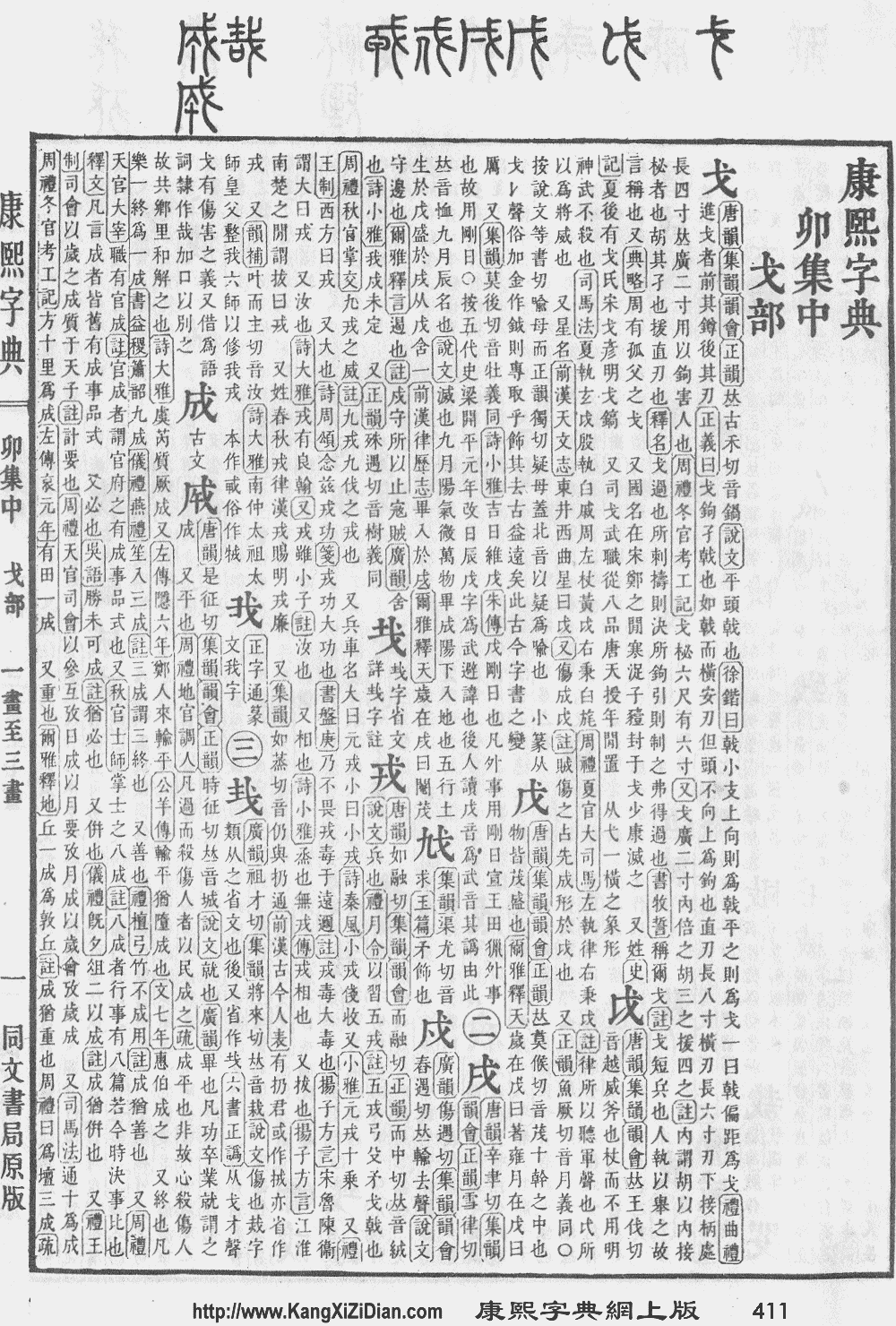
  • Kangxi Dictionary: page 411, character 4
  • Dai Kanwa Jiten: character 11535
  • Dae Jaweon: page 752, character 8
  • Hanyu Da Zidian (first edition): volume 2, page 1398, character 1
  • Unihan data for U+620C

Chinese

simp. and trad.
戌

Glyph origin

Historical forms of the character 戌
Shang Western Zhou Shuowen Jiezi (compiled in Han) Liushutong (compiled in Ming)
Oracle bone script Bronze inscriptions Small seal script Transcribed ancient scripts

Pictogram (象形) .

Etymology 1

Smith (2011) proposes that 戌 (OC *smid), graphically depicting an ax or halberd, is a nominal derivative of the verb 滅 (OC *med) "to annihilate" "by the multivalent prefix *s- (‘annihilate’ > ‘annihilator’ and thus ‘axe’)", and it was used to name the late, broad waxing crescent moon.

Association with the dog was possibly arbitrary; just as how 辰 was associated arbitarily with the dragon (see Ferlus, 2013).

Pronunciation


  • Dialectal data
Variety Location 戌
Mandarin Beijing /ɕy⁵⁵/
Harbin /ɕy⁴⁴/
Tianjin /ɕy⁵³/
Jinan /ɕy²¹³/
Qingdao /sy⁵⁵/
Zhengzhou /sy²⁴/
Xi'an /ɕy²¹/
Xining /ɕy⁴⁴/
Yinchuan /ɕy¹³/
Lanzhou /ɕy¹³/
Ürümqi /ɕy⁴⁴/
Wuhan /ɕy²¹³/ 新
/ɕi²¹³/ 舊
Chengdu /ɕyo³¹/
/ɕy⁵⁵/
Guiyang /ɕiu²¹/
Kunming /ɕiu³¹/
Nanjing /syʔ⁵/
Hefei /ɕyəʔ⁵/
Jin Taiyuan /ɕyəʔ²/
Pingyao /ɕyʌʔ¹³/
Hohhot /ɕyəʔ⁴⁴³⁵/
Wu Shanghai /ɕiɪʔ⁵/
Suzhou /siəʔ⁵/
Hangzhou /ɕiəʔ⁵/
Wenzhou /ɕy²¹³/
Hui Shexian /ɕyʔ²¹/
Tunxi /ɕy¹¹/
Xiang Changsha /si²⁴/
Xiangtan /si²⁴/
Gan Nanchang /ɕyʔ⁵/
Hakka Meixian /sut̚¹/
Taoyuan
Cantonese Guangzhou /søt̚⁵/
Nanning /ɬɐt̚⁵⁵/
Hong Kong /søt̚⁵/
Min Xiamen (Hokkien) /sut̚³²/
Fuzhou (Eastern Min) /souʔ²³/
Jian'ou (Northern Min) /sy²⁴/
Shantou (Teochew) /suk̚²/
Haikou (Hainanese) /tut̚⁵/

Rime
Character 戌
Reading # 1/1
Initial (聲) 心 (16)
Final (韻) 術 (52)
Tone (調) Checked (Ø)
Openness (開合) Closed
Division (等) III
Fanqie 辛聿切
Baxter swit
Reconstructions
Zhengzhang
Shangfang
/siuɪt̚/
Pan
Wuyun
/sʷit̚/
Shao
Rongfen
/sjuet̚/
Edwin
Pulleyblank
/swit̚/
Li
Rong
/siuĕt̚/
Wang
Li
/sĭuĕt̚/
Bernard
Karlgren
/si̯uĕt̚/
Expected
Mandarin
Reflex
xu
Expected
Cantonese
Reflex
seot1
Baxter–Sagart system 1.1 (2014)
Character 戌
Reading # 1/1
Modern
Beijing
(Pinyin)
xū
Middle
Chinese
‹ swit ›
Old
Chinese
/*s.mi[t]/
English 11th earthly branch

Notes for Old Chinese notations in the Baxter–Sagart system:

* Parentheses "()" indicate uncertain presence;
* Square brackets "[]" indicate uncertain identity, e.g. *[t] as coda may in fact be *-t or *-p;
* Angle brackets "<>" indicate infix;
* Hyphen "-" indicates morpheme boundary;

* Period "." indicates syllable boundary.
Zhengzhang system (2003)
Character 戌
Reading # 1/1
No. 13945
Phonetic
component
戌
Rime
group
質
Rime
subdivision
2
Corresponding
MC rime
卹
Old
Chinese
/*smid/

Definitions

戌

  1. eleventh of twelve earthly branches (十二支)
  2. Dog (狗) of Chinese zodiac
Coordinate terms
  • (Chinese earthly branches) 地支 (dìzhī); 子, 丑 (chǒu), 寅 (yín), 卯 (mǎo), 辰 (chén), 巳 (sì), 午 (wǔ), 未 (wèi), 申 (shēn), 酉 (yǒu), 戌, 亥 (hài) (Category: zh:Chinese earthly branches)

Compounds

Pronunciation


Definitions

戌

  1. Only used in 屈戌 (“metal fastening”).

Etymology 3

For pronunciation and definitions of 戌 – see 恤 (“(Cantonese) latch”).
(This character is a variant form of 恤).

Japanese

Kanji

戌

(uncommon “Hyōgai” kanji)

Readings

Etymology 1

Kanji in this term
戌
いぬ
Hyōgaiji
kun’yomi

From 犬 (inu, “dog”).

Pronunciation

  • (Tokyo) いぬ [ìnú] (Heiban – [0])
  • IPA(key): [inɯ̟ᵝ]

Proper noun

戌(いぬ) • (Inu) 

  1. the Dog, the eleventh of the twelve Earthly Branches
    Hypernyms: 十二支, 地支
    Coordinate terms: 子, 丑, 寅, 卯, 辰, 巳, 午, 未, 申, 酉, 戌, 亥

Noun

戌(いぬ) • (inu) 

  1. the hour of the dog; a historical dual-hour equivalent to 7PM - 9PM
    • c. 935,: Tosa Nikki (page 3)
      それの年の十二月の二十日あまり一日の日の戌の刻に、門出す。
      I departed on the twenty and one day of the twelfth month of that year at the hour of the dog.

Etymology 2

Kanji in this term
戌
じゅつ
Hyōgaiji
on’yomi

From Middle Chinese 戌 (swit).

Proper noun

戌(じゅつ) • (Jutsu) 

  1. the Dog, the eleventh of the twelve Earthly Branches
    Hypernyms: 十二支, 地支
    Coordinate terms: 子, 丑, 寅, 卯, 辰, 巳, 午, 未, 申, 酉, 戌, 亥

References

    • Hasegawa, Masaharu with Yūichirō Imanishi, Hiroshi Itō, Hiroshi Yoshioka (1989) Shin Nihon Koten Bungaku Taikei 24: Tosa Nikki, Kagerō Nikki, Murasaki Shikibu Nikki, Sarashina Nikki, Tōkyō: Iwanami Shoten, →ISBN

    Korean

    Hanja

    戌 (eum 술 (sul))

    1. 11th terrestrial branch

    Vietnamese

    Han character

    戌: Hán Nôm readings: tuất

    1. chữ Hán form of Tuất (“eleventh of the twelve earthly branches”).
      Hypernyms: 地支, 十二支
      Coordinate terms: 子, 丑, 寅, 卯, 辰, 巳, 午, 未, 申, 酉, 戌, 亥

    Compounds

    This article is issued from Wiktionary. The text is licensed under Creative Commons - Attribution - Sharealike. Additional terms may apply for the media files.