卯
| ||||||||
Translingual
| Stroke order | |||
|---|---|---|---|
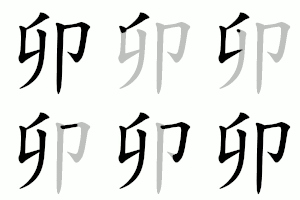 | |||
Han character
卯 (Kangxi radical 26, 卩+3, 5 strokes, cangjie input 竹竹尸中 (HHSL), four-corner 77720, composition ⿰𠂎卩)
Derived characters
References
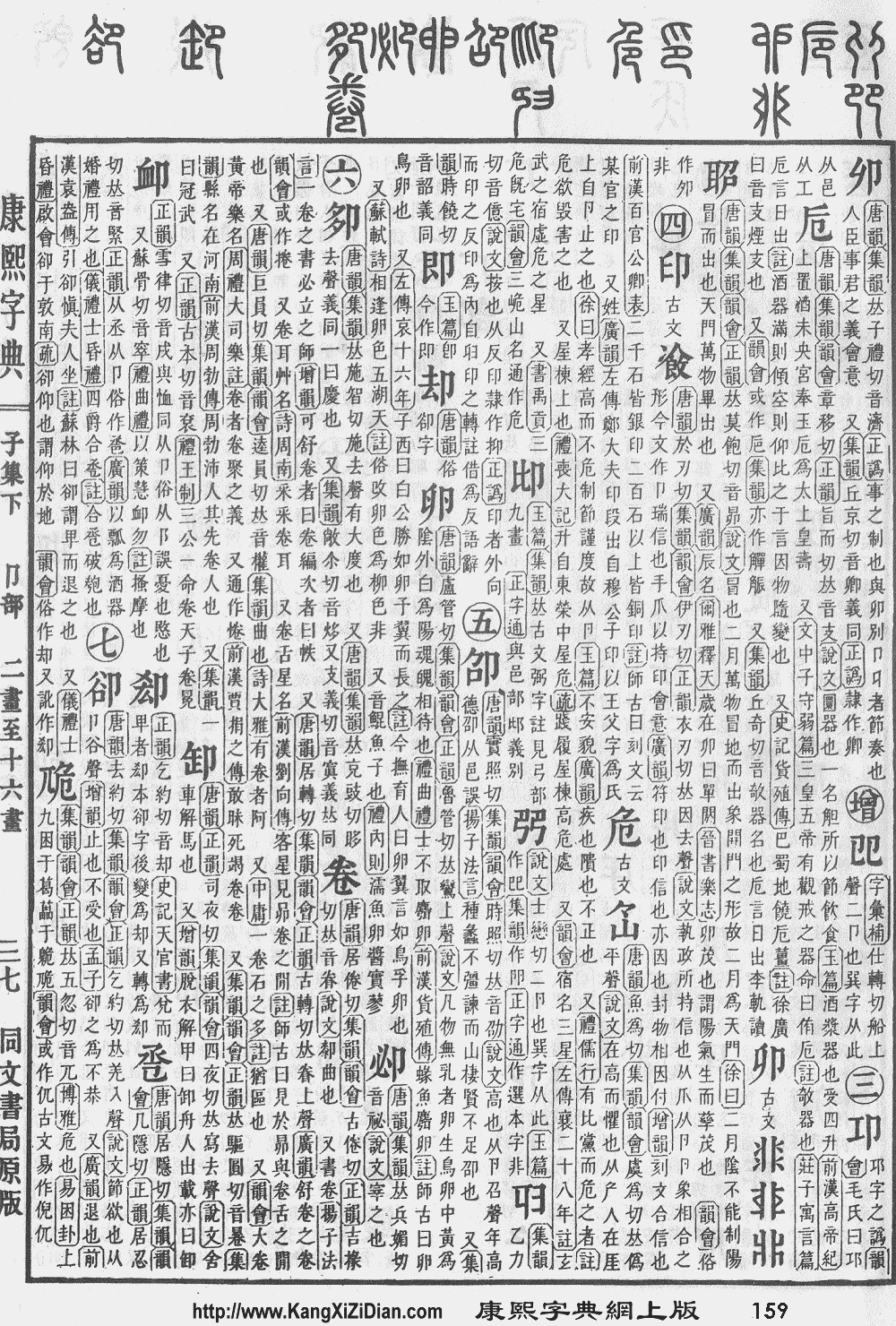
- Kangxi Dictionary: page 159, character 5
- Dai Kanwa Jiten: character 2847
- Dae Jaweon: page 363, character 15
- Hanyu Da Zidian (first edition): volume 1, page 311, character 5
- Unihan data for U+536F
Chinese
Glyph origin
| Historical forms of the character 卯 | |||||||
|---|---|---|---|---|---|---|---|
| Shang | Western Zhou | Warring States | Shuowen Jiezi (compiled in Han) | Liushutong (compiled in Ming) | |||
| Bronze inscriptions | Oracle bone script | Bronze inscriptions | Chu slip and silk script | Qin slip script | Ancient script | Small seal script | Transcribed ancient scripts |
 |
 |
 |
 |
 |
 |
 |
 |
| Old Chinese | |
|---|---|
| 卯 | *mruːʔ |
| 昴 | *mruːʔ |
| 泖 | *mruːʔ |
| 茆 | *mruːʔ, *m·ruʔ |
| 奅 | *m̥ʰruːs |
| 窌 | *m̥ʰruːs, *m·ruː, *m·rus |
| 聊 | *m·rɯːw |
| 貿 | *mlus |
| 鄮 | *mlus |
| 劉 | *m·ru |
| 留 | *m·ru, *m·rus |
| 蒥 | *m·ru |
| 鶹 | *m·ru |
| 騮 | *m·ru |
| 榴 | *m·ru |
| 瑠 | *ru |
| 瘤 | *m·ru, *m·rus |
| 遛 | *m·ru |
| 鎦 | *m·ru |
| 飀 | *m·ru |
| 鰡 | *m·ru |
| 嵧 | *m·ru |
| 餾 | *m·ru, *m·rus |
| 瀏 | *m·ru, *m·ruʔ |
| 懰 | *m·ru, *m·ruʔ |
| 柳 | *m·ruʔ |
| 珋 | *m·ruʔ |
| 罶 | *m·ruʔ |
| 嬼 | *m·ruʔ, *m·rus |
| 溜 | *m·rus |
| 霤 | *m·rus |
| 廇 | *m·rus |
| 塯 | *m·rus |
This character was found in oracle bone scripts depicting a sacrifice (a human or animal body) that is cut in half. This kind of practice mainly happened in Shang dynasty and was gradually eliminated after Zhou's conquest of Shang, leading to obscurity of the character's original meaning. An old variant is 戼. According to Shuowen Jiezi, it is an open door, like 門/𨳇 (mén) but reversed.
Etymology
Derived from root 流 (OC *r(j)u) with volitional or agentive OC prefix *m- (see Sagart, 1999); so *m-ruu means "(cause to flow >) pour out, empty" > *m-ruuʔ 卯 "pouring or emptying stage" i.e. "waning moon", "with the word in its sacrificial applications meaning 'to blood-let'" (Smith, 2011).
Association with the rabbit was probably arbitrary, just as how 辰 was arbitrarily associated with the dragon (see Ferlus, 2013).
Definitions
卯
- fourth of twelve earthly branches (十二支)
- rabbit (兔) of Chinese zodiac
- period from 5-7 a.m.
- early morning
- mortise
Coordinate terms
Compounds
References
- “卯”, in 漢語多功能字庫 (Multi-function Chinese Character Database), 香港中文大學 (the Chinese University of Hong Kong), 2014–
Japanese
Kanji
(“Jinmeiyō” kanji used for names)
- This term needs a translation to English. Please help out and add a translation, then remove the text
{{rfdef}}.
Compounds
- 卯建 (udatsu)
- 卯波 (unami), 卯浪 (unami)
- 卯の花 (unohana)
- 卯酒 (bōshu)
- 卯酉線 (bōyūsen)
Pronunciation
Proper noun
卯 • (U)