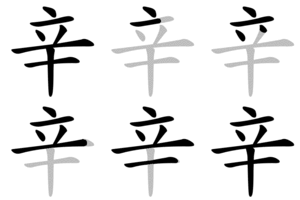
辛

See also: 幸, 羍, and 푸
辛 U+8F9B, 辛
CJK UNIFIED IDEOGRAPH-8F9B
← 辚
[U+8F9A]
CJK Unified Ideographs 辜 →
[U+8F9C]
⾟ U+2F9F, ⾟
KANGXI RADICAL BITTER
← ⾞
[U+2F9E]
Kangxi Radicals ⾠ →
[U+2FA0]

Translingual

Stroke order

Han character

辛 (Kangxi radical 160, 辛+0, 7 strokes, cangjie input 卜廿十 (YTJ), four-corner 00401, composition ⿱立十 or ⿱亠𢆉)

  1. Kangxi radical #160, ⾟.

Derived terms

References

  • Kangxi Dictionary: page 1250, character 25
  • Dai Kanwa Jiten: character 38630
  • Dae Jaweon: page 1729, character 31
  • Hanyu Da Zidian (first edition): volume 6, page 4036, character 1
  • Unihan data for U+8F9B

Chinese

simp. and trad.
辛
alternative forms 亲

Glyph origin

Historical forms of the character 辛
Shang Western Zhou Spring and Autumn Shuowen Jiezi (compiled in Han)
Bronze inscriptions Oracle bone script Bronze inscriptions Bronze inscriptions Small seal script

Pictogram (象形) of a tool—chisel, awl, spike—used to mark slaves and criminals. It is related to 䇂.

Etymology 1

From Proto-Sino-Tibetan *m-sin (“liver; heart; bile; bitter”); compare Tibetan མཆིན (mchin, “liver”), Burmese သည်း (sany:, “liver”), Tangut 𗮰 (*sji², “liver”) (Gong, 2002; Schuessler, 2007; STEDT).

Pronunciation


Rime
Character 辛
Reading # 1/1
Initial (聲) 心 (16)
Final (韻) 眞 (43)
Tone (調) Level (Ø)
Openness (開合) Open
Division (等) III
Fanqie 息鄰切
Baxter sin
Reconstructions
Zhengzhang
Shangfang
/siɪn/
Pan
Wuyun
/sin/
Shao
Rongfen
/sjen/
Edwin
Pulleyblank
/sin/
Li
Rong
/siĕn/
Wang
Li
/sĭĕn/
Bernard
Karlgren
/si̯ĕn/
Expected
Mandarin
Reflex
xīn
Expected
Cantonese
Reflex
san1
Baxter–Sagart system 1.1 (2014)
Character 辛
Reading # 1/2
Modern
Beijing
(Pinyin)
xīn
Middle
Chinese
‹ sin ›
Old
Chinese
/*[s]i[n]/
English pungent; painful

Notes for Old Chinese notations in the Baxter–Sagart system:

* Parentheses "()" indicate uncertain presence;
* Square brackets "[]" indicate uncertain identity, e.g. *[t] as coda may in fact be *-t or *-p;
* Angle brackets "<>" indicate infix;
* Hyphen "-" indicates morpheme boundary;

* Period "." indicates syllable boundary.
Zhengzhang system (2003)
Character 辛
Reading # 1/1
No. 13810
Phonetic
component
辛
Rime
group
眞
Rime
subdivision
2
Corresponding
MC rime
新
Old
Chinese
/*siŋ/
Notes 甲文象黥刺刀具,
𠞂
(皮傷)初文

Definitions

辛

  1. spicy; hot; pungent
    辛辣  ―  xīnlà  ―  spicy
  2. hard; laborious; toilsome
    辛苦  ―  xīnkǔ  ―  laborious
  3. sorrowful; miserable; hard
    辛酸  ―  xīnsuān  ―  bitter
  4. a surname
    辛棄疾/辛弃疾  ―  Xīn Qìjí  ―  Xin Qiji (Chinese poet during the Southern Song dynasty)
Synonyms

Compounds

Etymology 2

Smith (2011) proposes that the name for the heavenly stem is based on the Boötes constellation, which resembles an awl; it may be related to Etymology 1 with the “sharp” semantics connecting the two.

Pronunciation


Rime
Character 辛
Reading # 1/1
Initial (聲) 心 (16)
Final (韻) 眞 (43)
Tone (調) Level (Ø)
Openness (開合) Open
Division (等) III
Fanqie 息鄰切
Baxter sin
Reconstructions
Zhengzhang
Shangfang
/siɪn/
Pan
Wuyun
/sin/
Shao
Rongfen
/sjen/
Edwin
Pulleyblank
/sin/
Li
Rong
/siĕn/
Wang
Li
/sĭĕn/
Bernard
Karlgren
/si̯ĕn/
Expected
Mandarin
Reflex
xīn
Expected
Cantonese
Reflex
san1
Baxter–Sagart system 1.1 (2014)
Character 辛
Reading # 2/2
Modern
Beijing
(Pinyin)
xīn
Middle
Chinese
‹ sin ›
Old
Chinese
/*si[n]/
English 8th heavenly stem

Notes for Old Chinese notations in the Baxter–Sagart system:

* Parentheses "()" indicate uncertain presence;
* Square brackets "[]" indicate uncertain identity, e.g. *[t] as coda may in fact be *-t or *-p;
* Angle brackets "<>" indicate infix;
* Hyphen "-" indicates morpheme boundary;

* Period "." indicates syllable boundary.
Zhengzhang system (2003)
Character 辛
Reading # 1/1
No. 13810
Phonetic
component
辛
Rime
group
眞
Rime
subdivision
2
Corresponding
MC rime
新
Old
Chinese
/*siŋ/
Notes 甲文象黥刺刀具,
𠞂
(皮傷)初文

Definitions

辛

  1. eighth of the ten heavenly stems
  2. (in a list) eighth; number 8; VIII
  3. (organic chemistry) octa-
Coordinate terms
  • (Chinese heavenly stems) 天干 (tiāngān); 甲 (jiǎ), 乙 (yǐ), 丙 (bǐng), 丁, 戊 (wù), 己 (jǐ), 庚 (gēng), 辛 (xīn), 壬 (rén), 癸 (guǐ) (Category: zh:Chinese heavenly stems)

Compounds

  • 庚辛
  • 辛丑和約/辛丑和约
  • 辛亥革命 (Xīnhài Gémìng)

Descendants

Sino-Xenic (辛):
  • → Japanese: 辛(しん) (shin)
  • → Korean: 신(辛) (sin)
  • → Vietnamese: tân (辛)

Others:

  • → Zhuang: sin

Etymology 3

Borrowed from English symplectic.

Pronunciation


Definitions

辛

  1. (mathematics, attributive) symplectic

Pronunciation


Definitions

辛

  1. Used in transcription.

Compounds

Japanese

Kanji

辛

(common “Jōyō” kanji)

  1. spicy, hot, acrid
  2. bitter, painful, difficult

Readings

Compounds

Etymology 1

Kanji in this term
辛
しん
Grade: S
on’yomi

From Middle Chinese 辛 (sin).

Pronunciation

Proper noun

辛(しん) • (Shin) 

  1. the eighth of the ten heavenly stems
    Hypernyms: 天干 (tenkan), 十干 (jikkan)
    Coordinate terms: 甲, 乙, 丙, 丁, 戊, 己, 庚, 辛, 壬, 癸

Etymology 2

Kanji in this term
辛
かのと
Grade: S
kun’yomi

金 (Ka, “Metal”, one of the Five Elements) +‎ の (no, attributive marker) +‎ 弟 (oto, “younger brother”)

Pronunciation

  • (Tokyo) かの​と [kànóꜜtò] (Nakadaka – [2])
  • (Tokyo) かのと [kànótó] (Heiban – [0])
  • IPA(key): [ka̠no̞to̞]

Proper noun

辛(かのと) • (Kanoto) 

  1. the eighth of the ten heavenly stems
    Hypernyms: 天干 (tenkan), 十干 (jikkan)
    Coordinate terms: 甲, 乙, 丙, 丁, 戊, 己, 庚, 辛, 壬, 癸

Korean

Hanja

辛 (eumhun 매울 신 (mae'ul sin))

  1. bitter
  2. toilsome, laborious
  3. 8th heavenly stem

Vietnamese

Han character

辛: Hán Nôm readings: tân, tăn, tơn

  1. chữ Hán form of Tân (“eighth of the ten heavenly stems”).
    Hypernyms: 天干, 十干
    Coordinate terms: 甲, 乙, 丙, 丁, 戊, 己, 庚, 辛, 壬, 癸

Compounds

This article is issued from Wiktionary. The text is licensed under Creative Commons - Attribution - Sharealike. Additional terms may apply for the media files.