最
| ||||||||
| ||||||||
Translingual
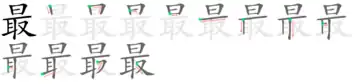
| Stroke order | |||
|---|---|---|---|
 | |||
Han character
最 (Kangxi radical 73, 曰+8, 12 strokes, cangjie input 日尸十水 (ASJE), four-corner 60147, composition ⿱⺜取 (CJKVHT))
Derived characters
References
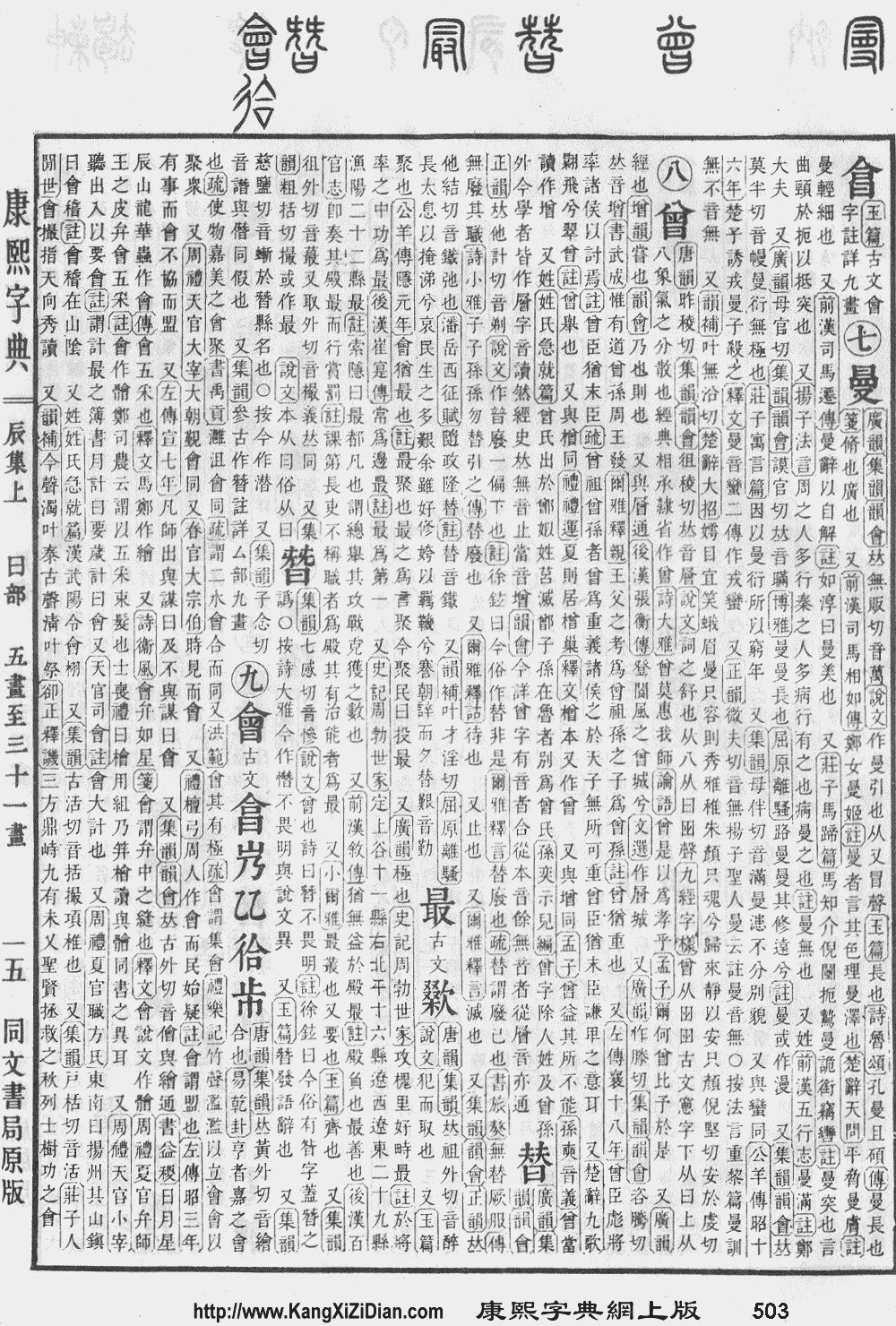
- Kangxi Dictionary: page 503, character 5
- Dai Kanwa Jiten: character 14301
- Dae Jaweon: page 877, character 4
- Hanyu Da Zidian (first edition): volume 2, page 1516, character 8
- Unihan data for U+6700
- Unihan data for U+2F8D4
Chinese
| trad. | 最 | |
|---|---|---|
| simp. # | 最 | |
| alternative forms | 冣 㝡 𥦡 𣤜 | |
Glyph origin
| Historical forms of the character 最 | ||
|---|---|---|
| Shang | Warring States | Shuowen Jiezi (compiled in Han) |
| Oracle bone script | Qin slip script | Small seal script |
 |
 |
 |
Characters in the same phonetic series (取) (Zhengzhang, 2003)
| Old Chinese | |
|---|---|
| 陬 | *ʔsloː, *ʔsru, *ʔslo |
| 棷 | *ʔsloː, *sʰloːʔ, *sloːʔ, *ʔsru |
| 掫 | *ʔsloː, *ʔsruʔ, *ʔslo |
| 緅 | *ʔsloː, *ʔsru, *slos |
| 趣 | *sʰloːʔ, *sʰlos |
| 取 | *sʰloːʔ, *sʰloʔ |
| 鯫 | *zloː, *zloːʔ, *sʰlo |
| 棸 | *rlu, *rluʔ, *ʔsru |
| 鄹 | *ʔsru, *zloʔ, *ljoːnʔ |
| 郰 | *ʔsru |
| 齱 | *ʔsru, *sʰroːɡ |
| 菆 | *ʔsru, *sʰros, *zloːn |
| 箃 | *ʔsru |
| 黀 | *ʔsru |
| 驟 | *zrus |
| 最 | *zloːds |
| 襊 | *sʰoːds, *sʰoːd |
| 蕞 | *zoːds |
| 嘬 | *sʰroːds |
| 諏 | *ʔslo |
| 娵 | *ʔslo |
| 娶 | *sʰloʔ, *sʰlos, *slo |
| 聚 | *zloʔ, *zlos |
| 埾 | *zlos |
| 藂 | *zloːŋ |
| 叢 | *zloːŋ |
| 繓 | *ʔsoːd |
| 撮 | *ʔsoːd, *sʰoːd |
Phono-semantic compound (形聲/形声, OC *zloːds) : semantic 冃 + phonetic 取 (OC *sʰloːʔ, *sʰloʔ).
Pronunciation
Definitions
最
Synonyms
Dialectal synonyms of 最 (“most”) [map]
Compounds
- 最上
- 最低工資/最低工资 (zuìdī gōngzī)
- 最佳 (zuìjiā)
- 最佳拍檔/最佳拍档
- 最先 (zuìxiān)
- 最初 (zuìchū)
- 最大公約數/最大公约数 (zuìdà gōngyuēshù)
- 最好 (zuìhǎo)
- 最小公倍數/最小公倍数 (zuìxiǎo gōngbèishù)
- 最少 (zuìshǎo)
- 最後/最后 (zuìhòu)
- 最後通牒/最后通牒 (zuìhòutōngdié)
- 最惠國待遇/最惠国待遇
- 最敬禮/最敬礼 (zuìjìnglǐ)
- 最為/最为 (zuìwéi)
- 最簡分數/最简分数 (zuìjiǎn fēnshù)
- 最終/最终 (zuìzhōng)
- 最近 (zuìjìn)
- 最速件
- 最適化/最适化 (zuìshìhuà)
- 最高法院 (zuìgāo fǎyuàn)
- 最高當局/最高当局
- 為善最樂/为善最乐 (wéishàn zuì lè)
Japanese
Readings
Compounds
Compounds of 最
- Common
- 最も (mottomo)
- 最愛 (saiai, “beloved”)
- 最悪 (saiaku, “the worst”)
- 最下 (saika, “the lowest”)
- 最強 (saikyō, “the strongest”)
- 最近 (saikin, “recently”)
- 最古 (saiko, “the oldest”)
- 最高 (saikō, “highest; supreme”)
- 最後 (saigo, “last”)
- 最期 (saigo, “one's last moment”)
- 最終 (saishū, “last; final; closing”)
- 最初 (saisho, “first; beginning”)
- 最小 (saishō, “the smallest”)
- 最新 (saishin, “latest; newest”)
- 最上 (saijō, “best”)
- 最善 (saizen, “the very best”)
- 最多 (saita, “the most”)
- 最短 (saitan, “the shortest”)
- 最大 (saidai, “the greatest”)
- 最中 (saichū, “middlemost”)
- 最長 (saichō)
- 最低 (saitei)
- 最適 (saiteki)
- 最良 (sairyō)
- 最早 (mohaya)
- 最寄り (moyori)
- 最恵国 (saikeikoku, “most favored nation”)
- 最盛期 (saiseiki, “golden age”)
- 最先端 (saisentan, “cutting-edge”)
- 最優遇 (saiyūgū)
- Uncommon
Names derived from 最
- Family names
- 最里 (Mori)
- Female given names[1]
- 最下 (Saika)
- 最子 (Saiko)
- 最澄 (Saichō)
- 最実 (Saimi), 最実 (Sami)
- 最美 (Saimi), 最美 (Sami)
- 最中 (Sanaka)
- 最莉 (Sari)
- 最愛 (Mana), 最愛 (Moa), 最愛 (Moai)
- 最燃 (Moe)
- 最可 (Moka)
- 最奈 (Mona)
- 最汝 (Mona)
- 最萌 (Momoe)
- 瑚最 (Komo)
- 夜最 (Yamo)
- 最央利 (Saori)
- 最鶴生 (Satsuki)
- 最登江 (Satoe)
- 沙妃最 (Sahimo)
- 最都子 (Motoko)
- 都最実 (Tomomi)
- Place names
- 最上 (Mogami)
Etymology 1
| Kanji in this term |
|---|
| 最 |
| かなめ Grade: 4 |
Etymology 2
| Kanji in this term |
|---|
| 最 |
| さい Grade: 4 |
References
- 女の子の名前辞書 - Name Catalogue (Girls only), Retrieved 6 May 2013
- 赤ちゃんの名前 好感度調査 - Baby Name Catalogue, Retrieved 6 May 2013
Korean
Vietnamese
This article is issued from Wiktionary. The text is licensed under Creative Commons - Attribution - Sharealike. Additional terms may apply for the media files.