至
| ||||||||
| ||||||||
| ||||||||
Translingual
| Stroke order | |||
|---|---|---|---|
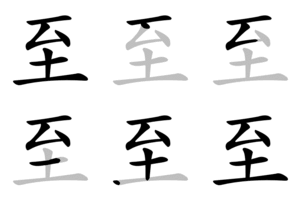 | |||
Han character
至 (Kangxi radical 133, 至+0, 6 strokes, cangjie input 一戈土 (MIG), four-corner 10104, composition ⿱𠫔土)
Derived characters
References
- Kangxi Dictionary: page 1001, character 11
- Dai Kanwa Jiten: character 30142
- Dae Jaweon: page 1457, character 17
- Hanyu Da Zidian (first edition): volume 4, page 2814, character 1
- Unihan data for U+81F3

Chinese
| simp. and trad. |
至 | |
|---|---|---|
Glyph origin
| Historical forms of the character 至 | |||
|---|---|---|---|
| Shang | Western Zhou | Shuowen Jiezi (compiled in Han) | Liushutong (compiled in Ming) |
| Oracle bone script | Bronze inscriptions | Small seal script | Transcribed ancient scripts |
 |
 |
 |
 |
Characters in the same phonetic series (至) (Zhengzhang, 2003)
| Old Chinese | |
|---|---|
| 致 | *tiɡs |
| 輊 | *tiɡs |
| 駤 | *tiɡs |
| 跮 | *tʰiɡs, *tʰiɡ |
| 荎 | *di, *diːɡ |
| 緻 | *diɡs |
| 至 | *tjiɡs |
| 鵄 | *tʰji |
| 胵 | *tʰji |
| 痓 | *tʰjiɡs |
| 咥 | *hriɡs, *tiːɡ, *diːɡ, *tʰiɡ |
| 窒 | *tiːɡ, *tiɡ |
| 蛭 | *tiːɡ, *tiɡ, *tjiɡ |
| 垤 | *diːɡ |
| 耋 | *diːɡ |
| 姪 | *diːɡ, *diɡ |
| 絰 | *diːɡ |
| 恎 | *diːɡ |
| 挃 | *tiɡ |
| 庢 | *tiɡ |
| 銍 | *tiɡ, *tjiɡ |
| 秷 | *tiɡ |
| 螲 | *tiɡ |
| 侄 | *diɡ, *tjiɡ |
| 桎 | *tjiɡ |
| 郅 | *tjiɡ |
| 晊 | *tjiɡ |
| 室 | *hliɡ |
Ideogram (指事) : an arrow stuck into the ground.
Pronunciation 1
Definitions
至
Synonyms
- (to arrive):
- (most):
Dialectal synonyms of 最 (“most”) [map]
- (only then):
Dialectal synonyms of 才 (“only after; only then; not ... until”) [map]
| Variety | Location | Words |
|---|---|---|
| Formal (Written Standard Chinese) | 才2, 再, 方, 始, 方才 | |
| Mandarin | Taiwan | 才2 |
| Singapore | 才2 | |
| Cantonese | Guangzhou | 先, 至, 先至 |
| Hong Kong | 先, 至, 先至 | |
| Hakka | Meixian | 正 |
| Southern Min | Xiamen | 才3 |
| Quanzhou | 才3 | |
| Zhangzhou | 才3 | |
| Singapore (Hokkien) | 才3 | |
| Manila (Hokkien) | 才3 | |
| Shantou | 正 | |
| Singapore (Teochew) | 正 | |
| Wu | Shanghai | 再, 才2 |
| Suzhou | 再 | |
| Xiang | Changsha | 才至 |
Compounds
- 一片至誠/一片至诚
- 一秉至公
- 一至於此/一至于此
- 不移至理
- 不至於/不至于 (bùzhìyú)
- 乃至 (nǎizhì)
- 事親至孝/事亲至孝
- 人跡罕至/人迹罕至 (rénjìhǎnzhì)
- 仁至義盡/仁至义尽 (rénzhìyìjìn)
- 以至 (yǐzhì)
- 充類至盡/充类至尽
- 冬至 (dōngzhì)
- 分至 (fēnzhì)
- 切至
- 分至點/分至点
- 刎頸至交/刎颈至交
- 南至
- 厥功至偉/厥功至伟
- 周至 (Zhōuzhì)
- 四至
- 四至兒/四至儿
- 四至八道
- 夏至 (xiàzhì)
- 夏至線/夏至线 (Xiàzhìxiàn)
- 夏至點/夏至点
- 大公至正
- 大至
- 如獲至寶/如获至宝 (rúhuòzhìbǎo)
- 家至人說/家至人说
- 家至戶曉/家至户晓
- 實至名歸/实至名归 (shízhìmíngguī)
- 小至
- 尤至
- 後發先至/后发先至
- 從古至今/从古至今
- 從始至終/从始至终
- 從頭至尾/从头至尾
- 心靈福至/心灵福至
- 悲喜交至
- 情至意盡/情至意尽
- 懇至/恳至
- 截至 (jiézhì)
- 投至
- 投至得
- 推崇備至/推崇备至 (tuīchóngbèizhì)
- 排空而至
- 接踵而至 (jiēzhǒng'érzhì)
- 摩頂至足/摩顶至足
- 摩頂至踵/摩顶至踵
- 日至
- 暴至
- 朝發夕至/朝发夕至 (zhāofāxīzhì)
- 止於至善/止于至善 (zhǐyúzhìshàn)
- 比至
- 沒摺至/没折至
- 沓至
- 滔滔而至
- 漸至佳境/渐至佳境
- 無微不至/无微不至 (wúwēibùzhì)
- 無所不至/无所不至 (wúsuǒbùzhì)
- 物至則反/物至则反
- 甚至 (shènzhì)
- 磨頂至踵/磨顶至踵
- 禍不妄至/祸不妄至
- 福無雙至/福无双至
- 福至心靈/福至心灵
- 積金至斗
- 紛至沓來/纷至沓来 (fēnzhìtàlái)
- 累土至山
- 繼踵而至/继踵而至
- 群賢畢至/群贤毕至 (qúnxiánbìzhì)
- 自始至終/自始至终 (zìshǐzhìzhōng)
- 至上 (zhìshàng)
- 至交 (zhìjiāo)
- 至交契友
- 至人 (zhìrén)
- 至人無夢/至人无梦
- 至仁
- 至今 (zhìjīn)
- 至信
- 至公
- 至公無私/至公无私
- 至公至明
- 至再至三
- 至友 (zhìyǒu)
- 至和
- 至善 (zhìshàn)
- 至善至美
- 至多 (zhìduō)
- 至大
- 至好 (zhìhǎo)
- 至如
- 至妙
- 至孝 (zhìxiào)
- 至寶/至宝 (zhìbǎo)
- 至尊 (zhìzūn)
- 至尊至貴/至尊至贵
- 至少 (zhìshǎo)
- 至德 (zhìdé)
- 至心
- 至忠
- 至急 (zhìjí)
- 至性
- 至情 (zhìqíng)
- 至感
- 至意
- 至愚極陋/至愚极陋
- 至意誠心/至意诚心
- 至敬無文/至敬无文
- 至於/至于 (zhìyú)
- 至日 (zhìrì)
- 至明
- 至材
- 至極/至极 (zhìjí)
- 至樂/至乐
- 至死 (zhìsǐ)
- 至死不屈
- 至死不悟
- 至死不泯
- 至死方休
- 至治
- 至理 (zhìlǐ)
- 至理名言
- 至當/至当
- 至節/至节
- 至終/至终 (zhìzhōng)
- 至聖/至圣
- 至聖先師/至圣先师
- 至若 (zhìruò)
- 至虛/至虚
- 至行
- 至要
- 至親/至亲 (zhìqīn)
- 至親兄弟/至亲兄弟
- 至親好友/至亲好友
- 至親骨肉/至亲骨肉
- 至言 (zhìyán)
- 至誠/至诚 (zhìchéng)
- 至誠無昧/至诚无昧
- 至誠高節/至诚高节
- 至賢/至贤
- 至道
- 至靈/至灵
- 至高無上/至高无上 (zhìgāowúshàng)
- 臻至
- 臻臻至至
- 興之所至/兴之所至 (xìngzhīsuǒzhì)
- 蜂擁而至/蜂拥而至 (fēngyǒng'érzhì)
- 賓至如歸/宾至如归 (bīnzhìrúguī)
- 跌至谷底
- 金石至交
- 長至/长至
- 關懷備至/关怀备至 (guānhuáibèizhì)
- 隨踵而至/随踵而至
- 須至/须至
- 飆舉電至/飙举电至
- 飲至/饮至
- 骨肉至親/骨肉至亲
- 麇至
- 麇至沓來/麇至沓来
Pronunciation 2
Definitions
至
- Only used in 單至/单至.
References
- “至”, in 漢語多功能字庫 (Multi-function Chinese Character Database), 香港中文大學 (the Chinese University of Hong Kong), 2014–
Japanese
Korean
Hanja
至 • (ji) (hangeul 지, revised ji, McCune–Reischauer chi, Yale ci)
- This term needs a translation to English. Please help out and add a translation, then remove the text
{{rfdef}}.
Vietnamese
This article is issued from Wiktionary. The text is licensed under Creative Commons - Attribution - Sharealike. Additional terms may apply for the media files.