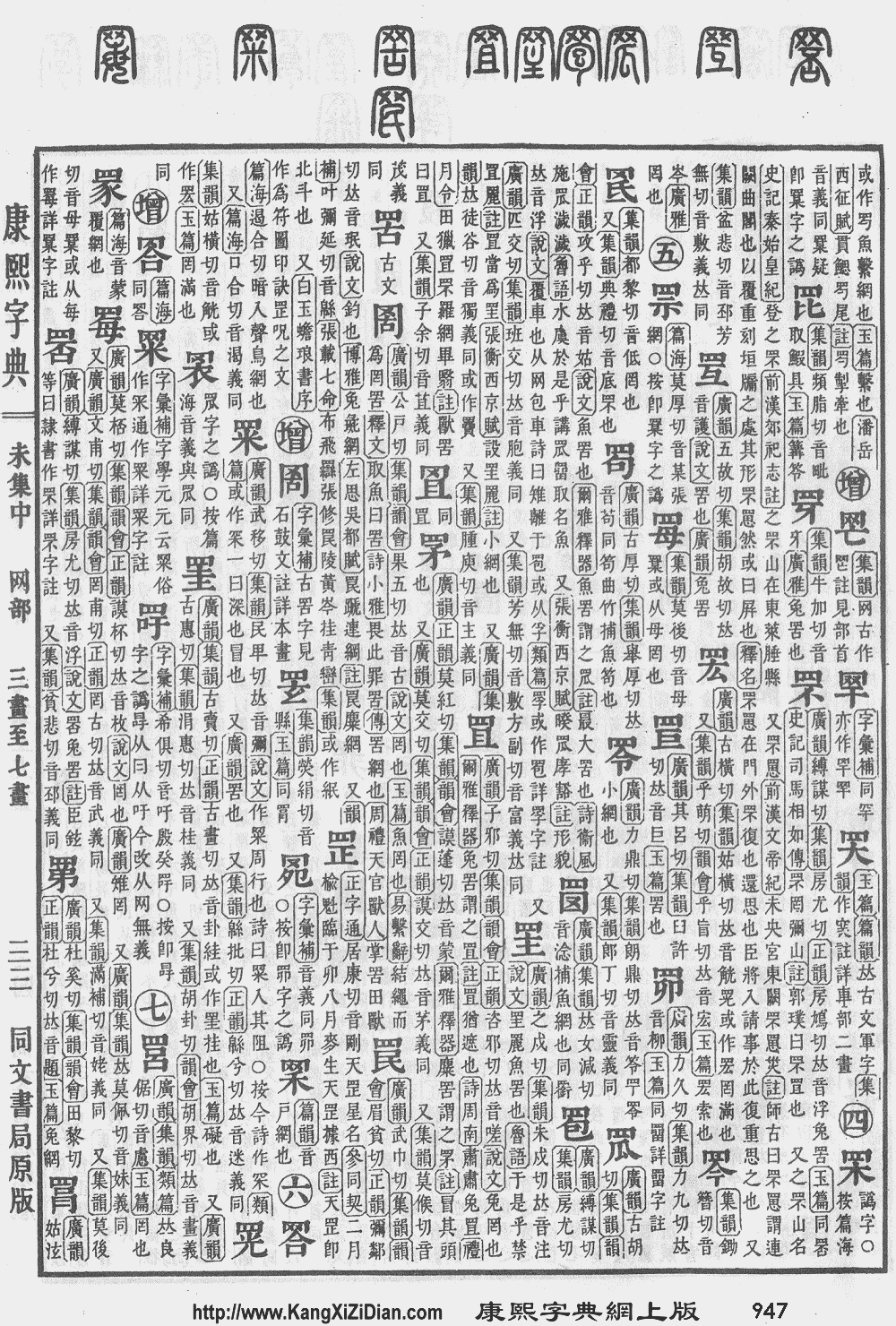
眔

眔 U+7714, 眔
CJK UNIFIED IDEOGRAPH-7714
← 眓
[U+7713]
CJK Unified Ideographs 眕 →
[U+7715]

Translingual

Han character

眔 (Kangxi radical 109, 目+5, 10 strokes, cangjie input 田中水 (WLE) or 田中火火 (WLFF), composition ⿱罒氺)

  1. to wink, glance

Derived characters

  • 䤽, 鰥(鳏), 遝, 䳴, 瘝, 褱, 㱎, 𣗶, 𥉀, 𥎅, 𦑶, 𧤩, 𧪟, 𡎯, 𣣴, 𣯉, 𦑲, 𩀚, 𦵺, 𥊽
  • 𰁞, 𰍓

References

Chinese

simp. and trad.
眔
alternative forms 𥄳

Glyph origin

Pictogram (象形) : an eye (目) with teardrops (now written similar to 水).

Pronunciation


Rime
Character 眔
Reading # 1/1
Initial (聲) 定 (7)
Final (韻) 覃 (160)
Tone (調) Checked (Ø)
Openness (開合) Open
Division (等) I
Fanqie 徒合切
Baxter dop
Reconstructions
Zhengzhang
Shangfang
/dʌp̚/
Pan
Wuyun
/dəp̚/
Shao
Rongfen
/dɒp̚/
Edwin
Pulleyblank
/dəp̚/
Li
Rong
/dᴀp̚/
Wang
Li
/dɒp̚/
Bernard
Karlgren
/dʱăp̚/
Expected
Mandarin
Reflex
dá
Expected
Cantonese
Reflex
daap6
Baxter–Sagart system 1.1 (2014)
Character 眔
Reading # 1/1
Modern
Beijing
(Pinyin)
tà
Middle
Chinese
‹ dop ›
Old
Chinese
/*m-rˁəp/
English reach to; and

Notes for Old Chinese notations in the Baxter–Sagart system:

* Parentheses "()" indicate uncertain presence;
* Square brackets "[]" indicate uncertain identity, e.g. *[t] as coda may in fact be *-t or *-p;
* Angle brackets "<>" indicate infix;
* Hyphen "-" indicates morpheme boundary;

* Period "." indicates syllable boundary.
Zhengzhang system (2003)
Character 眔
Reading # 1/1
No. 1954
Phonetic
component
眔
Rime
group
緝
Rime
subdivision
3
Corresponding
MC rime
Old
Chinese
/*l'uːb/
Notes 甲文象目流淚,
爲涙初文
(高鴻縉說)

Definitions

眔

  1. (obsolete) to squint
  2. † and

References

Japanese

Kanji

眔

(uncommon “Hyōgai” kanji)

  1. masculinity

Readings

  • On (unclassified): とう (tō); どう (dō)
This article is issued from Wiktionary. The text is licensed under Creative Commons - Attribution - Sharealike. Additional terms may apply for the media files.