流
| ||||||||
| ||||||||
 | ||||||||
| ||||||||
Translingual
| Stroke order | |||
Mainland China, Japan and Korea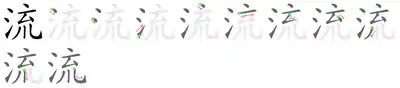 | |||
| Stroke order | |||
Taiwan | |||
Alternative forms
- In mainland China (based on Xin Zixing character form), Japanese kanji, Korean hanja and Vietnamese Nôm, the upper right component 𠫓 is written ⿱亠厶 (4 strokes) while the bottom right stroke is written 乚 with an ending hook which is the historical form found in the Kangxi Dictionary.
- In Taiwan and Hong Kong (based on Big5 character form), the upper right component 𠫓 is written ⿻一厶 (3 strokes) while the bottom right stroke is written ㇄ without the ending hook.
- Three CJK compatibility ideographs exist for this character:
U+F9CAcorresponds to a duplicate character found in South Korea's KS X 1001 character set.U+FA97corresponds to an alternative form used in North Korea which is similar to the character used in Taiwan/Hong Kong.U+2F902corresponds to an alternative form used in Taiwan which is similar to the character used in mainland China/Japan/Korea but the bottom right stroke is written ㇄ without the ending hook.
Han character
流 (Kangxi radical 85, 水+7, 9 strokes in traditional Chinese, 10 strokes in mainland China and Japanese and Korean, cangjie input 水卜戈山 (EYIU), four-corner 34113, composition ⿰氵㐬(GJKV or U+F9CA or U+2F902) or ⿰氵⿱𠫓⿲丿丨㇄(HT or U+FA97))
Descendants
- ル (Katakana character derived from Man'yōgana)
References
- Kangxi Dictionary: page 623, character 4
- Dai Kanwa Jiten: character 17572
- Dae Jaweon: page 1019, character 7
- Hanyu Da Zidian (first edition): volume 3, page 1631, character 12
- Unihan data for U+6D41
- Unihan data for U+F9CA
- Unihan data for U+FA97
- Unihan data for U+2F902

Chinese
| trad. | 流 | |
|---|---|---|
| simp. # | 流 | |
| alternative forms | ||
Glyph origin
Characters in the same phonetic series (流) (Zhengzhang, 2003)
Phono-semantic compound (形聲/形声, OC *ru) : semantic 水 (“water”) + phonetic 㐬 ().
Pronunciation
Definitions
流
- to flow
- 地震,梁山崩,壅河,三日不流。 [Classical Chinese, trad. and simp.]
- From: The Luxuriant Dew of the Spring and Autumn Annals
- Dìzhèn, Liángshān bēng, yōnghé, sān rì bù liú. [Pinyin]
- The earth trembled, and Mount Liang collapsed. It blocked a river which did not flow for three days.
- to drift; to wander
- class; grade
- 一流 ― yīliú ― first class; top grade
- (of water, electricity, other fluids) current; flow; stream
- to spread; to scatter; to disseminate
- (physics) Short for 流明 (liúmíng, “lumen”).
- (mathematics) flow
- (computing) stream
- (Cantonese, Hakka) of poor quality
- (Cantonese) fake; ingenuine
Compounds
- 一流
- 三教九流 (sānjiàojiǔliú)
- 上流 (shàngliú)
- 下流 (xiàliú)
- 三流 (sānliú)
- 下流社會/下流社会
- 上流頭/上流头
- 三通四流
- 不入流
- 不流
- 不流世俗
- 中流 (zhōngliú)
- 中流擊楫/中流击楫
- 中流砥柱 (zhōngliúdǐzhù)
- 主流 (zhǔliú)
- 乘流
- 九流 (jiǔliú)
- 九流三教 (jiǔliúsānjiào)
- 九流十家
- 九流百家
- 亂氣流/乱气流
- 亂流/乱流 (luànliú)
- 二流子
- 交流 (jiāoliú)
- 交通流量
- 人工流產/人工流产 (réngōng liúchǎn)
- 人才外流 (réncái wàiliú)
- 人欲橫流/人欲横流
- 付之東流/付之东流 (fùzhīdōngliú)
- 付之流水
- 付諸東流/付诸东流 (fùzhūdōngliú)
- 付諸流水/付诸流水
- 伏流 (fúliú)
- 依流平進/依流平进
- 俗流
- 倒流 (dàoliú)
- 倒流刺
- 倒背如流 (dàobèirúliú)
- 偏流
- 傾斜流/倾斜流
- 傳流/传流
- 入流 (rùliú)
- 內流區/内流区
- 內流河/内流河 (nèiliúhé)
- 冷平流
- 分流 (fēnliú)
- 剖決如流/剖决如流
- 力爭上流/力争上流
- 功流萬世/功流万世
- 勇退激流
- 勝流/胜流
- 匯流/汇流 (huìliú)
- 匯流排/汇流排 (huìliúpái)
- 千古流傳/千古流传
- 半流體/半流体 (bànliútǐ)
- 合流 (héliú)
- 名流 (míngliú)
- 同流合汙/同流合污 (tóngliúhéwū)
- 吹送流
- 周流 (zhōuliú)
- 品流
- 嘎巴流星
- 噴射氣流/喷射气流
- 回流 (huíliú)
- 回西流
- 土壤細流/土壤细流
- 土石流 (tǔshíliú)
- 外流 (wàiliú)
- 外流區/外流区
- 外流河
- 大步流星 (dàbùliúxīng)
- 大氣環流/大气环流
- 大流士 (Dàliúshì)
- 大流行病 (dà liúxíngbìng)
- 奔流 (bēnliú)
- 奔流不息
- 女流 (nǚliú)
- 安全電流/安全电流
- 宣流
- 寒流 (hánliú)
- 射流 (shèliú)
- 對流/对流 (duìliú)
- 對流層/对流层 (duìliúcéng)
- 對流雨/对流雨
- 對答如流/对答如流 (duìdárúliú)
- 導流板/导流板
- 小原流
- 尿流屁滾/尿流屁滚
- 屁滾尿流/屁滚尿流 (pìgǔnniàoliú)
- 屎滾尿流/屎滚尿流 (shǐgǔnniàoliú)
- 層流/层流 (céngliú)
- 岔流 (chàliú)
- 川流
- 川流不息 (chuānliúbùxī)
- 工藝雜流/工艺杂流
- 巨流 (jùliú)
- 巧言如流 (qiǎoyán rú liú)
- 平流層/平流层 (píngliúcéng)
- 平流緩進/平流缓进
- 平流霧/平流雾
- 幹流/干流 (gànliú)
- 幽流
- 引流 (yǐnliú)
- 彤管流芳
- 徑流/径流
- 從令如流/从令如流
- 從善如流/从善如流 (cóngshànrúliú)
- 從善若流/从善若流
- 從流/从流
- 御溝流葉/御沟流叶
- 從諫如流/从谏如流
- 循流
- 德厚流光
- 德流子孫/德流子孙
- 急景流年
- 急流 (jíliú)
- 急流勇退 (jíliúyǒngtuì)
- 感激流涕
- 意識流/意识流 (yìshíliú)
- 慟哭流涕/恸哭流涕
- 慶流子孫/庆流子孙
- 應對如流/应对如流
- 應答如流/应答如流
- 截斷眾流/截断众流
- 截流
- 截流管
- 投鞭斷流/投鞭断流
- 握炭流湯/握炭流汤
- 播流
- 擊楫中流/击楫中流
- 擾流器/扰流器
- 支流 (zhīliú)
- 改土歸流/改土归流 (gǎitǔguīliú)
- 放任自流
- 放飯流歠/放饭流歠
- 整流 (zhěngliú)
- 整流器 (zhěngliúqì)
- 整流罩
- 文化交流 (wénhuà jiāoliú)
- 新潮流
- 斷梗流萍/断梗流萍
- 斷決如流/断决如流
- 日月如流
- 星流
- 時流/时流 (shíliú)
- 晴空亂流/晴空乱流
- 暗流 (ànliú)
- 暖流 (nuǎnliú)
- 曲水流觴/曲水流觞
- 曲流
- 木牛流馬/木牛流马 (mùniú liúmǎ)
- 未入流
- 末流 (mòliú)
- 本流
- 枕流漱石
- 枕石漱流 (zhěnshíshùliú)
- 棲流所/栖流所
- 樛流
- 橫流/横流 (héngliú)
- 檢流計/检流计 (jiǎnliújì)
- 歲月如流/岁月如流
- 歸流/归流
- 氣流/气流 (qìliú)
- 水射流
- 水流 (shuǐliú)
- 水流花謝/水流花谢
- 池坊流
- 汊流 (chàliú)
- 江流
- 汗流如雨
- 汗流洽背
- 汗流浹背/汗流浃背 (hànliújiābèi)
- 決斷如流/决断如流
- 沖流/冲流
- 汩流
- 沿岸流
- 波流
- 河流 (héliú)
- 泥流 (níliú)
- 沿流溯源
- 沿流討源/沿流讨源
- 泥石流 (níshíliú)
- 波迸流移
- 流丟/流丢
- 流丸
- 流亞/流亚 (liúyà)
- 流亡 (liúwáng)
- 流人 (liúrén)
- 流俗 (liúsú)
- 流傳/流传 (liúchuán)
- 流傳於世/流传于世
- 流光
- 流光瞬息
- 流刑 (liúxíng)
- 流別/流别
- 流利 (liúlì)
- 流刺網/流刺网
- 流動/流动 (liúdòng)
- 流勢/流势
- 流口水 (liú kǒushuǐ)
- 流口轍/流口辙
- 流向 (liúxiàng)
- 流和心性
- 流品
- 流域 (liúyù)
- 流外
- 流失 (liúshī)
- 流失生 (liúshīshēng)
- 流妓
- 流子
- 流宕
- 流宕忘反
- 流寇 (liúkòu)
- 流寓 (liúyù)
- 流峪 (Liúyù)
- 流布 (liúbù)
- 流年 (liúnián)
- 流年不利
- 流年帳/流年帐
- 流弊 (liúbì)
- 流彈/流弹 (liúdàn)
- 流形 (liúxíng)
- 流徙 (liúxǐ)
- 流徵/流征
- 流感 (liúgǎn)
- 流憩
- 流播 (liúbō)
- 流放 (liúfàng)
- 流散 (liúsàn)
- 流於/流于
- 流於形式/流于形式
- 流易
- 流明 (liúmíng)
- 流星 (liúxīng)
- 流景
- 流暢/流畅 (liúchàng)
- 流會/流会 (liúhuì)
- 流棍
- 流標/流标 (liúbiāo)
- 流毒 (liúdú)
- 流民 (liúmín)
- 流氓 (liúmáng)
- 流氣/流气 (liúqì)
- 流水 (liúshuǐ)
- 活水源流
- 流汗 (liúhàn)
- 流汗浹背/流汗浃背
- 流沙 (liúshā)
- 流沙墜簡/流沙坠简
- 流波
- 流泉 (liúquán)
- 流沫
- 流注
- 流沿兒/流沿儿
- 洋流 (yángliú)
- 洪流 (hóngliú)
- 流派 (liúpài)
- 流涎
- 流涕 (liútì)
- 流浪 (liúlàng)
- 流涎症
- 流淚/流泪 (liúlèi)
- 流淌 (liútǎng)
- 流湎
- 流滑
- 流溢
- 流滯/流滞
- 流漫
- 流澌 (liúsī)
- 流澤/流泽
- 流瀉/流泻
- 流灑/流洒
- 流火
- 流理臺/流理台
- 流產/流产 (liúchǎn)
- 流當品/流当品
- 流目
- 流盼
- 流眄 (liúmiǎn)
- 流矢
- 流移 (liúyí)
- 流程 (liúchéng)
- 流程圖/流程图 (liúchéngtú)
- 流竄/流窜 (liúcuàn)
- 流籠/流笼 (liúlóng)
- 流精 (liújīng)
- 流紋岩/流纹岩
- 流網/流网
- 流線/流线 (liúxiàn)
- 流線型/流线型 (liúxiànxíng)
- 流腦/流脑 (liúnǎo)
- 流芳 (liúfāng)
- 流落 (liúluò)
- 流蕩/流荡 (liúdàng)
- 流蘇/流苏 (liúsū)
- 流蘇帳/流苏帐
- 流蘇髻/流苏髻
- 流螢/流萤 (liúyíng)
- 流血 (liúxuè)
- 流行 (liúxíng)
- 流衍
- 流裡流氣/流里流气
- 流覽/流览 (liúlǎn)
- 流觴/流觞
- 流言 (liúyán)
- 流議/流议
- 流變/流变 (liúbiàn)
- 流貫/流贯
- 流賊/流贼
- 流質/流质 (liúzhì)
- 流輩/流辈
- 流轉/流转 (liúzhuǎn)
- 流送
- 流通 (liútōng)
- 流連/流连 (liúlián)
- 流逐
- 流逝 (liúshì)
- 流速 (liúsù)
- 流遞/流递
- 流配
- 流量 (liúliàng)
- 流金
- 流離/流离 (liúlí)
- 流雲/流云
- 流電/流电
- 流霞
- 流露 (liúlù)
- 流響/流响
- 流風/流风
- 流食 (liúshí)
- 流體/流体 (liútǐ)
- 流魚出聽/流鱼出听
- 流鶯/流莺 (liúyīng)
- 流麗/流丽 (liúlì)
- 流黃/流黄 (liúhuáng)
- 海岸流
- 涕泗交流
- 涕泗橫流/涕泗横流 (tìsì héngliú)
- 涓流 (juānliú)
- 涇流/泾流
- 涌流 (yǒngliú)
- 海流 (hǎiliú)
- 海洋放流
- 海洋環流/海洋环流
- 海流計/海流计
- 涕淚交流/涕泪交流
- 浮翠流丹
- 淑教流徽
- 清流 (qīngliú)
- 淚流滿面/泪流满面 (lèiliúmǎnmiàn)
- 清濁同流/清浊同流
- 淵遠流長/渊远流长
- 湧升流
- 渦流/涡流 (wōliú)
- 湍流 (tuānliú)
- 滑流
- 溢流
- 源流 (yuánliú)
- 溪流 (xīliú)
- 溯流徂源
- 溯流從源/溯流从源
- 滑流水
- 溯流求源
- 源流考
- 滄海橫流/沧海横流
- 源清流清
- 源清流淨/源清流净
- 源清流潔/源清流洁
- 源深流長/源深流长
- 溯源窮流/溯源穷流
- 源遠流長/源远流长 (yuányuǎnliúcháng)
- 漂流 (piāoliú)
- 滴流
- 滿流/满流
- 漫流
- 滴流撲/滴流扑
- 漱流枕石
- 滴流流
- 漱石枕流
- 潮流 (cháoliú)
- 潛流/潜流 (qiánliú)
- 激流 (jīliú)
- 濁流/浊流 (zhuóliú)
- 灣流/湾流 (Wānliú)
- 火山碎屑流 (huǒshān suìxiè liú)
- 火耕流種/火耕流种
- 焦金流石
- 熱流/热流 (rèliú)
- 燋金流石
- 爍石流金/烁石流金
- 物流 (wùliú)
- 玄流
- 環流/环流 (huánliú)
- 甘處下流/甘处下流
- 異重流/异重流
- 痛哭流涕 (tòngkūliútì)
- 百世流芳
- 皮破血流
- 盡付東流/尽付东流
- 目無流視/目无流视
- 直流電/直流电 (zhíliúdiàn)
- 直流馬達/直流马达
- 眼若流星 (yǎnruòliúxīng)
- 砥柱中流
- 破爛流丟/破烂流丢
- 碌碌庸流
- 福流
- 萬古流芳/万古流芳
- 萬壑爭流/万壑争流
- 積厚流光/积厚流光
- 窮源溯流/穷源溯流
- 第一流
- 筆翰如流/笔翰如流
- 節流/节流
- 素流
- 納流/纳流
- 納諫如流/纳谏如流
- 素門凡流/素门凡流
- 細水長流/细水长流 (xìshuǐchángliú)
- 細流/细流 (xìliú)
- 絕流/绝流
- 緇流/缁流
- 羽流
- 習流/习流
- 翦枝竭流
- 自流 (zìliú)
- 自流井 (zìliújǐng)
- 自流灌溉
- 菩提流支
- 落花流水 (luòhuāliúshuǐ)
- 蜚短流長/蜚短流长 (fēiduǎnliúcháng)
- 血流如注 (xuèliúrúzhù)
- 血流成河 (xuèliúchénghé)
- 血流成渠
- 血流漂杵 (xuèliúpiāochǔ)
- 行雲流水/行云流水 (xíngyúnliúshuǐ)
- 表面流
- 西流河 (Xīliúhé)
- 西皮流水
- 談吐如流/谈吐如流
- 諫爭如流/谏争如流
- 謬種流傳/谬种流传
- 變流器/变流器
- 貨暢其流/货畅其流
- 赤道洋流
- 赫赫名流
- 車流/车流 (chēliú)
- 軟流圈/软流圈
- 輪流/轮流 (lúnliú)
- 輩流/辈流
- 迅流
- 逆流 (nìliú)
- 迸流 (bèngliú)
- 送眼流眉
- 逕流/迳流
- 遞流/递流
- 遷流/迁流
- 邁越常流/迈越常流
- 配流 (pèiliú)
- 鋒發韻流/锋发韵流
- 長流/长流
- 開源節流/开源节流
- 隨大流/随大流 (suídàliú)
- 隨波漂流/随波漂流
- 隨波逐流/随波逐流 (suíbōzhúliú)
- 雜流/杂流
- 電流/电流 (diànliú)
- 青史流芳
- 順大流/顺大流 (shùndàliú)
- 順流/顺流 (shùnliú)
- 頭破血流/头破血流 (tóupòxuèliú)
- 顛沛流離/颠沛流离 (diānpèiliúlí)
- 風流/风流 (fēngliú)
- 飄流/飘流 (piāoliú)
- 飆流/飙流
- 飛流/飞流
- 飛流短長/飞流短长
- 飛短流長/飞短流长
- 飲流懷源/饮流怀源
- 飲流霞/饮流霞
- 餘韻流風/余韵流风
- 香象絕流/香象绝流
- 馬流/马流
- 駛流/驶流
- 高壓迴流/高压回流
- 高山流水 (gāoshānliúshuǐ)
- 高鳳流麥/高凤流麦
- 麻流點/麻流点
- 黃流/黄流
- 黑汗白流
Japanese
| Shinjitai | 流 | |
| Kyūjitai [1][2][3] |
流󠄂 流+ 󠄂?(Hanyo-Denshi) (Moji_Joho) |
|
| The displayed kanji may be different from the image due to your environment. See here for details. | ||
Readings
Compounds
Etymology
From Middle Chinese 流 (MC ljuw).
Noun
Derived terms
Derived terms
- 流亜 (ryūa)
- 流圧 (ryūatsu)
- 流移 (ryūi)
- 流域 (ryūiki)
- 流溢 (ryūitsu)
- 流淫 (ryūin)
- 流雲 (ryūun)
- 流盈 (ryūei)
- 流英 (ryūei)
- 流裔 (ryūei)
- 流易 (ryūeki)
- 流越 (ryūetsu)
- 流衍 (ryūen)
- 流鶯 (ryūō)
- 流霞 (ryūka)
- 流下 (ryūka)
- 流化 (ryūka)
- 流火 (ryūka)
- 流丐 (ryūkai)
- 流汗 (ryūkan)
- 流㵎 (ryūkan)
- 流観 (ryūkan)
- 流丸 (ryūgan)
- 流棄 (ryūki)
- 流暉 (ryūki)
- 流綺 (ryūki)
- 流議 (ryūgi)
- 流響 (ryūkyō)
- 流寓 (ryūgū)
- 流刑 (ryūkei)
- 流形 (ryūkei)
- 流蛍 (ryūkei)
- 流憩 (ryūkei)
- 流景 (ryūkei)
- 流谿 (ryūkei)
- 流血 (ryūketsu)
- 流言 (ryūgen)
- 流戸 (ryūko)
- 流伍 (ryūgo)
- 流語 (ryūgo)
- 流荒 (ryūkō)
- 流寇 (ryūkō)
- 流行 (ryūkō)
- 流光 (ryūkō)
- 流黄 (ryūkō)
- 流魂 (ryūkon)
- 流沙 (ryūsa)
- 流槎 (ryūsa)
- 流灑 (ryūsai)
- 流罪 (ryūzai)
- 流散 (ryūsan)
- 流霰 (ryūsan)
- 流竄 (ryūzan)
- 流澌 (ryūshi)
- 流尸 (ryūshi)
- 流矢 (ryūshi)
- 流死 (ryūshi)
- 流巵 (ryūshi)
- 流失 (ryūshitsu)
- 流出 (ryūshutsu)
- 流腫 (ryūshō)
- 流觴 (ryūshō)
- 流冗 (ryūjō)
- 流心 (ryūshin)
- 流塵 (ryūjin)
- 流人 (ryūjin)
- 流水 (ryūsui)
- 流彗 (ryūsui)
- 流声 (ryūsei)
- 流星 (ryūsei)
- 流歠 (ryūsetsu)
- 流泄 (ryūsetsu)
- 流宣 (ryūsen)
- 流羨 (ryūsen)
- 流霰 (ryūsen)
- 流涎 (ryūzen)
- 流箭 (ryūzen)
- 流漸 (ryūzen)
- 流蘇 (ryūso)
- 流素 (ryūso)
- 流霜 (ryūsō)
- 流俗 (ryūzoku)
- 流賊 (ryūzoku)
- 流沢 (ryūtaku)
- 流湍 (ryūtan)
- 流弾 (ryūdan)
- 流注 (ryūchū)
- 流黜 (ryūchutsu)
- 流潮 (ryūchō)
- 流暢 (ryūchō)
- 流通 (ryūtsū)
- 流涕 (ryūtei)
- 流伝 (ryūden)
- 流宕 (ryūtō)
- 流蕩 (ryūtō)
- 流動 (ryūdō)
- 流遁 (ryūton)
- 流遯 (ryūton)
- 流年 (ryūnen)
- 流波 (ryūha)
- 流派 (ryūha)
- 流播 (ryūha)
- 流輩 (ryūhai)
- 流杯 (ryūhai)
- 流泊 (ryūhaku)
- 流盼 (ryūhan)
- 流萍 (ryūhyō)
- 流漂 (ryūhyō)
- 流品 (ryūhin)
- 流普 (ryūfu)
- 流風 (ryūfū)
- 流氛 (ryūfun)
- 流聞 (ryūbun)
- 流弊 (ryūhei)
- 流辟 (ryūheki)
- 流僻 (ryūheki)
- 流別 (ryūbetsu)
- 流変 (ryūhen)
- 流便 (ryūben)
- 流眄 (ryūben)
- 流逋 (ryūho)
- 流芳 (ryūhō)
- 流氓 (ryūbō)
- 流亡 (ryūbō)
- 流邁 (ryūmai)
- 流沫 (ryūmatsu)
- 流漫 (ryūman)
- 流民 (ryūmin)
- 流湎 (ryūmen)
- 流目 (ryūmoku)
- 流庸 (ryūyō)
- 流傭 (ryūyō)
- 流耀 (ryūyō)
- 流落 (ryūraku)
- 流覧 (ryūran)
- 流乱 (ryūran)
- 流離 (ryūri)
- 流亮 (ryūryō)
- 流涙 (ryūrui)
- 流麗 (ryūrei)
- 流例 (ryūrei)
- 流隷 (ryūrei)
- 流連 (ryūren)
- 流漣 (ryūren)
- 流潦 (ryūrō)
- 亜流 (aryū)
- 斡流 (atsuryū)
- 暗流 (anryū)
- 一流 (ichiryū)
- 運流 (unryū)
- 横流 (ōryū)
- 遠流 (enryū)
- 下流 (karyū)
- 化流 (karyū)
- 河流 (karyū)
- 雅流 (garyū)
- 回流 (kairyū), 廻流 (kairyū)
- 海流 (kairyū)
- 貫流 (kanryū)
- 寒流 (kanryū)
- 還流 (kanryū)
- 灌流 (kanryū)
- 気流 (kiryū)
- 逆流 (gyakuryū)
- 九流 (kyūryū)
- 旧流 (kyūryū)
- 急流 (kyūryū)
- 驚流 (kyōryū)
- 渓流 (keiryū)
- 激流 (gekiryū)
- 決流 (ketsuryū)
- 涓流 (kenryū)
- 畎流 (kenryū)
- 源流 (genryū)
- 古流 (koryū)
- 涸流 (koryū)
- 交流 (kōryū)
- 江流 (kōryū)
- 鴻流 (kōryū)
- 合流 (gōryū)
- 才流 (sairyū)
- 細流 (sairyū)
- 雑流 (zatsuryū)
- 士流 (shiryū)
- 支流 (shiryū)
- 緇流 (shiryū)
- 駛流 (shiryū)
- 自流 (jiryū)
- 時流 (jiryū)
- 主流 (shuryū)
- 儒流 (juryū)
- 舟流 (shūryū)
- 周流 (shūryū)
- 習流 (shūryū)
- 衆流 (shūryū)
- 春流 (shunryū)
- 順流 (junryū)
- 諸流 (shoryū)
- 女流 (joryū)
- 湘流 (shōryū)
- 勝流 (shōryū)
- 上流 (jōryū)
- 乗流 (jōryū)
- 人流 (jinryū)
- 迅流 (jinryū)
- 水流 (suiryū)
- 随流 (zuiryū)
- 西流 (seiryū)
- 清流 (seiryū)
- 儕流 (seiryū)
- 勢流 (seiryū)
- 絶流 (zetsuryū)
- 川流 (senryū)
- 泉流 (senryū)
- 穿流 (senryū)
- 旋流 (senryū)
- 潺流 (senryū)
- 双流 (sōryū)
- 俗流 (zokuryū)
- 他流 (taryū)
- 対流 (tairyū)
- 濁流 (dakuryū)
- 湍流 (tanryū)
- 暖流 (danryū)
- 嫡流 (chakuryū)
- 中流 (chūryū)
- 長流 (chōryū)
- 潮流 (chōryū)
- 直流 (chokuryū)
- 枕流 (chinryū)
- 東流 (tōryū)
- 同流 (dōryū)
- 徳流 (tokuryū)
- 独流 (dokuryū)
- 南流 (nanryū)
- 年流 (nenryū)
- 波流 (haryū)
- 配流 (hairyū)
- 輩流 (hairyū)
- 飛流 (hiryū)
- 微流 (biryū)
- 漂流 (hyōryū)
- 飄流 (hyōryū)
- 風流 (fūryū)
- 伏流 (fukuryū)
- 分流 (bunryū)
- 碧流 (hekiryū)
- 貶流 (henryū)
- 方流 (hōryū)
- 放流 (hōryū)
- 芳流 (hōryū)
- 傍流 (bōryū)
- 北流 (hokuryū)
- 本流 (honryū)
- 奔流 (honryū)
- 翻流 (honryū)
- 末流 (matsuryū)
- 名流 (meiryū)
- 門流 (monryū)
- 沃流 (yokuryū)
- 乱流 (ranryū)
- 臨流 (rinryū)
References
- 白川静 (Shirakawa Shizuka) (2014) “流”, in 字通 (Jitsū) (in Japanese), popular edition, Tōkyō: Heibonsha, →ISBN
- Haga, Gōtarō (1914) 漢和大辞書 [The Great Kanji-Japanese Dictionary] (in Japanese), Fourth edition, Tōkyō: Kōbunsha, , page 1273 (paper), page 687 (digital)
- Shōundō Henshūjo, editor (1927), 新漢和辞典 [The New Kanji-Japanese Dictionary] (in Japanese), Ōsaka: Shōundō, , page 752 (paper), page 389 (digital)
- Matsumura, Akira, editor (2006), 大辞林 [Daijirin] (in Japanese), Third edition, Tōkyō: Sanseidō, →ISBN
Korean
Etymology
From Middle Chinese 流 (MC ljuw). Recorded as Middle Korean 류 (lyu) (Yale: lyu) in Hunmong Jahoe (訓蒙字會 / 훈몽자회), 1527.
Compounds
Compounds
- 교류 (交流, gyoryu)
- 기류 (氣流, giryu)
- 난류 (暖流, nallyu)
- 물류 (物流, mullyu)
- 유동 (流動, yudong)
- 유성 (流星, yuseong)
- 유역 (流域, yuyeok)
- 유입 (流入, yuip)
- 유체 (流體, yuche)
- 유출 (流出, yuchul)
- 유통 (流通, yutong)
- 유포 (流布, yupo)
- 급류 (急流, geumnyu)
- 전류 (電流, jeollyu)
- 조류 (潮流, joryu)
- 주류 (主流, juryu)
- 표류 (漂流, pyoryu)
- 풍류 (風流, pungnyu)
- 해류 (海流, haeryu)
- 한류 (韓流, hallyu)
- 유행 (流行, yuhaeng, “fashion; vogue”)
Vietnamese
Han character
流: Hán Việt readings: lưu[1][2][3]
流: Nôm readings: lưu[1][2]
- This term needs a translation to English. Please help out and add a translation, then remove the text
{{rfdef}}.
References
- Nguyễn (2014).
- Nguyễn et al. (2009).
- Trần (2004).
This article is issued from Wiktionary. The text is licensed under Creative Commons - Attribution - Sharealike. Additional terms may apply for the media files.