离

See also: 離
离 U+79BB, 离
CJK UNIFIED IDEOGRAPH-79BB
← 禺
[U+79BA]
CJK Unified Ideographs 禼 →
[U+79BC]

Translingual

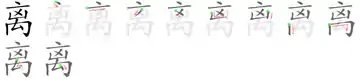
Stroke order
10 strokes

Han character

离 (Kangxi radical 114, 禸+6, 11 strokes, cangjie input 卜山大月 (YUKB), four-corner 00227, composition ⿱㐫禸)

Derived characters

References

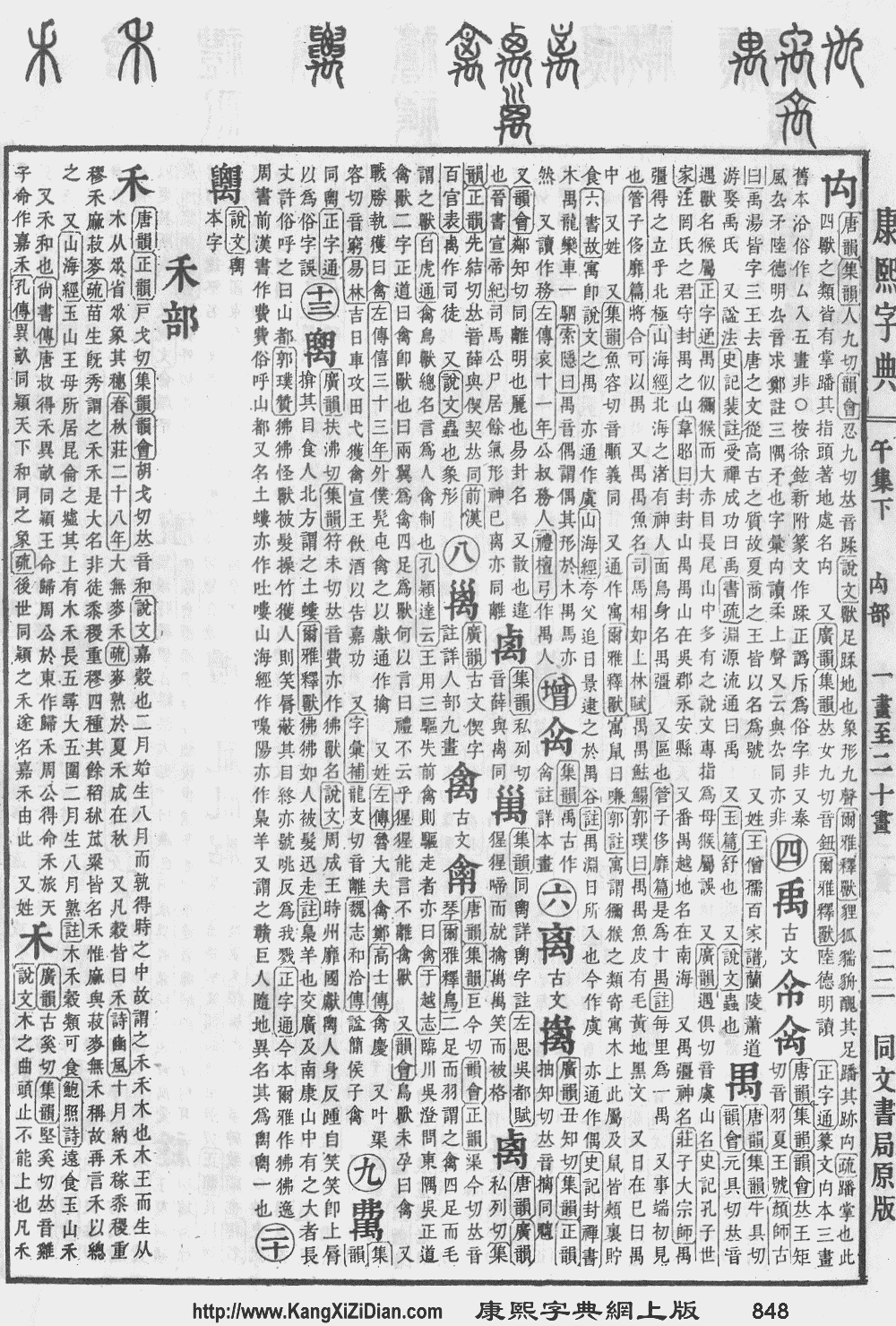
  • Kangxi Dictionary: page 848, character 7
  • Dai Kanwa Jiten: character 24888
  • Dae Jaweon: page 1270, character 2
  • Hanyu Da Zidian (first edition): volume 1, page 287, character 11
  • Unihan data for U+79BB

Chinese

Glyph origin

Historical forms of the character 离
Shuowen Jiezi (compiled in Han) Liushutong (compiled in Ming)
Small seal script Transcribed ancient scripts

In bronze inscriptions, Ideogrammic compound (會意/会意) : 林 (“forest”) + 𠦒 (“net”) – to set up a net in the forest for hunting.

The modern form descends from a variant that replaced 林 with 艸, later simplified as 屮 in small seal script, which corrupted further into 亠 in clerical script. The bottom component 𠦒 has corrupted into ⿱凶禸. Compare with 畢 and 禽.

Exists as traditional character, but also simplified from 離.

Etymology 1

For pronunciation and definitions of 离 – see 離 (“to depart”).
(This character is the simplified form of 離).
Notes:

Etymology 2

trad. 离
simp. # 离
alternative forms 𡴥

Pronunciation


Rime
Character 离
Reading # 2/2
Initial (聲) 徹 (10)
Final (韻) 支 (13)
Tone (調) Level (Ø)
Openness (開合) Open
Division (等) III
Fanqie 丑知切
Baxter trhje
Reconstructions
Zhengzhang
Shangfang
/ʈʰˠiᴇ/
Pan
Wuyun
/ʈʰᵚiɛ/
Shao
Rongfen
/ȶʰiɛ/
Edwin
Pulleyblank
/ʈʰjiə̆/
Li
Rong
/ȶʰje/
Wang
Li
/ȶʰǐe/
Bernard
Karlgren
/ȶʰie̯/
Expected
Mandarin
Reflex
chī
Expected
Cantonese
Reflex
ci1
Baxter–Sagart system 1.1 (2014)
Character 离
Reading # 1/1
Modern
Beijing
(Pinyin)
chī
Middle
Chinese
‹ trhje ›
Old
Chinese
/*r̥aj/
English mountain demon

Notes for Old Chinese notations in the Baxter–Sagart system:

* Parentheses "()" indicate uncertain presence;
* Square brackets "[]" indicate uncertain identity, e.g. *[t] as coda may in fact be *-t or *-p;
* Angle brackets "<>" indicate infix;
* Hyphen "-" indicates morpheme boundary;

* Period "." indicates syllable boundary.
Zhengzhang system (2003)
Character 离
Reading # 2/2
No. 7799
Phonetic
component
离
Rime
group
歌
Rime
subdivision
2
Corresponding
MC rime
摛
Old
Chinese
/*r̥ʰel/

Definitions

离

  1. a kind of legendary beast, Alternative form of 魑

Pronunciation


Rime
Character 离
Reading # 1/2
Initial (聲) 來 (37)
Final (韻) 支 (11)
Tone (調) Level (Ø)
Openness (開合) Open
Division (等) III
Fanqie 呂支切
Baxter lje
Reconstructions
Zhengzhang
Shangfang
/liᴇ/
Pan
Wuyun
/liɛ/
Shao
Rongfen
/ljɛ/
Edwin
Pulleyblank
/liə̆/
Li
Rong
/lie/
Wang
Li
/lǐe/
Bernard
Karlgren
/lie̯/
Expected
Mandarin
Reflex
lí
Expected
Cantonese
Reflex
lei4
Zhengzhang system (2003)
Character 离
Reading # 1/2
No. 7783
Phonetic
component
离
Rime
group
歌
Rime
subdivision
2
Corresponding
MC rime
離
Old
Chinese
/*rel/

Definitions

离

  1. bright, alternative form of 離

Japanese

Kanji

离

(uncommon “Hyōgai” kanji)

  1. rare beast
  2. strange
  3. elegant

Readings

  • Go-on: ち (chi); り (ri)
  • Kan-on: ち (chi); り (ri)

Korean

Hanja

离 • (ri>i) (hangeul 리>이, revised ri>i, McCune–Reischauer ri>i, Yale li>i)

  1. to leave
  2. to divide
This article is issued from Wiktionary. The text is licensed under Creative Commons - Attribution - Sharealike. Additional terms may apply for the media files.