禽
| ||||||||
Translingual
Han character
禽 (Kangxi radical 114, 禸+8, 13 strokes, cangjie input 人卜山月 (OYUB), four-corner 80427, composition ⿱𠆢离)
References
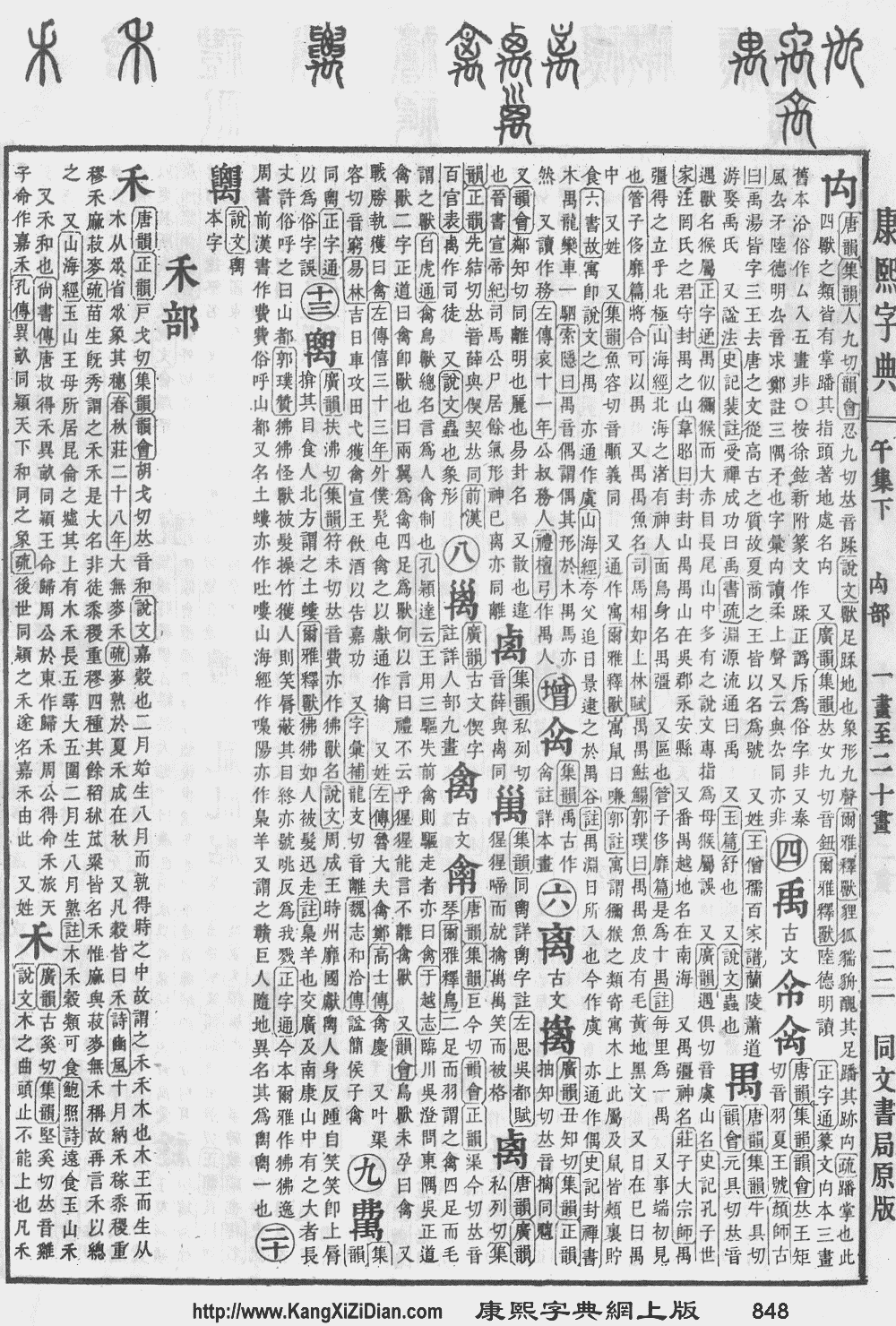
- Kangxi Dictionary: page 848, character 13
- Dai Kanwa Jiten: character 24893
- Dae Jaweon: page 1270, character 6
- Hanyu Da Zidian (first edition): volume 1, page 199, character 4
- Unihan data for U+79BD
Chinese
| trad. | 禽 | |
|---|---|---|
| simp. # | 禽 | |
Glyph origin
| Historical forms of the character 禽 | |||
|---|---|---|---|
| Shang | Western Zhou | Shuowen Jiezi (compiled in Han) | Liushutong (compiled in Ming) |
| Oracle bone script | Bronze inscriptions | Small seal script | Transcribed ancient scripts |
 |
 |
 |
 |
Characters in the same phonetic series (今) (Zhengzhang, 2003)
| Old Chinese | |
|---|---|
| 貪 | *kʰl'uːm |
| 嗿 | *l̥ʰuːmʔ |
| 僋 | *l̥ʰuːms, *luːms |
| 酓 | *qʰɯːm, *qlamʔ, *qlɯːms |
| 馠 | *qʰɯːm |
| 谽 | *qʰɯːm |
| 唅 | *qʰɯːm, *ɡɯːms |
| 含 | *ɡɯːm |
| 肣 | *ɡɯːm, *ɡɯːmʔ |
| 頷 | *ɡɯːm, *ɡɯːmʔ |
| 筨 | *ɡɯːm |
| 梒 | *ɡɯːm |
| 鋡 | *ɡɯːm |
| 莟 | *ɡɯːmʔ, *ɡɯːms |
| 琀 | *ɡɯːms |
| 浛 | *ɡɯːms |
| 盦 | *qɯːm, *qaːb |
| 韽 | *qɯːm, *qrɯːms |
| 玪 | *krɯːm |
| 妗 | *qʰrɯːm, *kʰjam, *qʰlɯːm, *ɡrɯms |
| 欦 | *qʰrɯːmʔ, *qʰram, *kʰlam, *kʰlamʔ, *qʰlɯːm |
| 黔 | *ɡram, *ɡrɯm |
| 鈐 | *ɡram |
| 鳹 | *ɡram |
| 雂 | *ɡram, *ɡrɯm |
| 念 | *nɯːms |
| 梣 | *sɡɯm, *sɡrɯm |
| 枔 | *sɢrɯm |
| 岑 | *sɡrɯm |
| 笒 | *sɡrɯm, *ɡrɯms |
| 涔 | *sɡrɯm |
| 侺 | *ɡjɯms |
| 今 | *krɯm |
| 黅 | *krɯm |
| 衿 | *krɯm |
| 衾 | *kʰrɯm |
| 坅 | *kʰrɯmʔ |
| 搇 | *kʰrɯms |
| 琴 | *ɡrɯm |
| 禽 | *ɡrɯm |
| 芩 | *ɡrɯm |
| 庈 | *ɡrɯm |
| 耹 | *ɡrɯm |
| 靲 | *ɡrɯm |
| 擒 | *ɡrɯm |
| 檎 | *ɡrɯm |
| 紟 | *ɡrɯms |
| 吟 | *ŋɡrɯm, *ŋɡrɯms |
| 訡 | *ŋɡrɯm |
| 廞 | *qʰrɯm, *qʰrɯmʔ |
| 陰 | *qrɯm |
| 霠 | |
| 飲 | *qrɯmʔ, *qrɯms |
| 蔭 | *qrɯms |
| 廕 | *qrɯms |
| 矜 | *ɡrɯn, *ɡɯn, *kɯŋ |
In oracle bone inscriptions, pictogram (象形) of a net, originally the same character as 𠦒 and 畢. In bronze inscriptions, the phonetic component 今 (OC *krɯm) was added, making the character phono-semantic (形聲/形声, OC *ɡrɯm) . This form was borrowed for its modern meaning, and the original meaning of "capture" came to be represented by 擒 (OC *ɡrɯm).
In the modern form, 今 has corrupted into 人 and 𠦒 into 离. Compare with 畢.
Pronunciation
Definitions
禽
Compounds
- 並禽/并禽
- 五禽戲/五禽戏
- 信禽
- 冤禽
- 匹禽
- 原禽 (yuánqín)
- 夜禽類/夜禽类
- 委禽
- 家禽 (jiāqín)
- 德禽
- 攀禽類/攀禽类
- 智禽
- 水禽類/水禽类
- 涉禽 (shèqín)
- 游禽類/游禽类
- 演禽
- 猛禽 (měngqín)
- 珍禽
- 珍禽異獸/珍禽异兽
- 瑰禽怪獸/瑰禽怪兽
- 禽困覆車/禽困覆车
- 禽奔獸遁/禽奔兽遁
- 禽息鳥視/禽息鸟视
- 禽犢/禽犊
- 禽犢之愛/禽犊之爱
- 禽獸/禽兽 (qínshòu)
- 禽獸不如/禽兽不如
- 禽荒
- 禽言
- 禽鳥/禽鸟 (qínniǎo)
- 良禽擇木/良禽择木 (liángqínzémù)
- 草薙禽獮/草剃禽狝
- 衣冠禽獸/衣冠禽兽 (yīguānqínshòu)
- 走禽
- 霜禽
- 飛禽/飞禽 (fēiqín)
- 飛禽走獸/飞禽走兽 (fēiqínzǒushòu)
- 魯禽/鲁禽
- 鳴禽/鸣禽 (míngqín)
References
- “禽”, in 漢語多功能字庫 (Multi-function Chinese Character Database), 香港中文大學 (the Chinese University of Hong Kong), 2014–
Japanese
Readings
Usage notes
Rarely used in modern Japanese. The character 鳥 is used instead to spell the tori reading.
Vietnamese
This article is issued from Wiktionary. The text is licensed under Creative Commons - Attribution - Sharealike. Additional terms may apply for the media files.