私
| ||||||||
Translingual
| Stroke order | |||
|---|---|---|---|
 | |||
Han character
私 (Kangxi radical 115, 禾+2, 7 strokes, cangjie input 竹木戈 (HDI), four-corner 22930, composition ⿰禾厶)
Derived characters
- 俬, 𭈀, 𦮺, 𥢅/𥢆/𫁅
References
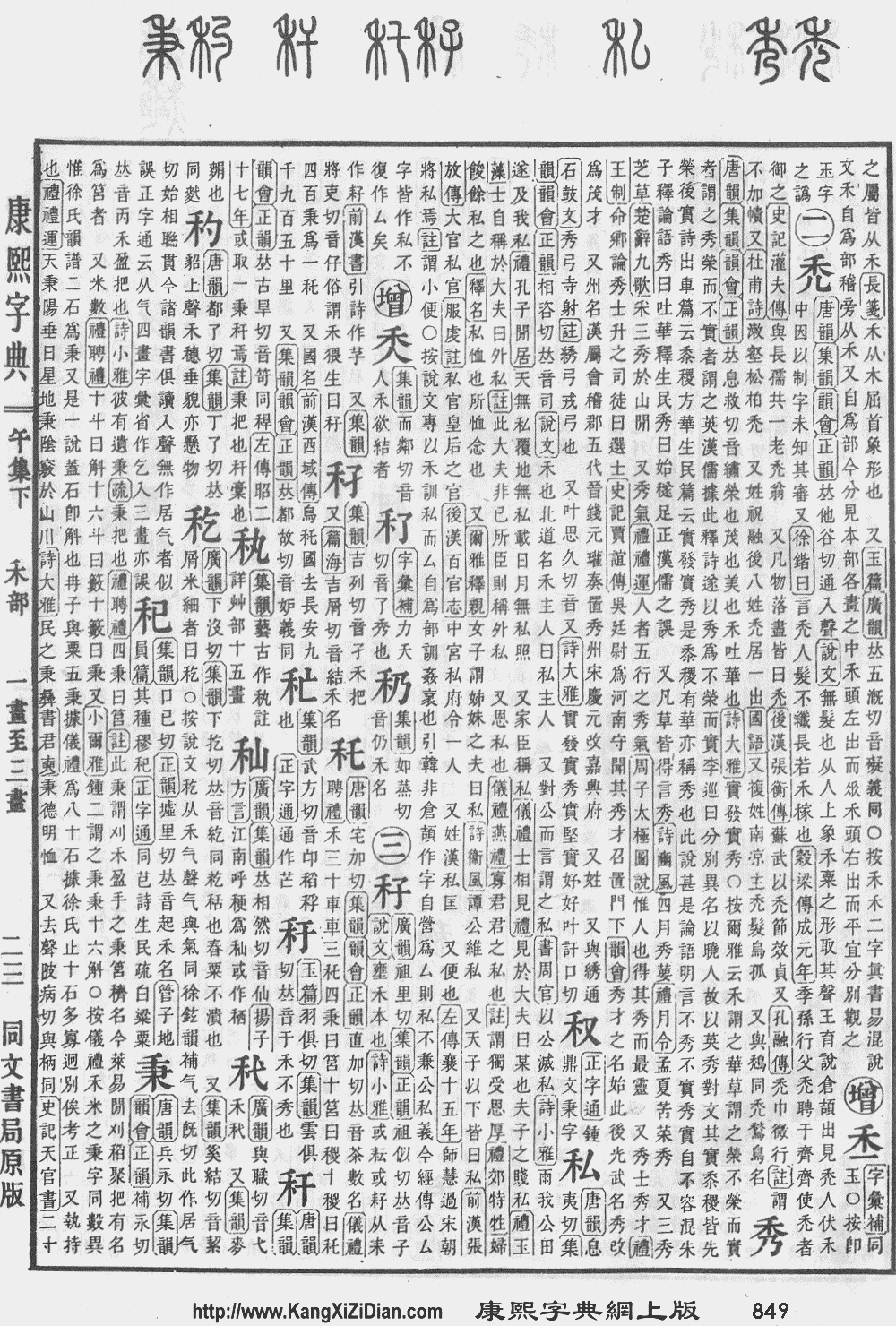
- Kangxi Dictionary: page 849, character 5
- Dai Kanwa Jiten: character 24913
- Dae Jaweon: page 1271, character 2
- Hanyu Da Zidian (first edition): volume 4, page 2589, character 6
- Unihan data for U+79C1
Chinese
| simp. and trad. |
私 | |
|---|---|---|
| 2nd round simp. | 厶 | |
| alternative forms | 厶 ancient | |
Glyph origin
Phono-semantic compound (形聲/形声, OC *sil) : semantic 禾 (“grain”) + phonetic 厶 (OC *sil) – private grain or field.
Displaced the original form 厶.
Pronunciation
Definitions
私
- self; personal; private
- selfish
- 自私 ― zìsī ― selfish
- (Can we add an example for this sense?) (Classical, humble) first-person singular pronoun: I; me
- illegal or secret goods
- 走私 ― zǒusī ― to smuggle
- stealthily; secretly
- 私语 ― sīyǔ ― to whisper
- (obsolete) Used by women to refer to their sister's husband
- reproductive organs; genitals
- (Internet slang) Short for 私聊 (sīliáo, “to PM, to DM”).
Compounds
- 一己之私 (yījǐzhīsī)
- 中私
- 中飽私囊/中饱私囊 (zhōngbǎosīnáng)
- 交私
- 以公滅私/以公灭私
- 以私害公
- 以私廢公/以私废公
- 便私
- 借公行私
- 假公濟私/假公济私 (jiǎgōngjìsī)
- 假公營私/假公营私
- 停私
- 偏私 (piānsī)
- 先公後私/先公后私
- 光私
- 公報私仇/公报私仇 (gōngbàosīchóu)
- 公報私讎/公报私雠
- 公平無私/公平无私
- 公正無私/公正无私
- 公爾忘私/公尔忘私
- 公私 (gōngsī)
- 公私交困
- 公私兩便/公私两便
- 公私兩全/公私两全
- 公私兩利/公私两利
- 公私兩濟/公私两济
- 公私兩盡/公私两尽
- 公私兼顧/公私兼顾 (gōngsījiāngù)
- 公私分明
- 公私皆辦/公私皆办
- 公私要速
- 公而忘私
- 公耳忘私
- 兼愛無私/兼爱无私
- 出公忘私
- 切切私語/切切私语 (qièqièsīyǔ)
- 刻私
- 協私罔上/协私罔上
- 受私
- 吃私
- 因公假私
- 因公行私
- 國際私法/国际私法 (guójì sīfǎ)
- 場私/场私
- 外私
- 多私
- 大公無私/大公无私 (dàgōngwúsī)
- 大飽私囊/大饱私囊
- 夾私/夹私
- 姦私/奸私
- 姻私
- 嬿私
- 官報私仇/官报私仇
- 宴私
- 家私 (jiāsī)
- 寵私/宠私
- 少私寡慾/少私寡欲
- 屈私
- 己私
- 幸私
- 床笫之私 (chuángzǐzhīsī)
- 廢私立公/废私立公
- 彈劾無私/弹劾无私
- 徇公滅私/徇公灭私
- 徇私
- 徇私作弊
- 徇私廢公/徇私废公
- 徇私舞弊
- 從私/从私
- 微服私行
- 忘私
- 忝私
- 恩私
- 情私
- 感私
- 憂公忘私/忧公忘私
- 憂公無私/忧公无私
- 憂國忘私/忧国忘私
- 慮私/虑私
- 懷私/怀私
- 我私
- 拜恩私第
- 挾私/挟私
- 損公肥私/损公肥私
- 收私
- 昧私
- 暗室私心
- 曲私
- 有私 (yǒusī)
- 梟私/枭私
- 棄公營私/弃公营私
- 植黨營私/植党营私
- 植黨自私/植党自私
- 橫私/横私
- 樹私/树私
- 正直無私/正直无私
- 殊私
- 殉私
- 殖私
- 洪私
- 滅私奉公/灭私奉公
- 潑家私/泼家私
- 濟私/济私
- 火院家私
- 烏私/乌私
- 烏鳥私情/乌鸟私情
- 無私/无私 (wúsī)
- 無私之光/无私之光
- 無私有弊/无私有弊
- 無私有意/无私有意
- 燕私
- 營私/营私 (yíngsī)
- 營私作弊/营私作弊
- 營私植黨/营私植党
- 營私罔利/营私罔利
- 營私舞弊/营私舞弊 (yíngsīwǔbì)
- 犯私
- 率私
- 盜私/盗私
- 眷私
- 睚眥之私/睚眦之私
- 萬貫家私/万贯家私
- 私下 (sīxià)
- 私下裏/私下里 (sīxiàlǐ)
- 私乘
- 私亂/私乱
- 私了 (sīliǎo)
- 私事 (sīshì)
- 私事官讎/私事官雠
- 私交 (sījiāo)
- 私人 (sīrén)
- 私仇 (sīchóu)
- 私仗
- 私伢
- 私伺
- 私侍
- 私佼
- 私便
- 私倡
- 私倖/私幸
- 私倒
- 私假
- 私債/私债
- 私傳/私传
- 私僮
- 私僻
- 私兄弟
- 私充
- 私入道
- 私全
- 私兵
- 私冒
- 私凡
- 私函 (sīhán)
- 私分
- 私刑 (sīxíng)
- 私利 (sīlì)
- 私券
- 私刻
- 私制
- 私劍/私剑
- 私力
- 私勇
- 私務/私务
- 私勞/私劳
- 私卒
- 私卒君子
- 私占
- 私印
- 私厚
- 私取
- 私史
- 私向
- 私名
- 私合
- 私名號/私名号
- 私告
- 私吞 (sītūn)
- 私和
- 私商
- 私問/私问
- 私單/私单
- 私喪/私丧
- 私善
- 私嗜
- 私器
- 私囊 (sīnáng)
- 私回
- 私圖/私图
- 私土
- 私地
- 私坐
- 私填
- 私塞
- 私塾 (sīshú)
- 私塾先生
- 私增
- 私士
- 私夫
- 私奇 (sai-khia) (Min Nan)
- 私奔 (sībēn)
- 私奴
- 私好
- 私姻
- 私姦/私奸
- 私威
- 私娼 (sīchāng)
- 私婿
- 私嫌
- 私子
- 私孩子 (sīháizi)
- 私學/私学 (sīxué)
- 私學堂/私学堂
- 私學館/私学馆
- 私宅 (sīzhái)
- 私官
- 私室
- 私客
- 私家 (sījiā)
- 私宴
- 私宰
- 私富
- 私寓
- 私寮
- 私封
- 私尊
- 私就
- 私局
- 私居
- 私屬/私属
- 私己 (sījǐ)
- 私布
- 私市
- 私帑
- 私幣/私币
- 私幫/私帮
- 私幸
- 私庇
- 私府
- 私底下
- 私度
- 私庭
- 私廉
- 私廟/私庙
- 私廚/私厨
- 私廩/私廪
- 私弊 (sībì)
- 私徇
- 私徒
- 私微
- 私德 (sīdé)
- 私心 (sīxīn)
- 私心妄念
- 私心自用
- 私心藏奸
- 私心話/私心话
- 私心雜念/私心杂念
- 私忌
- 私志
- 私忌日
- 私忿
- 私念 (sīniàn)
- 私怨
- 私急
- 私恩
- 私恚
- 私恨
- 私恩小惠
- 私悅/私悦
- 私悖
- 私惠
- 私情 (sīqíng)
- 私情密語/私情密语
- 私意 (sīyì)
- 私愛/私爱
- 私感
- 私慝
- 私慮/私虑
- 私慕
- 私憂/私忧
- 私慾/私欲 (sīyù)
- 私憎
- 私憤/私愤 (sīfèn)
- 私憾
- 私懷/私怀
- 私我
- 私戚
- 私房
- 私房話/私房话 (sīfánghuà)
- 私房買賣/私房买卖
- 私房錢/私房钱 (sīfángqián)
- 私押
- 私拷
- 私接
- 私授
- 私掠 (sīlüè)
- 私援
- 私撰
- 私支
- 私政
- 私教 (sījiào)
- 私敬
- 私斂/私敛
- 私文
- 私方
- 私族
- 私易
- 私昵
- 私春
- 私智
- 私暱/私昵
- 私曲 (sīqū)
- 私書/私书 (sīshū)
- 私會/私会 (sīhuì)
- 私有 (sīyǒu)
- 私有主
- 私有制 (sīyǒuzhì)
- 私有制度
- 私有觀念/私有观念
- 私有財產/私有财产 (sīyǒu cáichǎn)
- 私服
- 私望
- 私朝
- 私本
- 私校保險/私校保险
- 私梟/私枭
- 私椷
- 私業/私业
- 私榮/私荣
- 私樹/私树
- 私橈/私桡
- 私橐
- 私權/私权 (sīquán)
- 私欲 (sīyù)
- 私款
- 私歷/私历
- 私殊
- 私殖
- 私求
- 私法 (sīfǎ)
- 私注
- 私淑
- 私淑弟子
- 私淑艾
- 私溺
- 私潤/私润
- 私火
- 私為/私为
- 私煮
- 私煎
- 私照
- 私燕
- 私營/私营 (sīyíng)
- 私燭/私烛
- 私牘/私牍
- 私牙子
- 私獨/私独
- 私理
- 私生子 (sīshēngzǐ)
- 私生活 (sīshēnghuó)
- 私產/私产 (sīchǎn)
- 私產制度/私产制度
- 私用
- 私田
- 私畜
- 私當/私当
- 私痛
- 私瘞/私瘗
- 私白
- 私益
- 私盟
- 私相授受 (sīxiāngshòushòu)
- 私眷
- 私知
- 私短
- 私神
- 私祭
- 私祧
- 私視/私视
- 私禁
- 私福
- 私私
- 私科子
- 私秩
- 私稱/私称
- 私穀/私谷
- 私積/私积
- 私窠
- 私窟
- 私窠子
- 私窩子/私窝子
- 私竊/私窃
- 私立 (sīlì)
- 私童
- 私童史
- 私第 (sīdì)
- 私篋/私箧
- 私簿
- 私糴/私籴
- 私糶/私粜
- 私約/私约
- 私納/私纳
- 私累
- 私繫/私系
- 私置
- 私罪
- 私署
- 私罰/私罚
- 私羡
- 私義/私义
- 私習/私习
- 私耽
- 私聽/私听
- 私肥
- 私股
- 私胎
- 私腹
- 私臆
- 私臣
- 私自 (sīzì)
- 私舍
- 私艱/私艰
- 私茶
- 私著
- 私蓄 (sīxù)
- 私藏
- 私處/私处 (sīchù)
- 私行
- 私術/私术
- 私衙
- 私衣
- 私衷 (sīzhōng)
- 私製/私制
- 私褚
- 私褻/私亵 (sīxiè)
- 私覆
- 私見/私见 (sījiàn)
- 私親/私亲
- 私覲/私觐
- 私覿/私觌
- 私覿官/私觌官
- 私解
- 私言
- 私言切語/私言切语
- 私計/私计
- 私記/私记
- 私訪/私访 (sīfǎng)
- 私設公堂/私设公堂
- 私詞/私词
- 私訶國/私诃国
- 私訶條國/私诃条国
- 私試/私试
- 私話/私话 (sīhuà)
- 私誠/私诚
- 私說/私说
- 私語/私语 (sīyǔ)
- 私誓
- 私談/私谈
- 私請/私请
- 私論/私论
- 私誼/私谊 (sīyì)
- 私諼/私谖
- 私謁/私谒
- 私諱/私讳 (sīhuì)
- 私諡/私谥
- 私諧歡好/私谐欢好
- 私謚/私谥
- 私謝/私谢
- 私謾/私谩
- 私議/私议 (sīyì)
- 私譴/私谴
- 私譽/私誉
- 私讎/私雠 (sīchóu)
- 私讖/私谶
- 私豵獻豜/私𫎆献豜
- 私負/私负
- 私財/私财 (sīcái)
- 私責/私责
- 私販/私贩
- 私貨/私货 (sīhuò)
- 私貺/私贶
- 私貯/私贮
- 私貼/私贴
- 私費/私费
- 私賊/私贼
- 私賄/私贿
- 私資/私资
- 私賂/私赂
- 私賞/私赏
- 私賣/私卖
- 私贓/私赃
- 私贖/私赎
- 私起
- 私越
- 私路
- 私身
- 私躬
- 私車/私车
- 私載/私载
- 私辦/私办
- 私辰
- 私巡
- 私逃
- 私逋
- 私造
- 私通 (sītōng)
- 私逮
- 私違/私违
- 私過/私过
- 私遁
- 私道
- 私邑
- 私邪
- 私邸 (sīdǐ)
- 私酒
- 私酤
- 私醞/私酝
- 私釀/私酿
- 私重
- 私金
- 私鈚頭/私𬬫头
- 私錢/私钱
- 私鑄錢/私铸钱
- 私門/私门
- 私門子/私门子
- 私門生/私门生
- 私閒/私闲
- 私闖/私闯 (sīchuǎng)
- 私阿
- 私附
- 私隙
- 私隱/私隐 (sīyǐn)
- 私隸/私隶
- 私面
- 私章
- 私願/私愿
- 私飽/私饱
- 私養/私养
- 私養錢/私养钱
- 私館/私馆
- 私鬥/私斗
- 私鬻
- 私鹽/私盐 (sīyán)
- 私鹽包/私盐包
- 私鹽私醋/私盐私醋
- 私黨/私党 (sīdǎng)
- 私黷/私黩
- 私齎/私赍
- 秉公滅私/秉公灭私
- 秉公無私/秉公无私
- 秉正無私/秉正无私
- 竊竊私私/窃窃私私
- 竊竊私語/窃窃私语 (qièqièsīyǔ)
- 竊竊私議/窃窃私议
- 結黨營私/结党营私 (jiédǎngyíngsī)
- 緣私/缘私
- 緝私/缉私 (jīsī)
- 耍私情
- 聖私/圣私
- 肥私
- 背公向私
- 背公營私/背公营私
- 自私 (zìsī)
- 自私自利 (zìsīzìlì)
- 至公無私/至公无私
- 蓄私
- 藏私
- 行私
- 衷私
- 角巾私第
- 言不及私
- 託公報私/托公报私
- 託公行私/托公行私
- 設私/设私
- 話私/话私
- 謀私/谋私
- 謝私/谢私
- 讌私/宴私
- 豔私/艳私
- 販私/贩私 (fànsī)
- 貪私/贪私
- 貴私/贵私
- 買私/买私
- 賀私/贺私
- 賈女私窺/贾女私窥
- 賣公營私/卖公营私
- 賣私/卖私
- 賞私/赏私
- 賤私/贱私
- 購私/购私
- 贊私/赞私
- 贍私/赡私
- 贐私/赆私
- 贓私/赃私
- 贓私狼籍/赃私狼籍
- 贓私狼藉/赃私狼借
- 走私 (zǒusī)
- 退私
- 通私
- 逞私
- 遏私
- 還私/还私
- 鄰私/邻私
- 銅斗家私
- 鐵筆無私/铁笔无私
- 鐵面無私/铁面无私 (tiěmiànwúsī)
- 開私門/开私门
- 阿私
- 陰私/阴私 (yīnsī)
- 隆私
- 隱私/隐私 (yǐnsī)
- 隱私權/隐私权 (yǐnsīquán)
- 顧私/顾私
- 骨肉私情
- 鬻私
- 鴻私/鸿私
Japanese
Readings
Etymology 1
| Kanji in this term |
|---|
| 私 |
| わたし Grade: 6 |
| kun’yomi |
| Alternative spelling |
|---|
| 和多志 (neologism) |
Shift from watakushi below.[1][2]
This reading was already prevalent in early modern times, possibly around the mid-late Muromachi to early-Edo period.
Pronoun
私 • (watashi)
- (polite) first-person singular pronoun: I, me
- 私はイギリス人です。
- Watashi wa Igirisu-jin desu.
- I am British.
- 私はイギリス人です。
Usage notes
Watashi is the usual polite term for referring to oneself.
Quotations
For quotations using this term, see Citations:私.
Coordinate terms
Japanese first-person pronouns by speakers and situations according to Yuko Saegusa, Concerning the First Personal Pronoun of Native Japanese Speakers (2009)
| Speaker | Situation | 1 | 2 | 3 |
|---|---|---|---|---|
| Female | To friends | うち 49% | First name 26% | あたし 15% |
| In the family | First name 33% | あたし 29% | うち 23% | |
| In a class | わたし 86% | あたし 7% | うち 6% | |
| To an unknown visitor | わたし 75% | あたし, first name, うち 8% each | ||
| To the class teacher | わたし 66% | First name 13% | あたし 9% | |
| Male | To friends | おれ 72% | ぼく 19% | First name 4% |
| In the family | おれ 62% | ぼく 23% | うち 6% | |
| In a class | ぼく 85% | おれ 13% | First name, nickname 1% each | |
| To an unknown visitor | ぼく 64% | おれ 26% | First name 4% | |
| To the class teacher | ぼく 67% | おれ 27% | First name 3% | |
| Speaker | Situation | 1 | 2 | 3 |
|---|---|---|---|---|
| Female | To friends | うち 39% | あたし 30% | わたし 22% |
| In the family | あたし 28% | First name 27% | うち 18% | |
| In a class | わたし 89% | あたし 7% | 自分 3% | |
| To an unknown visitor | わたし 81% | あたし 10% | 自分 6% | |
| To the class teacher | わたし 77% | あたし 17% | 自分 7% | |
| Male | To friends | おれ 87% | うち 4% | わたし, 自分 2% each |
| In the family | おれ 88% | ぼく, 自分 5% each | ||
| In a class | わたし 48% | 自分 28% | ぼく 22% | |
| To an unknown visitor | ぼく 36% | 自分 29% | わたし 22% | |
| To the class teacher | 自分 38% | ぼく 29% | わたし 22% | |
Derived terms
Etymology 2
| Kanji in this term |
|---|
| 私 |
| わたくし Grade: 6 |
| kun’yomi |
From Old Japanese 私 (watakusi).
A surface analysis suggests a compound term. However, no likely etyma are known.
- From first-person pronoun 我 (wa, “I, me”) + takusi: although the first element seems likely, the original meaning of watakushi was “private”, as opposed to “public”, with no first-person pronoun usage until the late 13th century.
- From wata + kusi: the only phonetic matches are 綿 (wata, “cotton; cotton batting”), 腸 (wata, “guts, one's innards”, likely derived from the “batting” sense), 海 (wata, “sea, ocean”) + 串 (kusi, “skewer”), 奇し (kusi, “magic, fantastic, supernatural”, adjective), 酒 (kusi, “alcoholic beverage”, likely derived from the “magic” sense), 櫛 (kusi, “comb”).
- From wataku + si: no such word wataku appears to exist.
- From wa + ta + ku + si: unknown.
The meaning evolved over time from “private” or “privatization”, to refer to things that are personal, to refer to one's own person, and then finally to serve as a generic first-person pronoun. The full form watakushi is still used in modern Japanese as a formal, highly polite first-person pronoun. The abbreviated form watashi is now the most common and neutrally polite first-person pronoun.
Noun
私 • (watakushi)
- a personal or private matter
- (by extension) selfishness
- Synonyms: 自分勝手 (jibun katte), 私利私欲 (shiri shiyoku)
Derived terms
- 私する (watakushisuru)
- 私商い (watakushi akinai)
- 私雨 (watakushi ame, “sudden rain shower falling in just a small area”)
- 私戦, 私軍 (watakushi ikusa, “private feud”)
- 私銀, 私金 (watakushigane, “personal money, secret savings, financial nest egg”)
- 私事 (watakushigoto)
- 私戦い (watakushi tatakai, “private feud”)
- 私戯れ (watakushi tawabure, “chatting up a go-between or mediator, as an aside to the main issue being mediated”)
Usage notes
Watakushi is the formal term, only used in certain circumstances, such as by TV announcers or public figures such as politicians. Conversely, it is too formal for casual conversation for men, where terms like 俺 (ore) are preferred.
Derived terms
Derived terms
- 私愛 (shiai, “favoritism, partiality; a secret love for a woman; the woman so loved”)
- 私安警察 (shian-keisatsu, “private police”)
- 私案 (shian, “private plan or proposal”)
- 私意 (shī, “personal opinion; bias; selfishness”)
- 私印 (shīn, “private sigil, signet, stamp, or seal”)
- 私印偽造 (shīngizō, “creating a copy of someone else's sigil to forge their stamp”)
- 私営 (shiei, “private operation, privately operated”)
- 私営鉄道 (shiei tetsudō, “privately-operated railway, private rails”)
- 私営田 (shieiden): in the Heian Period, fields used for large-scale private farming by powerful clans, rather than public farming by the state
- 私益 (shieki, “private or individual profit or gain”)
- 私謁 (shietsu, “audience with the emperor regarding a private matter; a private rather than public request”)
- 私怨 (shien, “private grudge, hatred, ill will”)
- 私恩 (shion, “favor or duty owed to an individual”)
- 私家 (shika, “one's own home; an individual's home, as opposed to the palace or an office”)
- 私家集 (shikashū): in the Edo Period and earlier, an individual's collection or anthology of poetry
- 私家版 (shikaban, “self-publishing, generally without profit motive and with limited distribution; private printing or private edition”)
- 私学 (shigaku, “individual's school of thought”)
- 私学校 (shigakkō, “private school”)
- 私学助成 (shigaku josei, “government subsidization of private education”)
- 私感 (shikan, “one's personal feeling about something”)
- 私間法 (shikanhō, “conflict of laws; private international law”)
- 私企業 (shikigyō, “private enterprise; privately-owned company”)
- 私記 (shiki, “private record of something”)
- 私擬-憲法 (shigikenpō, “privately drafted constitution”, more specifically the Japanese constitution created during 1880-1887)
- 私義務 (shi gimu, “duty or obligation arising from private law”)
- 私議 (shigi, “secret criticism, badmouthing; personal or private opinion”)
- 私教類聚 (shikyō-ruijū, Japan's oldest collection of moral instructions, written by Kibi Makibi in the 700s)
- 私業 (shigyō, “work done as an individual; work done for individual profit”)
- 私曲 (shikyoku, “unjust act committed solely to benefit oneself”)
- 私金 (shikin, “private money; money owned by an individual”)
- 私刑 (shikei, “punishment meted out by vigilante or mob justice”)
- 私恵 (shikei, “private favor”)
- 私経済 (shikeizai, “private economy: economic dealings between private individuals or companies”)
- 私計 (shikei, “one's own thoughts and opinions; one's own schemes or plans”)
- 私隙 (shigeki, “private discord”)
- 私権 (shiken, “private or personal rights”)
- 私見 (shiken, humble word for “one's own personal opinions”)
- 私語 (shigo, “whisper, whispering, private conversation”)
- 私交 (shikō, “personal or private friendship or socializing”)
- 私考 (shikō, “one's own personal thoughts”)
- 私行 (shikō, “private actions in one's own life; secret act; going out for personal reasons; sneaking out”)
- 私田 (shiden)
- 私稲 (shitō): in the Nara and Heian periods, rice plants owned by an individual rather than by the state
- 私法 (shihō)
Noun
私 • (shi)
- a personal or private matter
- selfishness
- privacy, secrecy
- (women's speech, obsolete) a brother-in-law
Derived terms
- 私バス (shibasu, “privately operated bus”)
Etymology 4
| Kanji in this term |
|---|
| 私 |
| あたし Grade: 6 |
| irregular |
| For pronunciation and definitions of 私 – see the following entry. | ||
| ||
| (This term, 私, is an alternative spelling of the above term.) |
Etymology 5
| Kanji in this term |
|---|
| 私 |
| あたくし Grade: 6 |
| irregular |
| For pronunciation and definitions of 私 – see the following entry. | ||
| ||
| (This term, 私, is an alternative spelling of the above term.) |
Etymology 6
| Kanji in this term |
|---|
| 私 |
| あっし Grade: 6 |
| irregular |
| For pronunciation and definitions of 私 – see the following entry. | ||
| ||
| (This term, 私, is an alternative spelling of the above term.) |
Etymology 7
| Kanji in this term |
|---|
| 私 |
| あし Grade: 6 |
| irregular |
| For pronunciation and definitions of 私 – see the following entry: あし |
(The following entry is uncreated: あし.)
Etymology 8
| Kanji in this term |
|---|
| 私 |
| あたい Grade: 6 |
| irregular |
| For pronunciation and definitions of 私 – see the following entry. | ||
| ||
| (This term, 私, is an alternative spelling of the above term.) |
Etymology 9
| Kanji in this term |
|---|
| 私 |
| あて Grade: 6 |
| irregular |
| For pronunciation and definitions of 私 – see the following entry. | ||
| ||
| (This term, 私, is an alternative spelling of the above term.) |
Etymology 10
| Kanji in this term |
|---|
| 私 |
| わい Grade: 6 |
| irregular |
| For pronunciation and definitions of 私 – see the following entry. | ||
| ||
| (This term, 私, is an alternative spelling of the above term.) |
Etymology 11
| Kanji in this term |
|---|
| 私 |
| わし Grade: 6 |
| irregular |
| For pronunciation and definitions of 私 – see the following entry. | ||
| ||
| (This term, 私, is an alternative spelling (more common) of the above term.) |
Etymology 12
| Kanji in this term |
|---|
| 私 |
| わっし Grade: 6 |
| irregular |
| For pronunciation and definitions of 私 – see the following entry. | ||
| ||
| (This term, 私, is an alternative spelling of the above term.) |
Etymology 13
| Kanji in this term |
|---|
| 私 |
| わっち Grade: 6 |
| irregular |
| For pronunciation and definitions of 私 – see the following entry. | ||
| ||
| (This term, 私, is an alternative spelling of the above term.) |
Etymology 14
| Kanji in this term |
|---|
| 私 |
| わたい Grade: 6 |
| irregular |
| For pronunciation and definitions of 私 – see the following entry: わたい |
(The following entry is uncreated: わたい.)
Etymology 15
| Kanji in this term |
|---|
| 私 |
| わちき Grade: 6 |
| irregular |
| For pronunciation and definitions of 私 – see the following entry: わちき |
(The following entry is uncreated: わちき.)
Etymology 16
| Kanji in this term |
|---|
| 私 |
| わて Grade: 6 |
| irregular |
| For pronunciation and definitions of 私 – see the following entry: わて |
(The following entry is uncreated: わて.)
Etymology 17
| Kanji in this term |
|---|
| 私 |
| わらわ Grade: 6 |
| irregular |
| For pronunciation and definitions of 私 – see the following entry. | ||
| ||
| (This term, 私, is an alternative spelling of the above term.) |
References
- Matsumura, Akira (1995) 大辞泉 [Daijisen] (in Japanese), First edition, Tōkyō: Shogakukan, →ISBN
- Matsumura, Akira, editor (2006), 大辞林 [Daijirin] (in Japanese), Third edition, Tōkyō: Sanseidō, →ISBN
- NHK Broadcasting Culture Research Institute, editor (1998), NHK日本語発音アクセント辞典 [NHK Japanese Pronunciation Accent Dictionary] (in Japanese), Tōkyō: NHK Publishing, →ISBN