僕
| ||||||||
Translingual
| Japanese | 僕 |
|---|---|
| Simplified | 仆 |
| Traditional | 僕 |
| Stroke order | |||
|---|---|---|---|
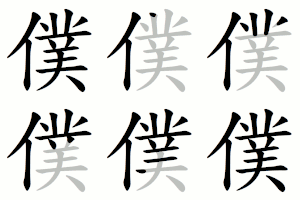 | |||
Han character
僕 (Kangxi radical 9, 人+12, 14 strokes, cangjie input 人廿金人 (OTCO), four-corner 22234, composition ⿰亻菐)
References
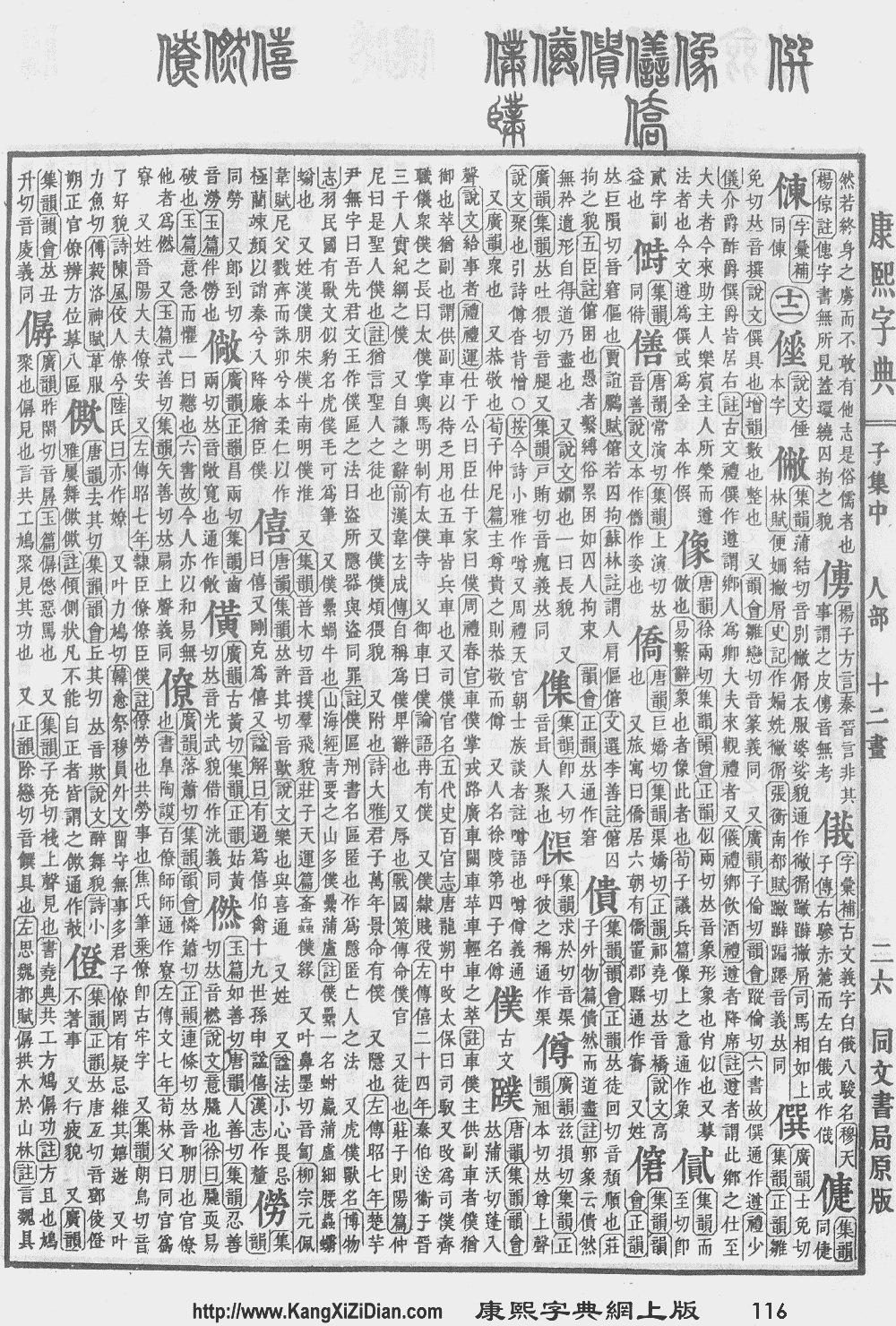
- Kangxi Dictionary: page 116, character 18
- Dai Kanwa Jiten: character 1094
- Dae Jaweon: page 247, character 30
- Hanyu Da Zidian (first edition): volume 1, page 218, character 9
- Unihan data for U+50D5
Chinese
| trad. | 僕 | |
|---|---|---|
| simp. | 仆* | |
| alternative forms | 㒒 | |
Glyph origin
| Historical forms of the character 僕 | ||||||||||||||||||||||||||||||||
|---|---|---|---|---|---|---|---|---|---|---|---|---|---|---|---|---|---|---|---|---|---|---|---|---|---|---|---|---|---|---|---|---|
| ||||||||||||||||||||||||||||||||
|
References: Mostly from Richard Sears' Chinese Etymology site (authorisation),
|


In the oracle bone script and the early Western Zhou bronze script, it was a pictogram (象形) of a slave or prisoner, with hands holding a basket (其) to pick up garbage, an instrument of punishment (辛) above the head, and a tail (尾) to represent the slave's low status, akin to animals.
其 later corrupts into 甾, the hands (廾) move below 辛, and the slave's body (人) moves to become the left component. Later, 辛 corrupts into 丵 (probably by fusing with 甾) and combines with 廾 to give 菐 (OC *boːɡ, *puɡ), which functions as a phonetic component.
In the current form, it is essentially a phono-semantic compound (形聲/形声, OC *boːɡ, *buːɡ) : semantic 人 (“man”) + phonetic 菐 (OC *boːɡ, *puɡ).
Etymology
Probably related to Tibetan བུ (bu, “son; boy”) (Coblin, 1986).
Alternatively, Peiros and Starostin (1996) compare it to Tibetan ཕྲུག (phrug, “child”).
Pronunciation
Definitions
僕
- servant; slave (often male)
- (literary, humble, men's speech) I; me; your humble servant
- (obsolete) coachman; groom
- (obsolete) to attach; to adhere
- 君子萬年,景命有僕。 [Pre-Classical Chinese, trad.]
- From: The Classic of Poetry, c. 11th – 7th centuries BCE, translated based on James Legge's version
- Jūnzǐ wàn nián, jǐngmìng yǒu pú. [Pinyin]
- Yea for ten thousand years,
The bright appointment is attached to your person.
君子万年,景命有仆。 [Pre-Classical Chinese, simp.]
- a surname
Coordinate terms
- (slave): (female) 婢 (bì)
Compounds
References
- “僕”, in 漢語多功能字庫 (Multi-function Chinese Character Database), 香港中文大學 (the Chinese University of Hong Kong), 2014–
Japanese
Compounds
Etymology 1
| Kanji in this term |
|---|
| 僕 |
| ぼく Grade: S |
| goon |
Shift in reading to use the on'yomi, becoming prevalent from around the Meiji period.[1][2]
Pronunciation
Pronoun
僕 or 僕 • (boku)
- (men's speech) I; me (personal pronoun; usually used by males; implies that the speaker is a young boy or otherwise boyish)
- 1997 August 12, Maekawa, Takeshi, “未知なる大地への巻 [To the Strange Land]”, in 新鉄拳チンミ (新鉄拳チンミ) [New Ironfist Chinmi], volume 1 (fiction), Tokyo: Kodansha, →ISBN, page 32:
- ぼく?ぼくは南高山大林寺からちょっとした用で…
- Boku? Boku wa Nankō-zan Dairin-ji kara chotto shita yō de…
- Me? I was sent by the Dairin Temple on Mount Nankō...
- ぼく?ぼくは南高山大林寺からちょっとした用で…
- 2003 September 22, Akinobu Uraku, “第61話 愛しきものの為に [Chapter 61: All for Our Loved Ones]”, in 東京アンダーグラウンド [Tokyo Underground], volume 11 (fiction), Square Enix, →ISBN, page 48:
- 昔の僕とは違う
- Mukashi no boku to wa chigau
- I am not what I used to be.
- 昔の僕とは違う
- Kore Yamazaki, “第1篇 April showers bring May flowers. [第1篇 April showers bring May flowers., Composition 1: April showers bring May flowers.]”, in 魔法使いの嫁 (魔法使いの嫁) [The Ancient Magus’ Bride], volume 1 (fiction), Tokyo: Mag Garden, page 20:
- 君を魔法使いの弟子として歓迎するよ 死の愛し仔…いや チセ
- Kimi o boku no deshi to shite kangei suru yo Surei Bega… iya Chise
- You are welcome as my apprentice, Sleigh Beggey... I mean, Chise.
- you, he, she (only used in reference to a person who uses this term to refer to themselves, or is one who is assumed to use it, such as a young boy)
Usage notes
- If used by an adult male, semi-formal; in formal conversation 私 (watashi) is preferred.
See also
Japanese first-person pronouns by speakers and situations according to Yuko Saegusa, Concerning the First Personal Pronoun of Native Japanese Speakers (2009)
| Speaker | Situation | 1 | 2 | 3 |
|---|---|---|---|---|
| Female | To friends | うち 49% | First name 26% | あたし 15% |
| In the family | First name 33% | あたし 29% | うち 23% | |
| In a class | わたし 86% | あたし 7% | うち 6% | |
| To an unknown visitor | わたし 75% | あたし, first name, うち 8% each | ||
| To the class teacher | わたし 66% | First name 13% | あたし 9% | |
| Male | To friends | おれ 72% | ぼく 19% | First name 4% |
| In the family | おれ 62% | ぼく 23% | うち 6% | |
| In a class | ぼく 85% | おれ 13% | First name, nickname 1% each | |
| To an unknown visitor | ぼく 64% | おれ 26% | First name 4% | |
| To the class teacher | ぼく 67% | おれ 27% | First name 3% | |
| Speaker | Situation | 1 | 2 | 3 |
|---|---|---|---|---|
| Female | To friends | うち 39% | あたし 30% | わたし 22% |
| In the family | あたし 28% | First name 27% | うち 18% | |
| In a class | わたし 89% | あたし 7% | 自分 3% | |
| To an unknown visitor | わたし 81% | あたし 10% | 自分 6% | |
| To the class teacher | わたし 77% | あたし 17% | 自分 7% | |
| Male | To friends | おれ 87% | うち 4% | わたし, 自分 2% each |
| In the family | おれ 88% | ぼく, 自分 5% each | ||
| In a class | わたし 48% | 自分 28% | ぼく 22% | |
| To an unknown visitor | ぼく 36% | 自分 29% | わたし 22% | |
| To the class teacher | 自分 38% | ぼく 29% | わたし 22% | |
Etymology 2
| Kanji in this term |
|---|
| 僕 |
| しもべ Grade: S |
| kun’yomi |
Originally a compound of 下 (shimo, “lower”) + 部 (be, “servant to the imperial court”).[1][2]
Alternative forms
Pronunciation
Etymology 3
| Kanji in this term |
|---|
| 僕 |
| やつがれ Grade: S |
| kun’yomi |
| For pronunciation and definitions of 僕 – see the following entry. | ||
| ||
| (This term, 僕, is an alternative spelling of the above term.) |
References
- Shōgaku Tosho (1988) 国語大辞典(新装版) [Unabridged Dictionary of Japanese (Revised Edition)] (in Japanese), Tōkyō: Shogakukan, →ISBN
- Matsumura, Akira, editor (2006), 大辞林 [Daijirin] (in Japanese), Third edition, Tōkyō: Sanseidō, →ISBN
- NHK Broadcasting Culture Research Institute, editor (1998), NHK日本語発音アクセント辞典 [NHK Japanese Pronunciation Accent Dictionary] (in Japanese), Tōkyō: NHK Publishing, →ISBN
Korean
Hanja
僕 (eum 복 (bok))
- This term needs a translation to English. Please help out and add a translation, then remove the text
{{rfdef}}.
Vietnamese
Han character
- This term needs a translation to English. Please help out and add a translation, then remove the text
{{rfdef}}.