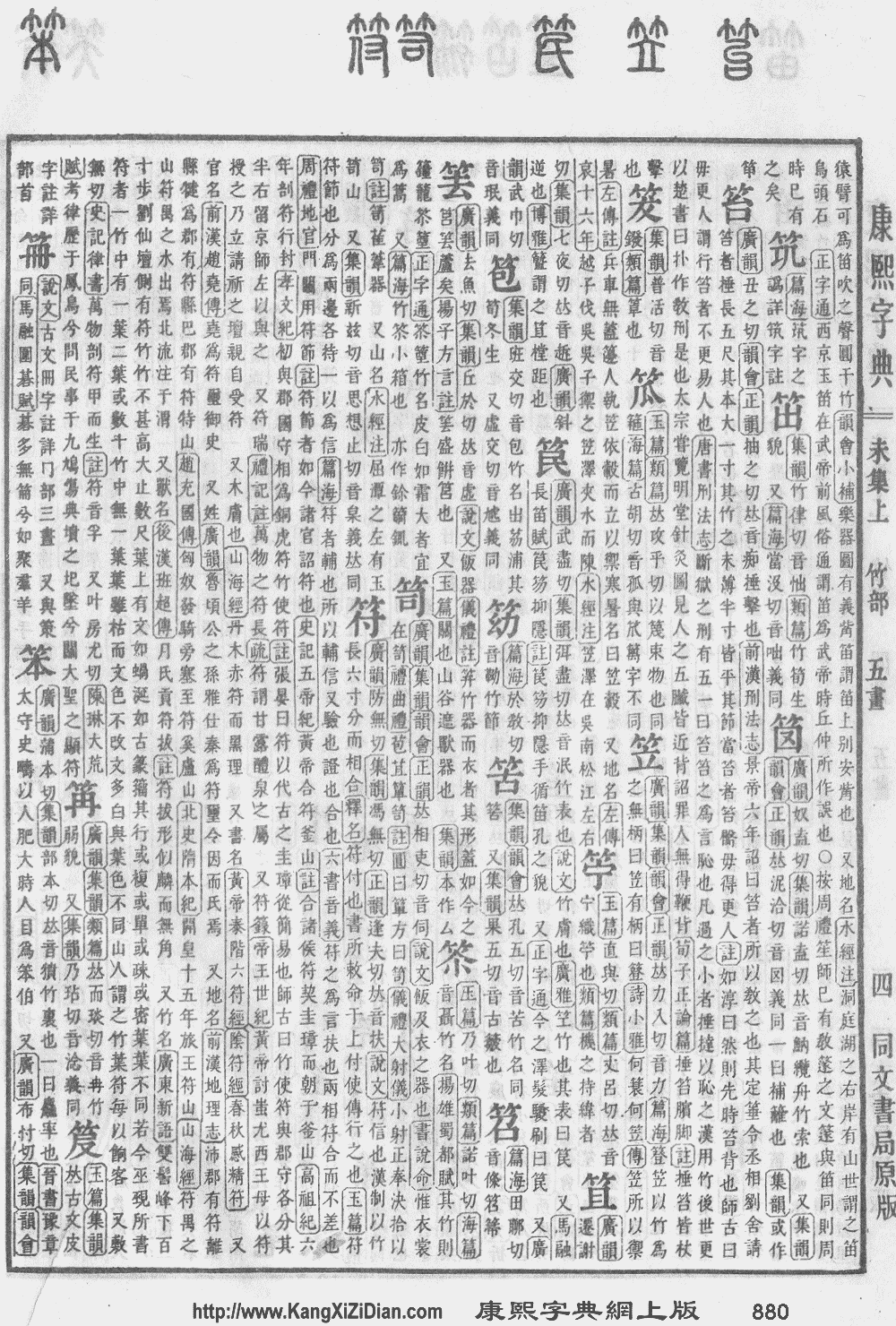
笠

笠 U+7B20, 笠
CJK UNIFIED IDEOGRAPH-7B20
← 笟
[U+7B1F]
CJK Unified Ideographs 笡 →
[U+7B21]
笠 U+F9F8, 笠
CJK COMPATIBILITY IDEOGRAPH-F9F8
← 立
[U+F9F7]
CJK Compatibility Ideographs 粒 →
[U+F9F9]

Translingual

Han character

笠 (Kangxi radical 118, 竹+5, 11 strokes, cangjie input 竹卜廿 (HYT), four-corner 88108, composition ⿱𥫗立)

References

Chinese

trad. 笠
simp. # 笠

Glyph origin

Historical forms of the character 笠
Shuowen Jiezi (compiled in Han) Liushutong (compiled in Ming)
Small seal script Transcribed ancient scripts

Phono-semantic compound (形聲/形声, OC *ɡ·rɯb) : semantic 竹 (“bamboo”) + phonetic 立 (OC *rɯb).

Etymology 1

Compare Proto-Tai *klɤpᴰ (“bamboo hat”) (Schuessler, 2007).

Pronunciation


Note:
  • sā̤ - vernacular;
  • lĭ - literary.

Rime
Character 笠
Reading # 1/1
Initial (聲) 來 (37)
Final (韻) 緝 (141)
Tone (調) Checked (Ø)
Openness (開合) Open
Division (等) III
Fanqie 力入切
Baxter lip
Reconstructions
Zhengzhang
Shangfang
/liɪp̚/
Pan
Wuyun
/lip̚/
Shao
Rongfen
/ljep̚/
Edwin
Pulleyblank
/lip̚/
Li
Rong
/liəp̚/
Wang
Li
/lĭĕp̚/
Bernard
Karlgren
/li̯əp̚/
Expected
Mandarin
Reflex
lì
Expected
Cantonese
Reflex
lap6
Baxter–Sagart system 1.1 (2014)
Character 笠
Reading # 1/1
Modern
Beijing
(Pinyin)
lì
Middle
Chinese
‹ lip ›
Old
Chinese
/*k.rəp/
English bamboo-splint hat

Notes for Old Chinese notations in the Baxter–Sagart system:

* Parentheses "()" indicate uncertain presence;
* Square brackets "[]" indicate uncertain identity, e.g. *[t] as coda may in fact be *-t or *-p;
* Angle brackets "<>" indicate infix;
* Hyphen "-" indicates morpheme boundary;

* Period "." indicates syllable boundary.
Zhengzhang system (2003)
Character 笠
Reading # 1/1
No. 7871
Phonetic
component
立
Rime
group
緝
Rime
subdivision
1
Corresponding
MC rime
立
Old
Chinese
/*ɡ·rɯb/

Definitions

笠

  1. Asian conical hat
Synonyms

Compounds

Pronunciation

Definitions

笠

  1. (Cantonese, Nanning Pinghua, Leizhou Min) basket (made from interwoven bamboo strips)
  2. (Cantonese, Leizhou Min) to cover (with); to slip on
    笠頂帽上個頭 [Cantonese, trad.]
    笠顶帽上个头 [Cantonese, simp.]
    lap1 deng2 mou6-2 soeng5 go3 tau4 [Jyutping]
    to put a hat on one's head
  3. (Cantonese) to flatter; to fool

Compounds

Japanese

笠

Kanji

笠

(“Jinmeiyō” kanji used for names)

  1. Asian conical hat

Readings

Etymology

Kanji in this term
笠
かさ
Jinmeiyō
kun’yomi

From Old Japanese, from Proto-Japonic *kasa (“cover, hat”). Cognate with Miyako 笠 (kasa), Okinawan 笠 (kasa), Yaeyama 笠 (kasa). Related to 傘 (kasa, “umbrella”).

Pronunciation

Noun

笠(かさ) • (kasa) 

  1. Asian conical hat

References

  1. Hirayama, Teruo, editor (1960), 全国アクセント辞典 (Zenkoku Akusento Jiten, “Nationwide Accent Dictionary”) (in Japanese), Tōkyō: Tōkyōdō, →ISBN

Korean

Hanja

笠 (eumhun 삿갓 립 (satgat rip), South Korea 삿갓 입 (satgat ip))

  1. This term needs a translation to English. Please help out and add a translation, then remove the text {{rfdef}}.

Vietnamese

Han character

笠: Hán Nôm readings: lạp, lợp, lép, liếp, lụp, rạp, lẹp, lớp, nập, rập, sập, sệp, sụp, tấp

  1. This term needs a translation to English. Please help out and add a translation, then remove the text {{rfdef}}.
This article is issued from Wiktionary. The text is licensed under Creative Commons - Attribution - Sharealike. Additional terms may apply for the media files.