粒
| ||||||||
| ||||||||
Translingual
Han character
粒 (Kangxi radical 119, 米+5, 11 strokes, cangjie input 火木卜廿 (FDYT), four-corner 90918, composition ⿰米立)
Derived characters
- 𨅀, 𩻑
References
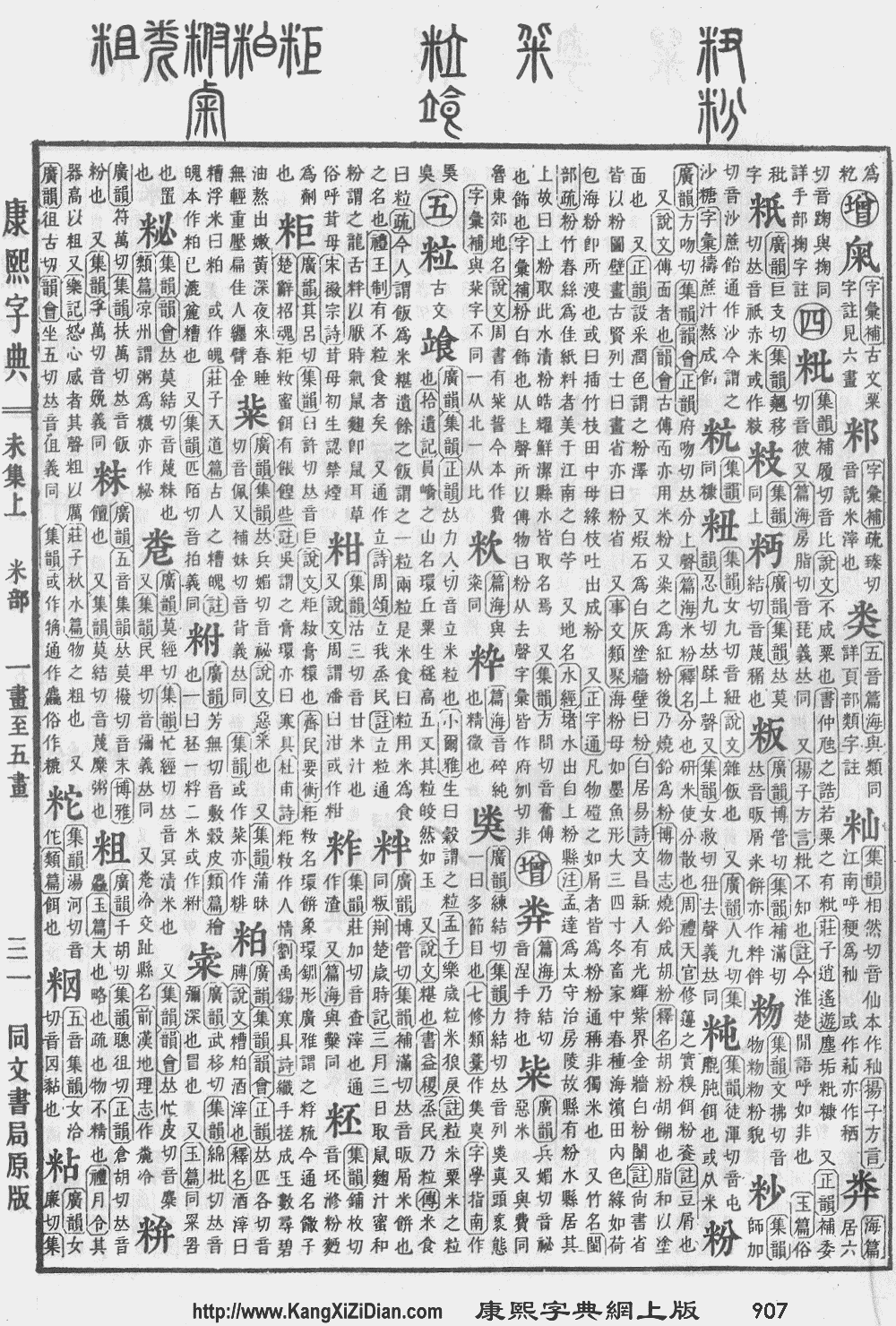
- Kangxi Dictionary: page 907, character 22
- Dai Kanwa Jiten: character 26884
- Dae Jaweon: page 1333, character 7
- Hanyu Da Zidian (first edition): volume 5, page 3145, character 12
- Unihan data for U+7C92
- Unihan data for U+F9F9
Chinese
| trad. | 粒 | |
|---|---|---|
| simp. # | 粒 | |
Glyph origin
| Historical forms of the character 粒 |
|---|
| Shuowen Jiezi (compiled in Han) |
| Small seal script |
 |
Characters in the same phonetic series (立) (Zhengzhang, 2003)
Phono-semantic compound (形聲/形声, OC *rɯb) : semantic 米 (“rice”) + phonetic 立 (OC *rɯb).
Pronunciation
Definitions
粒
- grain
- small particle
- Classifier for small, round objects: granule, grain, particle, piece ⇒ all nouns using this classifier
- (Hokkien, Eastern Min, Singapore and Malaysian Mandarin) Classifier for round, solid objects.
- (Cantonese) Classifier for hours.
- (Cantonese) Classifier for offspring.
- (Cantonese) Classifier for pips (insignia).
- (Cantonese, by extension) high-ranking police officer; police officer with pips
- (Cantonese, slang) Classifier for money: ten thousand yuan, dollars, etc.
Compounds
References
- “粒”, in 漢語多功能字庫 (Multi-function Chinese Character Database), 香港中文大學 (the Chinese University of Hong Kong), 2014–
- “Entry #7738”, in 臺灣閩南語常用詞辭典 [Dictionary of Frequently-Used Taiwan Minnan] (overall work in Mandarin and Hokkien), Ministry of Education, R.O.C., 2023.
Japanese
Readings
Korean
Etymology
From Middle Chinese 粒 (MC lip). Recorded as Middle Korean 립〮 (líp) (Yale: lip) in Hunmong Jahoe (訓蒙字會 / 훈몽자회), 1527.
Compounds
Vietnamese
Han character
- This term needs a translation to English. Please help out and add a translation, then remove the text
{{rfdef}}.
References
This article is issued from Wiktionary. The text is licensed under Creative Commons - Attribution - Sharealike. Additional terms may apply for the media files.