個
See also: 个
| ||||||||
Translingual
| Stroke order | |||
|---|---|---|---|
 | |||
| Stroke order | |||
|---|---|---|---|
 | |||
Han character
個 (Kangxi radical 9, 人+8, 10 strokes, cangjie input 人田十口 (OWJR), four-corner 26200, composition ⿰亻固)
References
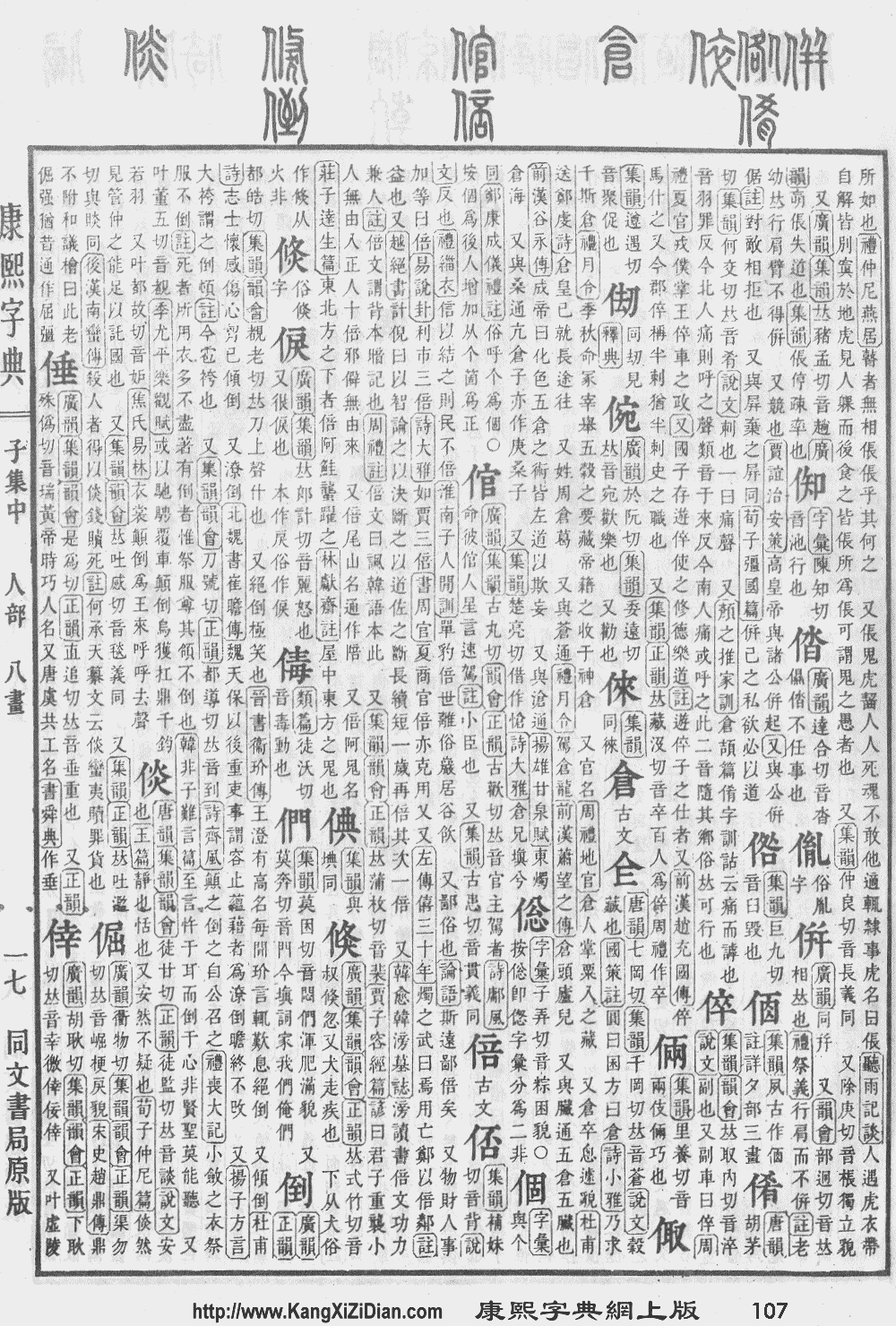
- Kangxi Dictionary: page 107, character 17
- Dai Kanwa Jiten: character 758
- Dae Jaweon: page 228, character 2
- Hanyu Da Zidian (first edition): volume 1, page 178, character 3
- Unihan data for U+500B
Chinese
| trad. | 個/箇 | |
|---|---|---|
| simp. | 个 | |
| alternative forms | 的 Hokkien; possessive particle ㄟ Taiwanese Hokkien; possessive particle 兮 Taiwanese Hokkien; possessive particle 亓 Hokkien; possessive particle | |
Glyph origin
Characters in the same phonetic series (古) (Zhengzhang, 2003)
| Old Chinese | |
|---|---|
| 箇 | *kaːls |
| 個 | *kaːls |
| 居 | *kɯ, *kas |
| 橭 | *kaː, *kʰaː |
| 嫴 | *kaː |
| 姑 | *kaː |
| 辜 | *kaː |
| 酤 | *kaː, *kaːs, *ɡaːʔ |
| 蛄 | *kaː |
| 鴣 | *kaː |
| 沽 | *kaː, *kaːʔ, *kaːs |
| 盬 | *kaː, *kaːʔ |
| 古 | *kaːʔ |
| 罟 | *kaːʔ |
| 估 | *kaːʔ |
| 鈷 | *kaːʔ |
| 詁 | *kaːʔ |
| 牯 | *kaːʔ |
| 故 | *kaːs |
| 固 | *kaːs |
| 稒 | *kaːɡs |
| 痼 | *kaːɡs |
| 錮 | *kaːɡs |
| 鯝 | *kaːɡs |
| 棝 | *kaːɡs |
| 凅 | *kaːɡs |
| 枯 | *kʰaː |
| 軲 | *kʰaː |
| 跍 | *kʰaː |
| 骷 | *kʰaː |
| 苦 | *kʰaːʔ, *kʰaːs |
| 葫 | *qʰaː, *ɡaː |
| 餬 | *ɡaː |
| 瑚 | *ɡaː |
| 湖 | *ɡaː |
| 鶘 | *ɡaː |
| 猢 | *ɡaː |
| 醐 | *ɡaː |
| 糊 | *ɡaː |
| 箶 | *ɡaː |
| 蝴 | *ɡaː |
| 胡 | *ɡaː |
| 瓳 | *ɡaː |
| 怙 | *ɡaːʔ |
| 祜 | *ɡaːʔ |
| 岵 | *ɡaːʔ |
| 婟 | *ɡaːʔ, *ɡaːɡs |
| 楛 | *ɡaːʔ |
| 据 | *ka |
| 裾 | *ka |
| 琚 | *ka |
| 椐 | *ka, *kas, *kʰa |
| 鶋 | *ka |
| 蜛 | *ka |
| 崌 | *ka |
| 涺 | *ka |
| 腒 | *ka, *ɡa |
| 鋸 | *kas |
| 倨 | *kas |
| 踞 | *kas |
| 涸 | *ɡaːɡ |
Phono-semantic compound (形聲/形声, OC *kaːls) : semantic 亻 (“person”) + phonetic 固 (OC *kaːs).
Etymology
The semantics may have developed along the grammaticalisation process "bamboo stalk" (箇) > "piece, item" > "classifier for every category of noun" > "possessive particle, generic particle". If so, it would then possibly be cognate with 竿 (OC *kaːn, “bamboo, rod”). Compare Tibetan མཁར་བ (mkhar ba), འཁར་བ ('khar ba, “walking stick, staff”) and Thai ก้าน (gâan, “stem, stalk”).
- Min Nan classifier and possessive particle
- Hokkien ê/gê (classifier), ê (possessive particle), Teochew gai5 (classifier), gai7 (possessive particle): from 其 (OC *ɡɯ) (Li, 2002; Douglas, 1899[1]). Cognate with Eastern Min 其 (gì, “possessive particle”), Northern Min 的 (gâ̤, “possessive particle”). The modern forms of these cognates all derive from the 陽平/阳平 (“yangping”) tone.
- Wu classifier and possessive particle
- Though the expected pronunciation (in for instance Shanghainese) would be /ku/, this has underwent glottalisation (Dai, 2004). Compare 勒 (“to be in, to be at”), 搭 (“to”). In Shanghainese, this often undergoes further lenition to /ɦəʔ/.
Pronunciation
Definitions
個
- single; alone; individual
- height; build; stature
- (dialectal Hakka, dialectal Min, dialectal Wu) one
- The generic classifier for people or for things lacking specific classifiers.
- Classifier for hours and months.
- Alternative classifier, for nouns having specific classifiers. Often colloquial and regional. Usage varies greatly between different topolects.
- (Cantonese, Hakka, Teochew, Puxian Min, Wenzhounese) Classifier for money: yuan, dollar; buck
- 三個九毫九/三个九毫九 [Cantonese] ― saam1 go3 gau2 hou4 gau2 [Jyutping] ― three dollars and ninety-nine cents
- 八個六/八个六 [Cantonese] ― baat3 go3 luk6 [ [Jyutping] ― eight dollars and sixty cents
- 三個銀/三个银 [Sixian Hakka] ― sâm ke ngiùn [Pha̍k-fa-sṳ] ― three dollars
- 兩斤五個/两斤五个 [Teochew] ― no6 geng1 ngou6 gai5 [Peng'im] ― two catties for five dollars
- 個銀三粒/个银三粒 [Teochew] ― gai5 ngeng5 san1 liab8 [Peng'im] ― three for a buck
- (Cantonese, slang) Classifier for money: ten thousand yuan, dollars, etc.
- (Mandarin, colloquial) Particle, placed between a verb and numbers, showing that the following numbers are approximate, not accurate.
- (Mandarin, Cantonese, colloquial) Particle, placed between a verb and its object or complement, adding a sense of ease, swiftness and one-offness to the action.
- (Mandarin, colloquial) Particle used after 些 (xiē).
- Particle between a verb and its complement.
- (dialectal Mandarin) Particle used in some time-related words.
- (literary or Wu, Xiang, Gan, dialectal Cantonese, dialectal Min) (= 搿 (Northern Wu)) this; that
- (dialectal Cantonese, Hakka, Southern Min, Wu) Possessive particle. Equivalent to Mandarin 的 (de).
- → 嘅 (ge3) (Cantonese); 格 (kaq), 額/额 (gheq) (Shanghainese) (Mandarin influenced); 噶, 葛 (Suzhounese); 的 (ê) (Hokkien)
- 我個冊/我个册 [Hokkien] ― góa ê chheh [Pe̍h-ōe-jī] ― my book
- 我個書/我个书 [Teochew] ― ua2 gai7 ze1 [Peng'im] ― my book
- 我個小囡/我个小囡 [Shanghainese] ― 6ngu-gheq 5shiau-noe [Wugniu] ― my child
- 客家個精神/客家个精神 [Sixian Hakka] ― hak-kâ ke chîn-sṳ̀n [Pha̍k-fa-sṳ] ― the Hakka spirit
- (dialectal) Sentence-final declarative, affirmative, or prohibitive particle. Equivalent to Mandarin 的 (de), 了 (le).
- 事體老妖個。 [Shanghainese, trad.]
- From: 2011, Hu Baotan, 弄堂
- 6zy-thi 6lau 1iau 0gheq [Wugniu]
- It's quite an odd happenstance.
事体老妖个。 [Shanghainese, simp.]
- (often dialectal) Emphatic particle between a pronoun and a noun, usually to highlight some negative quality of the person.
- (Teochew) to be
- 我個潮州來個。 [Teochew, trad.]
- From: Based on 2011, Hui Ling Xu; Stephen Matthews, On the polyfunctionality and grammaticalization of the morpheme kai in the Chaozhou dialect, in Foong Ha Yap; Karen Grunow-Hårsta; Janick Wrona (eds.), Nominalization in Asian Languages: Diachronic and typological perspectives, page 121
- ua2 gai5 dio5 ziu1 lai5 gai7 [Peng'im]
- I come from Chaozhou. (i.e., It is Chaozhou that I come from.)
我个潮州来个。 [Teochew, simp.]
- (dated Shanghainese) Used to indicate the past tense.
Usage notes
- For Hokkien, Taiwan's Ministry of Education recommends 个 for the general classifier ê and 的 for the possessive particle ê, reserving 個 for the month classifier kò.
- For Hakka, Taiwan's Ministry of Education recommends 个 for the possessive particle.
- In Cantonese, when used for "yuan/dollar", 個 is usually only used when followed by cents.
- Northern Wu languages can mark for tenses, as well as aspects. In Old Shanghainese, this is used to mark the past tense, as opposed to a perfect aspect.
Synonyms
- (height):
- (one):
Dialectal synonyms of 一 (“one”) [map]
- (classifier):
Dialectal synonyms of 個 (“(classifier for people)”) [map]
Dialectal synonyms of 個 (“(classifier for bowls)”) [map]
- (possessive particle):
Dialectal synonyms of 的 (“possessive particle”) [map]
- (yuan; dollar):
Dialectal synonyms of 元 (“yuan; dollar”) [map]
- (this):
Dialectal synonyms of 這 (“this”) [map]
Compounds
- 一個/一个 (yīgè)
- 一個勁兒/一个劲儿 (yīgejìnr)
- 一個子兒/一个子儿
- 一個樣兒/一个样儿
- 七個八個/七个八个
- 不是個兒/不是个儿
- 些個/些个 (xiēge)
- 今兒個/今儿个 (jīnrgè)
- 個中/个中 (gèzhōng)
- 個中三昧/个中三昧
- 個中人/个中人
- 個中滋味/个中滋味
- 個中道理/个中道理
- 個事/个事
- 個人/个人 (gèrén)
- 個人主義/个人主义 (gèrén zhǔyì)
- 個人外交/个人外交
- 個人所得/个人所得
- 個人撥接/个人拨接
- 個人本位/个人本位
- 個人秀/个人秀
- 個人衛生/个人卫生 (gèrén wèishēng)
- 個人資料/个人资料
- 個人電腦/个人电脑 (gèrén diànnǎo)
- 個人首頁/个人首页
- 個位/个位 (gèwèi)
- 個個/个个 (gègè)
- 個個稱羨/个个称羡
- 個兒/个儿 (gèr)
- 個別/个别 (gèbié)
- 個別差異/个别差异
- 個別輔導/个别辅导
- 個子/个子 (gèzi)
- 個展/个展 (gèzhǎn)
- 個性/个性 (gèxìng)
- 個性難改/个性难改
- 個把/个把
- 個數/个数 (gèshù)
- 個案/个案 (gè'àn)
- 個案分析/个案分析
- 個案研究/个案研究 (gè'àn yánjiū)
- 個樣/个样
- 個裡/个里
- 個頭/个头
- 個體/个体 (gètǐ)
- 個體戶/个体户 (gètǐhù)
- 做的個/做的个
- 傍個影兒/傍个影儿
- 兩個聲/两个声 (liǎnggèshēng)
- 則個/则个
- 前兒個/前儿个 (qiánrge)
- 半個/半个 (bànge)
- 半個人/半个人 (bàn ge rén)
- 又弱一個/又弱一个
- 各個/各个 (gègè)
- 各個擊破/各个击破 (gègèjīpò)
- 單個兒/单个儿
- 噶個點兒/噶个点儿
- 四個堅持/四个坚持
- 夜兒個/夜儿个 (yèrge)
- 大個/大个
- 大個兒/大个儿
- 大個子/大个子
- 好個/好个
- 寧個/宁个
- 帶個好/带个好
- 幫個場子/帮个场子
- 幾個/几个 (jǐgè)
- 幾兒個/几儿个
- 成個兒/成个儿 (chénggèr)
- 打一個吞/打一个吞
- 打個前失/打个前失
- 打個千兒/打个千儿
- 打個問號/打个问号
- 打個沉兒/打个沉儿
- 打個照會/打个照会
- 打個照面/打个照面
- 打個花/打个花
- 挨個兒/挨个儿 (āigèr)
- 探個究竟/探个究竟
- 揀啊揀,揀著一個賣龍眼/揀啊揀,揀著一个賣龍眼/拣啊拣,拣着一个卖龙眼 (kéng--ah kéng, kéng-tio̍h chi̍t ê bē lêng-géng) (Hokkien)
- 撲個滿懷/扑个满怀
- 撲個空/扑个空
- 整個/整个 (zhěnggè)
- 有個好歹/有个好歹
- 有個屁用/有个屁用
- 有個數兒/有个数儿
- 有個說兒/有个说儿
- 某個/某个 (mǒugè)
- 比個高下/比个高下
- 比個高低/比个高低
- 沒個出豁/没个出豁
- 沒個是處/没个是处
- 沒個見識/没个见识
- 沒個開交/没个开交
- 滅不個/灭不个
- 滿好個/满好个
- 猛個勁/猛个劲
- 獨自個/独自个
- 發個兒/发个儿
- 看個究竟/看个究竟
- 真個/真个 (zhēngè)
- 矬個兒/矬个儿
- 矮個/矮个 (ǎigè)
- 矮個兒/矮个儿 (ǎigèr)
- 矮個子/矮个子 (ǎigèzi)
- 第一個/第一个 (dì-yī gè)
- 自個兒/自个儿 (zìgěr)
- 若個/若个
- 行個方便/行个方便
- 見個情/见个情
- 覷個意順/觑个意顺
- 討個分曉/讨个分晓
- 賠個不是/赔个不是
- 賣個破綻/卖个破绽
- 這個/这个
- 這個擋口/这个挡口
- 這個當兒/这个当儿
- 這個那個/这个那个
- 那個/那个
- 郎個/郎个
- 隔裡個裡/隔里个里
- 高個兒/高个儿
- 高個子/高个子
- 麥個子/麦个子
Descendants
Others:
References
- Douglas, Carstairs (1873) “dê”, in Chinese-English Dictionary of the Vernacular or Spoken Language of Amoy, [With 1923 Supplement after the Appendix by Thomas Barclay, Shanghai: Commercial Press, Ltd.] edition (overall work in Hokkien and English), London: Trübner & Co., page 99; New Edition (With Chinese Character Glosses) edition, London: Presbyterian Church of England, 1899, page 99
Japanese
Usage notes
This is one of the most common counter words in Japanese. It can be used to count small, round objects.
See also
See Template:ja-number-counter:個.
This article is issued from Wiktionary. The text is licensed under Creative Commons - Attribution - Sharealike. Additional terms may apply for the media files.