平
| ||||||||
Translingual
| Stroke order | |||
|---|---|---|---|
 | |||
| Stroke order | |||
|---|---|---|---|
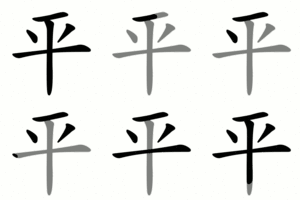 | |||
Han character
平 (Kangxi radical 51, 干+2, 5 strokes, cangjie input 一火十 (MFJ), four-corner 10409, composition ⿻干丷(GHTJV) or ⿻干八(K))
Derived characters
Further reading
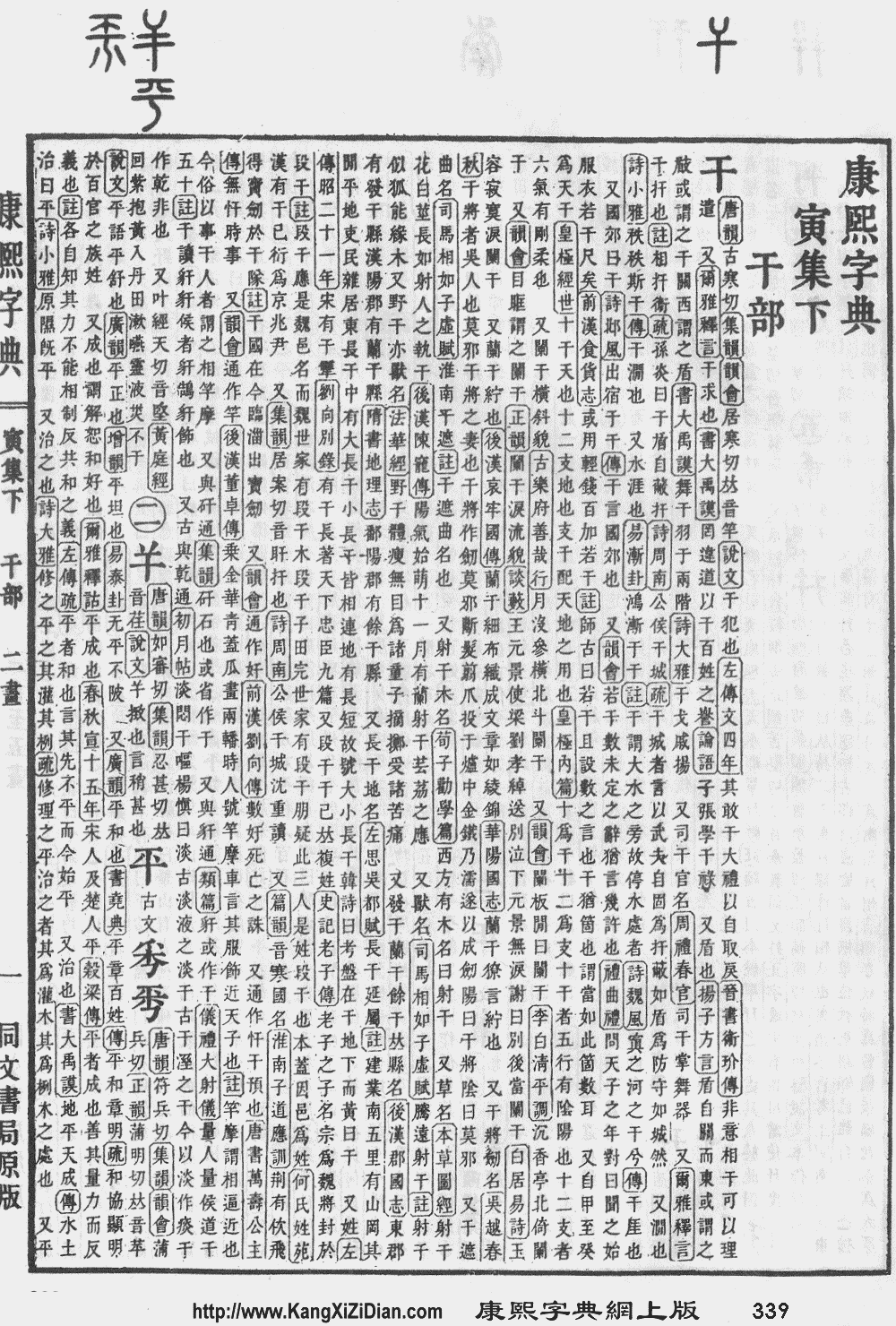
- Kangxi Dictionary: page 339, character 3
- Dai Kanwa Jiten: character 9167
- Dae Jaweon: page 646, character 3
- Hanyu Da Zidian (first edition): volume 1, page 407, character 1
- Unihan data for U+5E73
Chinese
| simp. and trad. |
平 | |
|---|---|---|
| alternative forms | 𠀒 𠀭 𤔁 | |
Glyph origin
| Historical forms of the character 平 | ||
|---|---|---|
| Western Zhou | Shuowen Jiezi (compiled in Han) | Liushutong (compiled in Ming) |
| Bronze inscriptions | Small seal script | Transcribed ancient scripts |
 |
 |
 |
Etymology
From Proto-Sino-Tibetan *(p/b)ljaŋ (“plank; palm; flat surface; wing”), whence Jingpho phun-pyen (phun⁵⁵ pjen³³, “plank”) and Burmese ပြန့် (pran., “flat and even”) (STEDT).
Pronunciation 1
Definitions
平
- level; even; flat
- equal; fair
- equal
- to level; to make level
- calm; peaceful
- Synonyms: 穩/稳 (wěn), 靜/静 (jìng)
- 太平 ― tàipíng ― peaceful and tranquil
- 風平浪靜/风平浪静 ― fēngpínglàngjìng ― to have no waves
- 心平氣和/心平气和 ― xīnpíngqìhé ― even-tempered and good-humoured
- 國治而後天下平。 [Classical Chinese, trad.]
- From: The Book of Rites, c. 4th – 2nd century BCE
- Guó zhì érhòu tiānxià píng. [Pinyin]
- Their states being rightly governed, the whole kingdom was made tranquil and happy.
国治而后天下平。 [Classical Chinese, simp.]
- to calm down; to make peaceful; to quiet down
- to pacify
- 平叛 ― píngpàn ― to suppress a rebellion
- 喪亂既平,既安且寧。 [Pre-Classical Chinese, trad.]
- From: The Classic of Poetry, c. 11th – 7th centuries BCE, translated based on Bernhard Karlgren's version
- Sāngluàn jì píng, jì ān qiě níng. [Pinyin]
- When death and disorder has been settled, there is calm and peace.
丧乱既平,既安且宁。 [Pre-Classical Chinese, simp.]
- ordinary; common; mediocre; average
- (Chinese phonetics) level tone (one of the four tones in Middle Chinese)
- (Cantonese, Hakka, Northern Min) cheap; inexpensive
- (Southern Min, Hakka) the same
- (historical) Short for 北平 (Běipíng).
- 平津戰役/平津战役 ― Píng Jīn zhànyì ― Pingjin campaign
- Short for 平方米 (píngfāngmǐ, “square metre”). Used with numbers without classifiers.
- A surname, number 95 of the Baijiaxing
Synonyms
See also
| The tones (of Chinese) in Mandarin · 聲調/声调 (shēngdiào) (layout · text) | ||||||||||
|---|---|---|---|---|---|---|---|---|---|---|
| 平仄 (píngzè) | 平 (píng) 平聲/平声 (píngshēng) |
仄 (zè) 仄聲/仄声 (zèshēng) | ||||||||
| 平上去入 (píngshǎngqùrù) 四聲/四声 (sìshēng) |
平 (píng) 平聲/平声 (píngshēng) |
上 (shǎng) 上聲/上声 (shǎngshēng) |
去 (qù) 去聲/去声 (qùshēng) |
入 (rù) 入聲/入声 (rùshēng) | ||||||
| 標調方法/标调方法 (biāodiào fāngfǎ) 標調法/标调法 |
四角標調法/四角标调法 | ꜀◌ | ꜂◌ | ◌꜄ | ◌꜆ | |||||
| [Term?] | ◌〪 | ◌〫 | ◌〬 | ◌〭 | ||||||
| 傍點/傍点 | ∅ | ◌〮 | ◌〯 | ∅ | ||||||
| 四聲八調/四声八调 | 陰平/阴平 (yīnpíng) | 陽平/阳平 (yángpíng) | 陰上/阴上 (yīnshǎng) | 陽上/阳上 (yángshǎng) | 陰去/阴去 (yīnqù) | 陽去/阳去 (yángqù) | 陰入/阴入 (yīnrù) | 陽入/阳入 (yángrù) | ||
| 陰/阴 (yīn) | 陽/阳 (yáng) | |||||||||
| 標調方法/标调方法 (biāodiào fāngfǎ) 標調法/标调法 |
四角標調法/四角标调法 | ꜀◌ | ꜁◌ | ꜂◌ | ꜃◌ | ◌꜄ | ◌꜅ | ◌꜆ | ◌꜇ | |
| The tones (of Standard Mandarin) in Mandarin · 聲調/声调 (shēngdiào) (layout · text) | ||||||||||
|---|---|---|---|---|---|---|---|---|---|---|
| 四聲/四声 (sìshēng) | 陰平/阴平 (yīnpíng) 一聲/一声 |
陽平/阳平 (yángpíng) 二聲/二声 (èrshēng) |
上聲/上声 (shǎngshēng) 三聲/三声 (sānshēng) |
去聲/去声 (qùshēng) 四聲/四声 (sìshēng) |
輕聲/轻声 (qīngshēng) | |||||
Compounds
- 一波未平,一波又起 (yī bō wèi píng, yī bō yòu qǐ)
- 一碗水往平處端/一碗水往平处端
- 一馬平川/一马平川 (yīmǎpíngchuān)
- 下平
- 三平二滿/三平二满
- 三通一平
- 不平 (bùpíng)
- 不平之氣/不平之气
- 不平之鳴/不平之鸣 (bùpíngzhīmíng)
- 不平則鳴/不平则鸣 (bùpíngzémíng)
- 不平等待遇
- 不平等條約/不平等条约 (bùpíngděng tiáoyuē)
- 不平而鳴/不平而鸣
- 不登高山,不顯平地/不登高山,不显平地
- 亂極則平/乱极则平
- 二滿三平/二满三平
- 低平 (dīpíng)
- 依流平進/依流平进
- 公平 (gōngpíng)
- 削平
- 剷平/铲平 (chǎnpíng)
- 北平 (Běipíng)
- 北平故宮/北平故宫
- 升平 (shēngpíng)
- 南平 (Nánpíng)
- 南平 (Nánpíng)
- 吃太平飯/吃太平饭
- 向平之願/向平之愿
- 君平
- 和平 (hépíng)
- 嘉平
- 四平八穩/四平八稳 (sìpíngbāwěn)
- 土平
- 地平天成
- 地平線/地平线 (dìpíngxiàn)
- 坦平 (tǎnpíng)
- 填平 (tiánpíng)
- 太平 (tàipíng)
- 天平 (tiānpíng)
- 太平公主 (Tàipíng Gōngzhǔ)
- 太平店 (Tàipíngdiàn)
- 太平溪 (Tàipíngxī)
- 夷平 (yípíng)
- 夷為平地/夷为平地 (yíwéipíngdì)
- 如履平地 (rú lǚ píngdì)
- 子平
- 安平 (ānpíng)
- 安平古堡
- 安平港
- 尸鳩之平
- 市平
- 平一
- 平上去入
- 平下氣/平下气
- 平不答的
- 平世
- 平亂/平乱 (píngluàn)
- 平交
- 平人 (píngrén)
- 平仄 (píngzè)
- 平伏
- 平作
- 平伸
- 平信 (píngxìn)
- 平假名 (píngjiǎmíng)
- 平價/平价 (píngjià)
- 平允 (píngyǔn)
- 平光 (píngguāng)
- 平凡 (píngfán)
- 平分 (píngfēn)
- 平列 (píngliè)
- 平劇/平剧 (píngjù)
- 平動/平动
- 平勻/平匀
- 平半
- 平南 (Píngnán)
- 平原 (píngyuán)
- 平反 (píngfǎn)
- 平叛 (píngpàn)
- 平台 (píngtái)
- 平和
- 平善
- 平圓/平圆
- 平土機/平土机
- 平地 (píngdì)
- 平均 (píngjūn)
- 平坦 (píngtǎn)
- 平埔
- 平壤 (Píngrǎng)
- 平天下 (píngtiānxià)
- 平天冠
- 平天大帝
- 平夷
- 平妥
- 平妖傳/平妖传
- 平安 (píng'ān)
- 平定 (píngdìng)
- 平家物語/平家物语
- 平寇 (píngkòu)
- 平寧/平宁
- 平實/平实 (píngshí)
- 平射
- 平局 (píngjú)
- 平居
- 平屋
- 平展
- 平山冷燕
- 平山堂
- 平川 (píngchuān)
- 平帖
- 平常 (píngcháng)
- 平平
- 平年 (píngnián)
- 平底 (píngdǐ)
- 平康 (píngkāng)
- 平庸 (píngyōng)
- 平復/平复 (píngfù)
- 平心
- 平快車/平快车
- 平息 (píngxī)
- 平房 (píngfáng)
- 平手 (píngshǒu)
- 平抑
- 平抬
- 平撇
- 平撫/平抚 (píngfǔ)
- 平擊球/平击球
- 平攤/平摊
- 平放
- 平政院 (píngzhèngyuàn)
- 平整 (píngzhěng)
- 平文 (píngwén)
- 平方 (píngfāng)
- 平日 (píngrì)
- 平旦
- 平明 (píngmíng)
- 平昔 (píngxī)
- 平易 (píngyì)
- 平星 (Píngxīng)
- 平時/平时 (píngshí)
- 平曉/平晓
- 平曠/平旷 (píngkuàng)
- 平月
- 平服
- 平板 (píngbǎn)
- 平林 (pínglín)
- 平梁
- 平楚
- 平樂/平乐 (Pínglè)
- 平槽
- 平橋/平桥 (Píngqiáo)
- 平權/平权 (píngquán)
- 平正 (píngzhèng)
- 平步青雲/平步青云 (píngbùqīngyún)
- 平毀/平毁 (pínghuǐ)
- 平民 (píngmín)
- 平水
- 平沙落雁
- 平治 (píngzhì)
- 平沽
- 平泛
- 平河 (Pínghé)
- 平泉莊/平泉庄
- 平津
- 平流
- 平淡 (píngdàn)
- 平添 (píngtiān)
- 平滑 (pínghuá)
- 平溪 (Píngxī)
- 平準/平准
- 平漢鐵路/平汉铁路
- 平潭 (Píngtán)
- 平爐/平炉
- 平版 (píngbǎn)
- 平王
- 平生 (píngshēng)
- 平畫求長/平画求长
- 平疇/平畴
- 平白 (píngbái)
- 平皋
- 平直 (píngzhí)
- 平視/平视 (píngshì)
- 平秩
- 平移 (píngyí)
- 平穩/平稳 (píngwěn)
- 平空 (píngkōng)
- 平等 (píngděng)
- 平米 (píngmǐ)
- 平糴/平籴
- 平糶/平粜
- 平紋/平纹 (píngwén)
- 平素 (píngsù)
- 平絨/平绒
- 平綏鐵路/平绥铁路
- 平緩/平缓 (pínghuǎn)
- 平羅/平罗 (Píngluó)
- 平聲/平声 (píngshēng)
- 平胡
- 平脈/平脉
- 平胸 (píngxiōng)
- 平臥/平卧 (píngwò)
- 平臺/平台 (píngtái)
- 平色
- 平莽
- 平落
- 平蕪/平芜
- 平行 (píngxíng)
- 平衍
- 平衡 (pínghéng)
- 平表
- 平裝/平装 (píngzhuāng)
- 平補/平补
- 平西
- 平角 (píngjiǎo)
- 平話/平话 (pínghuà)
- 平調/平调
- 平議/平议 (píngyì)
- 平起平坐 (píngqǐpíngzuò)
- 平足 (píngzú)
- 平跟
- 平路
- 平蹉
- 平身 (píngshēn)
- 平躺 (píngtǎng)
- 平車/平车 (píngchē)
- 平輩/平辈 (píngbèi)
- 平通
- 平遙/平遥 (Píngyáo)
- 平郵/平邮 (píngyóu)
- 平野 (píngyě)
- 平量
- 平金
- 平釘/平钉
- 平針縫/平针缝
- 平鉋/平刨
- 平鋪/平铺
- 平鋪直敘/平铺直叙 (píngpūzhíxù)
- 平鎮/平镇 (Píngzhèn)
- 平闊/平阔
- 平阜
- 平陸/平陆 (Pínglù)
- 平陽/平阳 (píngyáng)
- 平隴望蜀/平陇望蜀
- 平雕
- 平靖
- 平靜/平静 (píngjìng)
- 平面 (píngmiàn)
- 平章
- 平韻/平韵
- 平頂/平顶
- 平順/平顺 (píngshùn)
- 平頭/平头 (píngtóu)
- 平風靜浪/平风静浪
- 平飛球/平飞球
- 平魚/平鱼 (píngyú)
- 庫平/库平
- 延平 (Yánpíng)
- 延平郡王 (Yánpíng Jùnwáng)
- 弭平
- 心和氣平/心和气平
- 心平氣和/心平气和 (xīnpíngqìhé)
- 心平氣定/心平气定
- 心平靜氣/心平静气
- 性平 (xìngpíng)
- 恩平 (Ēnpíng)
- 悉平
- 扁平 (biǎnpíng)
- 打太平拳
- 打平 (dǎpíng)
- 扯平 (chěpíng)
- 找平
- 承平 (chéngpíng)
- 抹平 (mǒpíng)
- 拉平 (lāpíng)
- 持平 (chípíng)
- 掃平/扫平
- 揃平
- 摩平
- 撫平/抚平 (fǔpíng)
- 擺平/摆平 (bǎipíng)
- 攤平/摊平
- 放平
- 敉平 (mǐpíng)
- 昇平/升平 (shēngpíng)
- 昌平 (Chāngpíng)
- 氣憤難平/气愤难平
- 水平 (shuǐpíng)
- 治平 (Zhìpíng)
- 泰平 (tàipíng)
- 泰階平/泰阶平
- 海平階/海平阶
- 清平 (qīngpíng)
- 漢語水平考試/汉语水平考试 (Hànyǔ Shuǐpíng Kǎoshì)
- 熹平
- 牟平 (Mùpíng)
- 瑞平 (Ruìpíng)
- 生平 (shēngpíng)
- 生態平衡/生态平衡 (shēngtài pínghéng)
- 真平
- 短平快 (duǎnpíngkuài)
- 砥平繩直/砥平绳直
- 磨平
- 萬丈高樓平地起/万丈高楼平地起 (wànzhàng gāolóu píngdì qǐ)
- 秤平斗滿
- 興平/兴平 (Xīngpíng)
- 茌平
- 蕩平/荡平 (dàngpíng)
- 衡平
- 角平分線/角平分线 (jiǎo píngfēnxiàn)
- 討平/讨平
- 詳平/详平
- 跌四平
- 踏平 (tàpíng)
- 躧平/𰸐平
- 躺平 (tǎngpíng)
- 逆入平出
- 透平機/透平机 (tòupíngjī)
- 鋪平/铺平 (pūpíng)
- 鏟平/铲平 (chǎnpíng)
- 長平之戰/长平之战
- 開平/开平 (Kāipíng)
- 開平盤/开平盘
- 關平/关平
- 陰平/阴平 (yīnpíng)
- 陳平分肉/陈平分肉
- 陽平/阳平 (yángpíng)
- 風平波息/风平波息
- 風平浪靜/风平浪静 (fēngpínglàngjìng)
- 風靜浪平/风静浪平
- 饒平/饶平 (Ráopíng)
- 高平 (gāopíng)
Descendants
Others:
- → Iu Mien: baengh (“level”)
- → Proto-Palaungic: *-pre/iŋ (“equal, level”) (Sidwell, 2015)
- → Proto-Tai: *biangᴬ (“flat, even”)
Pronunciation 2
Pronunciation 3
Pronunciation 4
| For pronunciation and definitions of 平 – see 抨 (“to shoot with a catapult; to pat; to beat; etc.”). (This character is a variant form of 抨). |
References
- “平”, in 漢語多功能字庫 (Multi-function Chinese Character Database), 香港中文大學 (the Chinese University of Hong Kong), 2014–
- Dictionary of Chinese Character Variants (教育部異體字字典), A01192
Japanese
| Shinjitai | 平 | |
| Kyūjitai [1][2] |
平󠄁 平+ 󠄁?(Adobe-Japan1) |
 |
| 平󠄃 平+ 󠄃?(Hanyo-Denshi) (Moji_Joho) | ||
| The displayed kanji may be different from the image due to your environment. See here for details. | ||
Readings
From Middle Chinese 平 (MC bjaeng):
- Go-on: びょう (byō, Jōyō)←びやう (byau, historical)
- Kan-on: へい (hei, Jōyō)
- Tō-on: ひん (hin)
- Kan’yō-on: ひょう (hyō)←ひやう (fyau, historical)
From Middle Chinese 平 (MC bjien), as an alternative form for 弁:
From native Japanese roots:
- Kun: たいら (taira, 平ら, Jōyō)←たひら (tafira, 平ら, historical); たいら (taira, 平); たいらか (tairaka, 平らか); たいらぐ (tairagu, 平らぐ); たいらげる (tairageru, 平らげる); ひら (hira, 平, Jōyō); ひらに (hirani, 平に)
- Nanori: おさむ (osamu); さね (sane); たいら (taira); たか (taka); つね (tsune); とし (toshi); なり (nari); なる (naru); はかる (hakaru); ひとし (hitoshi); まさる (masaru); もち (mochi); よし (yoshi)
Etymology 1
| Kanji in this term |
|---|
| 平 |
| ひら Grade: 3 |
| kun’yomi |
⟨pi1ra⟩ → /pʲira/ → /ɸira/ → /hira/
From Old Japanese, from Proto-Japonic *pira.
Noun
平 • (hira)
- something flat; flattened
- something ordinary, common, mediocre
- a person of low-ranking status
- the top ridge of a roof parallel to the side of a building (Can we verify(+) this sense?)
- Short for 平織 (hiraori, “plain weave”).
- in bookbinding, the flat part of a cover (Can we verify(+) this sense?)
- Short for 平椀 (hirawan).
Etymology 2
| Kanji in this term |
|---|
| 平 |
| たいら Grade: 3 |
| kun’yomi |
⟨tapi1ra⟩ → /tapʲira/ → /taɸira/ → /tawira/ → /taira/
Proper noun
- a surname, especially of those descended from imperial lineage ineligible for the Chrysanthemum Throne:
- the 桓武平氏 (Kanmu Heishi), from Emperor Kanmu
- the 仁明平氏 (Ninmyō Heishi), from Emperor Ninmyō
- the 文徳平氏 (Montoku Heishi), from Emperor Montoku, and
- the 光孝平氏 (Kōkō Heishi), from Emperor Kōkō
- a placename, especially in Iwaki city, Fukushima Prefecture
- a male given name
Derived terms
- 松平 (Matsudaira)
Etymology 3
| Kanji in this term |
|---|
| 平 |
| へい Grade: 3 |
| kan’on |
From Middle Chinese 平 (MC bjaeng).
The 漢音 (kan'on, literally “Han sound”) reading, so likely a later borrowing from Middle Chinese.
Affix
平 • (hei)
Etymology 4
| Kanji in this term |
|---|
| 平 |
| ひょう Grade: 3 |
| kan’yōon |
/pʲau/ → /ɸʲɔː/ → /hʲoː/
Possibly from Middle Chinese 平 (MC bjaeng).
The 慣用音 (kan'yōon, literally “commonly accepted sound”) reading, a pronunciation in common usage based on a corruption of the Middle Chinese borrowing.
Noun
- Short for 平韻 (hyōin): This term needs a translation to English. Please help out and add a translation, then remove the text
{{rfdef}}. - Short for 平調 (hyōjō): This term needs a translation to English. Please help out and add a translation, then remove the text
{{rfdef}}.
Etymology 5
| Kanji in this term |
|---|
| 平 |
| びょう Grade: 3 |
| goon |
/bʲau/ → /bʲɔː/ → /bʲoː/
From Middle Chinese 平 (MC bjaeng).
The 呉音 (goon, literally “Wu sound”) reading, so likely the earlier borrowing from Middle Chinese.
Etymology 6
| Kanji in this term |
|---|
| 平 |
| Grade: 3 |
| nanori |
Nominalization of classical verb おさむ (osamu), modern おさめる (osameru, multiple definitions in kanji).
Etymology 7
| Kanji in this term |
|---|
| 平 |
| Grade: 3 |
| nanori |
Nominalization of classical adjective 等し (hitoshi), modern 等しい (hitoshii, “equal, same”).
Etymology 8
| Kanji in this term |
|---|
| 平 |
| Grade: 3 |
| nanori |
Nominalization of classical adjective 広し (hiroshi), modern 広い (hiroi, “vast, wide”).
Etymology 9
| Kanji in this term |
|---|
| 平 |
| Grade: 3 |
| nanori |
Nominalization of classical adjective 安し (yasushi), modern 安い (yasui, “peaceful, quiet”).
Etymology 10
| Kanji in this term |
|---|
| 平 |
| Grade: 3 |
| nanori |
Nominalization of classical adjective 良し (yoshi), modern 良い (yoi, “good, fine”).
References
- “平”, in 漢字ぺディア (Kanjipedia) (in Japanese), 日本漢字能力検定協会, 2015–2024
- Haga, Gōtarō (1914) 漢和大辞書 [The Great Kanji-Japanese Dictionary] (in Japanese), Fourth edition, Tōkyō: Kōbunsha, , page 772 (paper), page 436 (digital)
- Matsumura, Akira, editor (2006), 大辞林 [Daijirin] (in Japanese), Third edition, Tōkyō: Sanseidō, →ISBN
Korean
Vietnamese
Han character
平: Hán Việt readings: bình[1][2][3][4][5], biền[5]
平: Nôm readings: bình[1][2], bằng[1][2], bừng[1], bường[2]
Compounds
References
- Nguyễn (2014).
- Trần (2004).
- Trần (1999).
- Nguyễn (1974).
- Thiều Chửu (1942).