臨
See also: 临
| ||||||||
| ||||||||
Translingual
Han character
臨 (Kangxi radical 131, 臣+11, 17 strokes in Chinese, 18 strokes in Japanese, cangjie input 尸中人口口 (SLORR), four-corner 78766, composition ⿰臣⿱𠂉品)
Derived characters
- 瀶, 𠐼, 𡄦, 𤄈, 𮟤
References
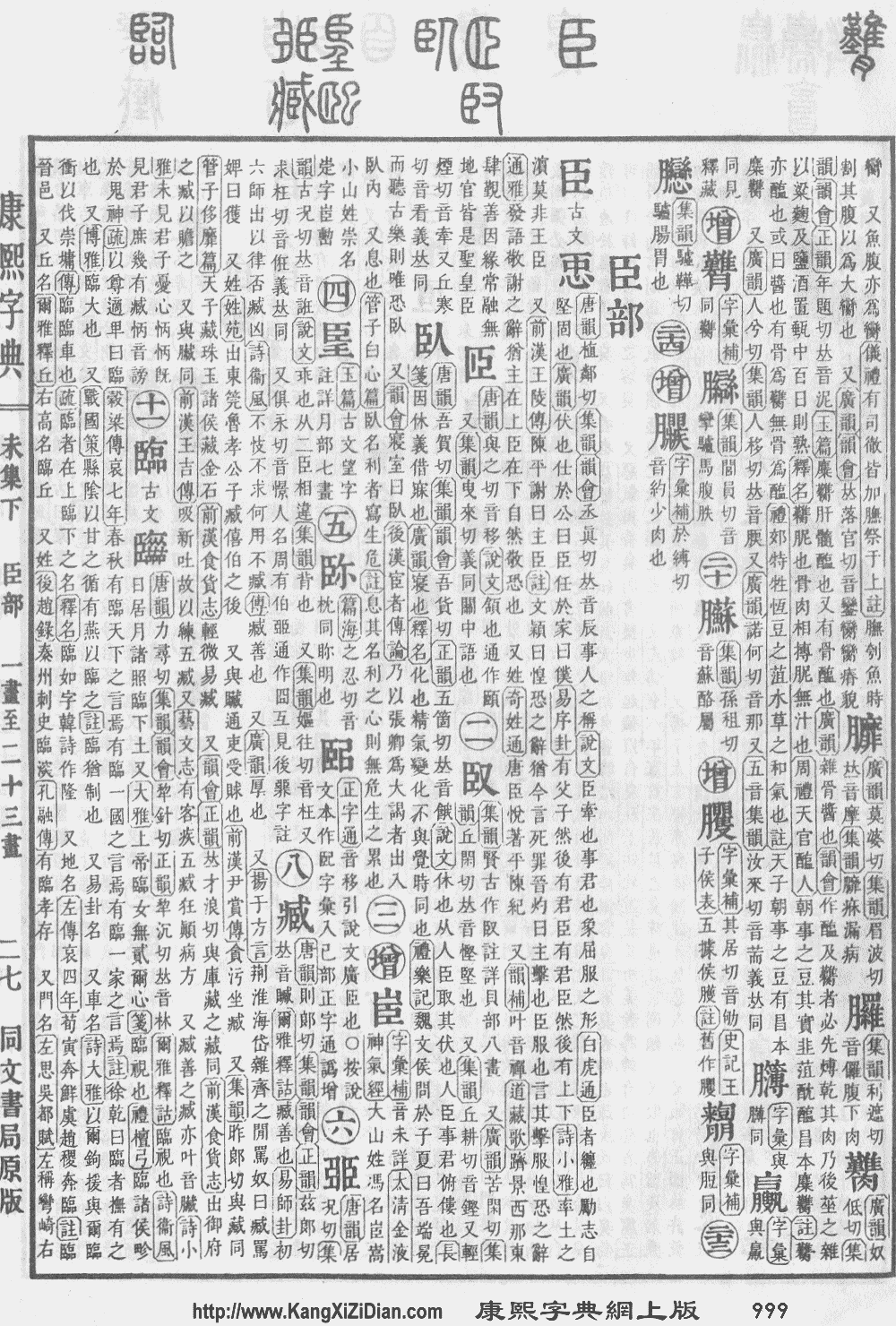
- Kangxi Dictionary: page 999, character 24
- Dai Kanwa Jiten: character 30087
- Dae Jaweon: page 1451, character 6
- Hanyu Da Zidian (first edition): volume 4, page 2802, character 19
- Unihan data for U+81E8
- Unihan data for U+F9F6
Chinese
Glyph origin
Characters in the same phonetic series (品) (Zhengzhang, 2003)
Ideogrammic compound (會意/会意) and phono-semantic compound (形聲/形声, OC *b·rɯm, *b·rɯms) : semantic 臣 (“eye”) + semantic 人 (“person”) + phonetic 品 (OC *pʰrɯmʔ, “objects”) – a person looking down at some objects.
Alternatively analyzed as a phono-semantic compound (形聲/形声, OC *b·rɯm, *b·rɯms) : semantic 臥 + phonetic 品 (OC *pʰrɯmʔ).
Pronunciation 1
Definitions
臨
Compounds
- 事到臨頭/事到临头
- 五福臨門/五福临门 (wǔfúlínmén)
- 來臨/来临 (láilín)
- 俯臨/俯临
- 光臨/光临 (guānglín)
- 兵臨城下/兵临城下 (bīnglínchéngxià)
- 到臨/到临
- 唐臨晉帖/唐临晋帖
- 單格臨書/单格临书
- 大禍臨頭/大祸临头
- 大難臨頭/大难临头 (dànànlíntóu)
- 大駕光臨/大驾光临
- 如履如臨/如履如临
- 如臨大敵/如临大敌 (rúlíndàdí)
- 如臨深淵/如临深渊 (rúlínshēnyuān)
- 如臨淵谷/如临渊谷
- 如臨深谷/如临深谷
- 將臨期/将临期 (jiānglínqī)
- 對臨/对临
- 屆臨/届临
- 居高臨下/居高临下 (jūgāolínxià)
- 履薄臨深/履薄临深
- 恩臨/恩临
- 惠臨/惠临
- 意臨/意临
- 握圖臨宇/握图临宇
- 揮翰臨池/挥翰临池
- 死臨侵/死临侵
- 瀕臨/濒临 (bīnlín)
- 照臨/照临 (zhàolín)
- 犬牙相臨/犬牙相临
- 玉樹臨風/玉树临风 (yùshùlínfēng)
- 登山臨水/登山临水
- 登臨/登临 (dēnglín)
- 盛氣臨人/盛气临人
- 監臨/监临
- 監臨自盜/监临自盗
- 禍到臨頭/祸到临头
- 移臨/移临
- 背臨/背临
- 臨了/临了 (línliǎo)
- 臨事以懼/临事以惧
- 臨事而懼/临事而惧
- 臨人/临人
- 臨凡/临凡
- 臨刑/临刑 (línxíng)
- 臨別/临别 (línbié)
- 臨別依依/临别依依
- 臨制/临制
- 臨到/临到 (líndào)
- 臨危/临危 (línwēi)
- 臨危下石/临危下石
- 臨危不亂/临危不乱 (línwēibùluàn)
- 臨危不懼/临危不惧
- 臨危不撓/临危不挠
- 臨危不顧/临危不顾
- 臨危受命/临危受命
- 臨危履冰/临危履冰
- 臨危授命/临危授命 (línwēishòumìng)
- 臨危效命/临危效命
- 臨危自悔/临危自悔
- 臨危自省/临危自省
- 臨危自計/临危自计
- 臨危致命/临危致命
- 臨去秋波/临去秋波
- 臨問/临问
- 臨噎掘井/临噎掘井
- 臨場/临场 (línchǎng)
- 臨場感/临场感 (línchǎnggǎn)
- 臨寂/临寂
- 臨寢/临寝
- 臨寫/临写
- 臨崖勒馬/临崖勒马
- 臨川羨魚/临川羡鱼
- 臨帖/临帖 (líntiè)
- 臨年/临年
- 臨幸/临幸 (línxìng)
- 臨床/临床 (línchuáng)
- 臨床實驗/临床实验
- 臨床經驗/临床经验
- 臨床醫學/临床医学 (línchuáng yīxué)
- 臨急抱佛腳/临急抱佛脚 (línjí bào fójiǎo)
- 臨感/临感
- 臨摹/临摹 (línmó)
- 臨摹本/临摹本
- 臨政/临政
- 臨敵賣陣/临敌卖阵
- 臨文/临文
- 臨文不諱/临文不讳
- 臨時/临时 (línshí)
- 臨時動議/临时动议
- 臨時工/临时工 (línshígōng)
- 臨時政府/临时政府
- 臨時會/临时会
- 臨時條款/临时条款
- 臨書/临书
- 臨月/临月 (línyuè)
- 臨期/临期 (línqī)
- 臨朝/临朝 (líncháo)
- 臨期失誤/临期失误
- 臨本/临本 (línběn)
- 臨榆縣/临榆县
- 臨榻/临榻
- 臨機/临机
- 臨機制勝/临机制胜
- 臨機制變/临机制变
- 臨機應變/临机应变
- 臨機處置/临机处置
- 臨檢/临检
- 臨歧/临歧
- 臨死/临死 (línsǐ)
- 臨死不怯/临死不怯
- 臨死不恐/临死不恐 (línsǐbùkǒng)
- 臨水夫人/临水夫人
- 臨水登山/临水登山
- 臨江/临江 (Línjiāng)
- 臨池/临池
- 臨池學書/临池学书
- 臨江折軸/临江折轴
- 臨江驛/临江驿
- 臨沂/临沂 (Línyí)
- 臨河羨魚/临河羡鱼
- 臨深履冰/临深履冰
- 臨深履薄/临深履薄
- 臨淵履薄/临渊履薄
- 臨淵結網/临渊结网
- 臨淵羨魚/临渊羡鱼 (línyuānxiànyú)
- 臨渴掘井/临渴掘井 (línkějuéjǐng)
- 臨渴穿井/临渴穿井
- 臨滄/临沧 (Líncāng)
- 臨潼鬥寶/临潼斗宝
- 臨濟宗/临济宗
- 臨照/临照
- 臨界/临界 (línjiè)
- 臨界線/临界线
- 臨界點/临界点 (línjièdiǎn)
- 臨畫/临画
- 臨盆/临盆 (línpén)
- 臨眺/临眺
- 臨睡/临睡 (línshuì)
- 臨終/临终 (línzhōng)
- 臨終關懷/临终关怀 (línzhōng guānhuái)
- 臨蓐/临蓐 (línrù)
- 臨行/临行 (línxíng)
- 臨街/临街 (línjiē)
- 臨衝/临冲
- 臨財/临财
- 臨財不苟/临财不苟
- 臨財苟得/临财苟得
- 臨走/临走 (línzǒu)
- 臨軍對壘/临军对垒
- 臨軍對陣/临军对阵
- 臨軒/临轩
- 臨近/临近 (línjìn)
- 臨逼/临逼
- 臨邛縣/临邛县
- 臨門/临门 (línmén)
- 臨門一腳/临门一脚
- 臨陣/临阵 (línzhèn)
- 臨陣磨槍/临阵磨枪 (línzhènmóqiāng)
- 臨陣脫逃/临阵脱逃 (línzhèntuōtáo)
- 臨雍
- 臨難/临难 (línnàn)
- 臨難不屈/临难不屈
- 臨難不恐/临难不恐 (línnànbùkǒng)
- 臨難不懾/临难不慑
- 臨難不懼/临难不惧 (línnànbùjù)
- 臨難不避/临难不避
- 臨難無懾/临难无慑
- 臨難苟免/临难苟免 (línnàngǒumiǎn)
- 臨難鑄兵/临难铸兵
- 臨頭/临头 (líntóu)
- 臨風/临风
- 臨風對月/临风对月
- 臨風搖曳/临风摇曳
- 臨風顧盼/临风顾盼
- 臨食廢箸/临食废箸
- 蒞臨/莅临 (lìlín)
- 親臨/亲临 (qīnlín)
- 賁臨/贲临 (bìlín)
- 賵臨/赗临
- 身臨其境/身临其境 (shēnlínqíjìng)
- 軍臨城下/军临城下
- 迫臨/迫临 (pòlín)
- 逼臨/逼临
- 闔第光臨/阖第光临
- 降臨/降临 (jiànglín)
- 雙喜臨門/双喜临门 (shuāngxǐlínmén)
- 面臨/面临 (miànlín)
- 馬端臨/马端临
- 駕臨/驾临 (jiàlín)
Pronunciation 2
Compounds
- 哀臨/哀临
- 哭臨/哭临
Pronunciation
Japanese
Korean
Vietnamese
This article is issued from Wiktionary. The text is licensed under Creative Commons - Attribution - Sharealike. Additional terms may apply for the media files.