吳
| ||||||||
Translingual
| Traditional | 吳 |
|---|---|
| Shinjitai | 呉 |
| Simplified | 吴 |
Han character
吳 (Kangxi radical 30, 口+4, 7 strokes, cangjie input 口女弓大 (RVNK), four-corner 26801, composition ⿺⿱𠃑大口)
References
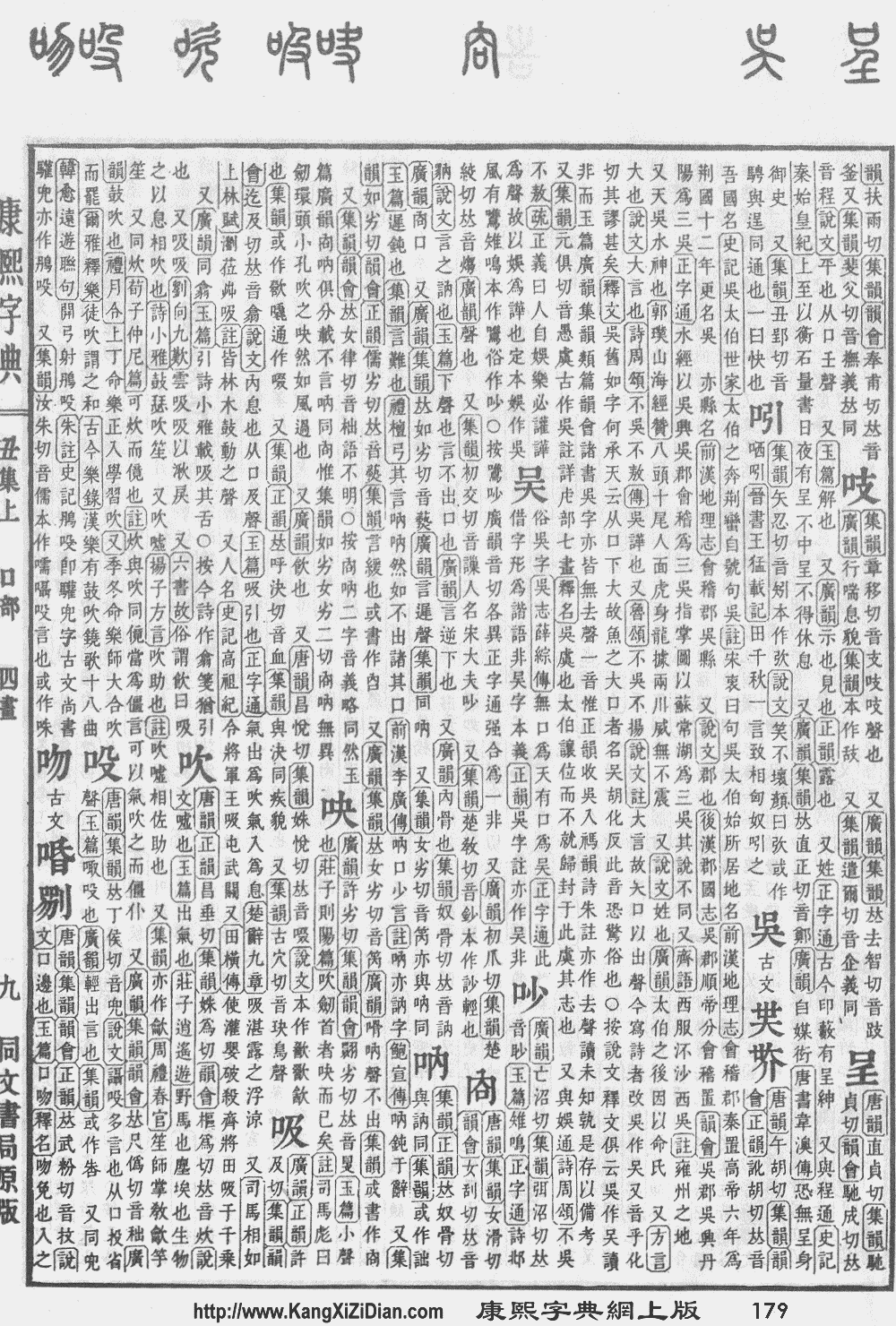
- Kangxi Dictionary: page 179, character 4
- Dai Kanwa Jiten: character 3365
- Dae Jaweon: page 396, character 15
- Hanyu Da Zidian (first edition): volume 1, page 595, character 8
- Unihan data for U+5433
Chinese
| trad. | 吳/吴* | |
|---|---|---|
| simp. | 吴* | |
| alternative forms | 呉 𠯵 㕦 𡗾 𡗿 | |
Glyph origin
| Historical forms of the character 吳 | |||
|---|---|---|---|
| Shang | Western Zhou | Shuowen Jiezi (compiled in Han) | Liushutong (compiled in Ming) |
| Oracle bone script | Bronze inscriptions | Small seal script | Transcribed ancient scripts |
 |
 |
 |
 |
Characters in the same phonetic series (吳) (Zhengzhang, 2003)
Ideogrammic compound (會意/会意) : 口 (“mouth”) + 夨 (“man with tilted head”) – to speak loudly.
Etymology 1
Pronunciation
Definitions
吳
- † to speak loudly; to shout
- 不吳不敖,胡考之休。 [Pre-Classical Chinese, trad.]
- From: The Classic of Poetry, c. 11th – 7th centuries BCE, translated based on James Legge's version
- Bù wú bù áo, hú kǎo zhī xiū. [Pinyin]
- There is no noise, no insolence: An auspice, [all this], of great longevity.
不吴不敖,胡考之休。 [Pre-Classical Chinese, simp.]
- † big
- (historical) (~國) Wu, a state during the Western Zhou dynasty and the Spring and Autumn period
- (historical) (~國) Eastern Wu, one of the Three Kingdoms
- (historical) (~國) Wu, one of the Ten Kingdoms in eastern China which was in existence from 907 to 937
- the region comprising southern Jiangsu and northern Zhejiang
- Wu; the Chinese dialects of that territory, including Suzhounese and Shanghainese
- See also: 吳語
- (~市) Kure (a city in Hiroshima Prefecture, Japan)
- a surname
Compounds
- 伐東吳/伐东吴
- 句吳/句吴 (Gōuwú)
- 吳下阿蒙/吴下阿蒙
- 吳儂/吴侬
- 吳剛伐桂/吴刚伐桂
- 吳國/吴国 (Wúguó)
- 吳堡/吴堡 (Wúbǔ)
- 吳子/吴子
- 吳宮教陣/吴宫教阵
- 吳家灣/吴家湾 (Wújiāwān)
- 吳山/吴山 (Wúshān)
- 吳川/吴川 (Wúchuān)
- 吳市吹簫/吴市吹箫
- 吳店/吴店 (Wúdiàn)
- 吳棚/吴棚 (Wúpéng)
- 吳榜/吴榜 (Wúbǎng)
- 吳樓/吴楼 (Wúlóu)
- 吳江/吴江 (Wújiāng)
- 吳沙/吴沙 (Wúshā)
- 吳派/吴派
- 吳淞江/吴淞江 (Wúsōngjiāng)
- 吳灣/吴湾 (Wúwān)
- 吳牛喘月/吴牛喘月 (Wú niú chuǎnyuè)
- 吹簫吳市/吹箫吴市
- 吳茱萸/吴茱萸 (wúzhūyú)
- 吳語/吴语 (wúyǔ)
- 吳越/吴越 (Wúyuè)
- 吳越同舟/吴越同舟
- 吳越春秋/吴越春秋
- 吳郭魚/吴郭鱼 (wúguōyú)
- 吳都/吴都
- 吳鉤/吴钩
- 吳鋪/吴铺 (Wúpù)
- 吳音/吴音 (wúyīn)
- 吳頭楚尾/吴头楚尾
- 吳鹽/吴盐
- 大吳/大吴
- 孫吳/孙吴
- 宋畫吳冶/宋画吴冶
- 東吳/东吴 (Dōngwú)
- 楚尾吳頭/楚尾吴头
See also
Pronunciation
Japanese
| 呉 | |
| 吳 |
Readings
Usage notes
This character lacks JIS support. The character 呉 (U+5449) is used instead in Japanese.
Korean
Hanja
吳 (eumhun 성씨 오 (seongssi o)) Surname:Oh
- This term needs a translation to English. Please help out and add a translation, then remove the text
{{rfdef}}.
吳 (eumhun 큰소리칠 화 (keunsorichil hwa))Making a loud noise or Make a loud noise.
- This term needs a translation to English. Please help out and add a translation, then remove the text
{{rfdef}}.
Vietnamese
This article is issued from Wiktionary. The text is licensed under Creative Commons - Attribution - Sharealike. Additional terms may apply for the media files.