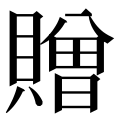
贈
See also: 赠
| ||||||||
 | ||||||||
 | ||||||||
Translingual
| Traditional | 贈 |
|---|---|
| Simplified | 赠 |
| Japanese | 贈 |
| Korean | 贈 |
Alternative forms
Note difference between Chinese form, which uses 曾, and Japanese shinjitai which uses 曽.
In Korea, the upper right component is 八 instead of 丷, which is also the historical form found in the Kangxi dictionary.
Han character
贈 (Kangxi radical 154, 貝+12 in Chinese, 貝+11 in Japanese, 19 strokes in Chinese, 18 strokes in Japanese, cangjie input 月金金田日 (BCCWA), four-corner 68866, composition ⿰貝曾(GHTKV or U+FA65) or ⿰貝曽(J or U+FAC1))
Derived characters
References
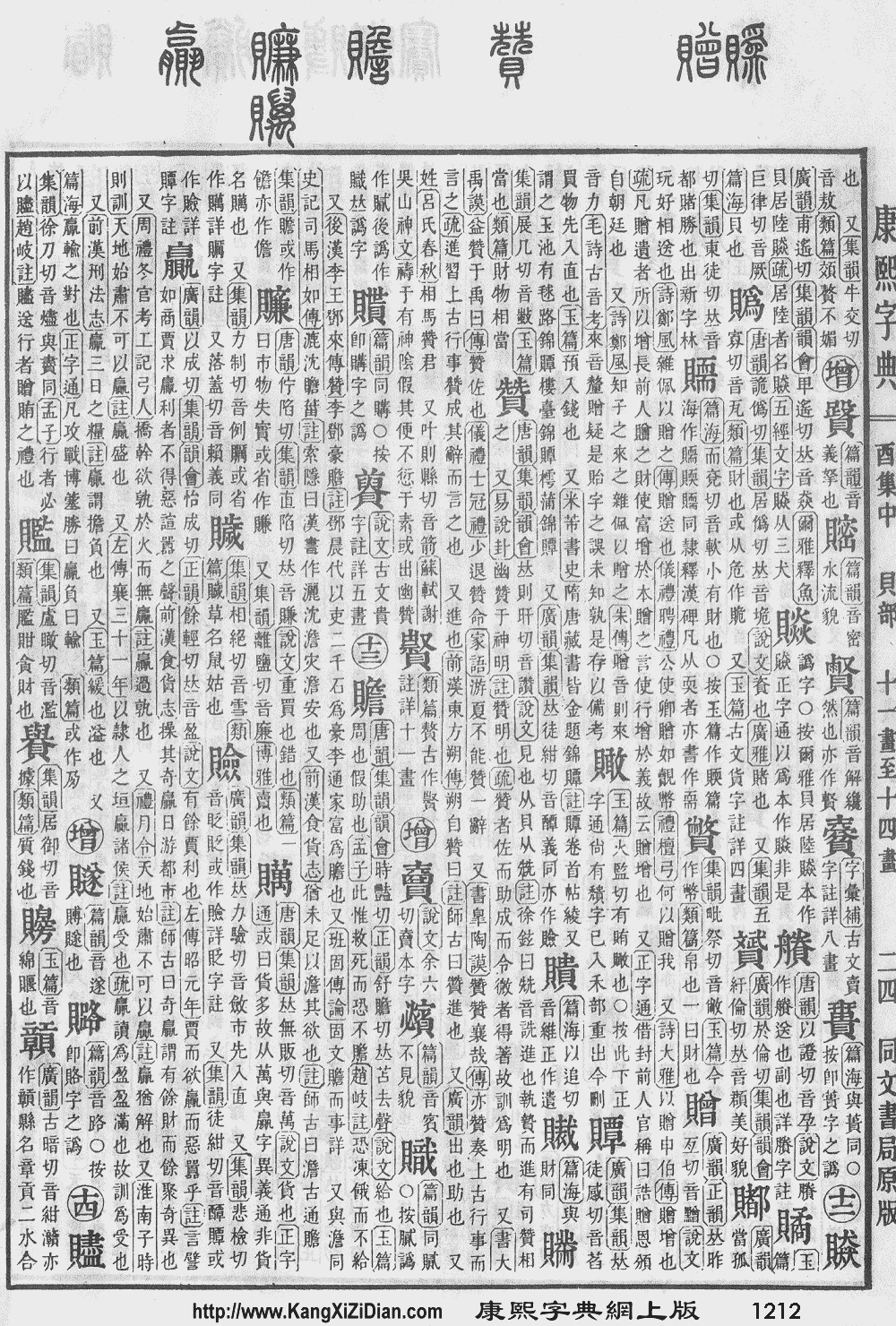
- Kangxi Dictionary: page 1212, character 15
- Dai Kanwa Jiten: character 36920
- Dae Jaweon: page 1678, character 19
- Hanyu Da Zidian (first edition): volume 6, page 3658, character 9
- Unihan data for U+8D08
- Unihan data for U+FA65
- Unihan data for U+FAC1
Chinese
| trad. | 贈 | |
|---|---|---|
| simp. | 赠 | |
| alternative forms | 𧸑 | |
Glyph origin
| Historical forms of the character 贈 | |
|---|---|
| Shuowen Jiezi (compiled in Han) | Liushutong (compiled in Ming) |
| Small seal script | Transcribed ancient scripts |
 |
 |
Characters in the same phonetic series (曾) (Zhengzhang, 2003)
Phono-semantic compound (形聲/形声, OC *zɯːŋs) : semantic 貝 + phonetic 曾 (OC *ʔsɯːŋ, *zɯːŋ).
Pronunciation
Compounds
- 回贈/回赠
- 奉贈/奉赠
- 封贈/封赠
- 惠贈/惠赠
- 捐贈/捐赠 (juānzèng)
- 敕贈/敕赠
- 綈袍之贈/绨袍之赠
- 腆贈/腆赠
- 致贈/致赠
- 誥贈/诰赠
- 貤贈/𰷠赠
- 賠贈/赔赠
- 賻贈/赙赠 (fùzèng)
- 贈予/赠予 (zèngyǔ)
- 贈別/赠别
- 贈品/赠品 (zèngpǐn)
- 贈嫁/赠嫁
- 贈序/赠序
- 贈獎/赠奖
- 贈禮/赠礼 (zènglǐ)
- 贈策/赠策
- 贈答/赠答
- 贈與/赠与 (zèngyǔ)
- 贈言/赠言 (zèngyán)
- 贈詩/赠诗
- 贈賻/赠赙
- 贈送/赠送 (zèngsòng)
- 贈遺/赠遗
- 贈閱/赠阅
- 轉贈/转赠 (zhuǎnzèng)
- 追贈/追赠
- 遺贈/遗赠 (yízèng)
- 采蘭贈芍/采兰赠芍
- 附贈/附赠
- 雪中贈襦/雪中赠襦
- 頒贈/颁赠 (bānzèng)
- 餽贈/馈赠 (kuìzèng)
- 饋贈/馈赠 (kuìzèng)
Japanese
| Shinjitai | 贈 | |
| Kyūjitai [1] |
贈 贈or 贈+ ︀? |
|
| 贈󠄁 贈+ 󠄁?(Adobe-Japan1) | ||
| 贈󠄃 贈+ 󠄃?(Hanyo-Denshi) (Moji_Joho) | ||
| The displayed kanji may be different from the image due to your environment. See here for details. | ||
Readings
References
- “贈”, in 漢字ぺディア (Kanjipedia) (in Japanese), 日本漢字能力検定協会, 2015–2024
Korean
Hanja
贈 • (jeung) (hangeul 증, revised jeung, McCune–Reischauer chŭng, Yale cung)
- This term needs a translation to English. Please help out and add a translation, then remove the text
{{rfdef}}.
Vietnamese
This article is issued from Wiktionary. The text is licensed under Creative Commons - Attribution - Sharealike. Additional terms may apply for the media files.