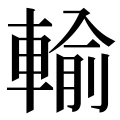
輸
| ||||||||
 | ||||||||
 | ||||||||
Translingual
Han character
輸 (Kangxi radical 159, 車+9, 16 strokes, cangjie input 十十人一弓 (JJOMN), four-corner 58021, composition ⿰車俞(GHTJV or U+FAC2) or ⿰車兪(K or U+2F9DF))
Derived characters
- 𭌋, 瀭, 𪿐
Related characters
References
- Kangxi Dictionary: page 1246, character 23
- Dai Kanwa Jiten: character 38438
- Dae Jaweon: page 1723, character 31
- Hanyu Da Zidian (first edition): volume 5, page 3546, character 1
- Unihan data for U+8F38
- Unihan data for U+FAC2
- Unihan data for U+2F9DF

Chinese
Glyph origin
Characters in the same phonetic series (俞) (Zhengzhang, 2003)
| Old Chinese | |
|---|---|
| 褕 | *low, *lo |
| 偷 | *l̥ʰoː |
| 媮 | *l̥ʰoː, *lo |
| 鍮 | *l̥ʰoː |
| 緰 | *l'oː, *slo |
| 牏 | *l'oː, *l'os, *lo |
| 揄 | *l'oː, *l'oːʔ, *lu, *lo |
| 窬 | *l'oː, *l'oːs, *lo |
| 歈 | *l'oː, *lo |
| 俞 | *l̥ʰus, *lo |
| 隃 | *slo, *hljo, *hljos, *lo |
| 毹 | *sro |
| 輸 | *hljo, *hljos |
| 鄃 | *hljo, *lo |
| 腧 | *hljos |
| 逾 | *lo |
| 榆 | *lo |
| 愉 | *lo |
| 渝 | *lo |
| 瑜 | *lo |
| 蕍 | *lo |
| 覦 | *lo, *los |
| 蝓 | *lo |
| 踰 | *lo |
| 崳 | *lo |
| 羭 | *lo |
| 堬 | *lo |
| 瘉 | *lo, *loʔ |
| 萮 | *lo |
| 騟 | *lo |
| 愈 | *loʔ |
| 貐 | *loʔ |
| 喻 | *los |
| 諭 | *los |
Phono-semantic compound (形聲/形声, OC *hljo, *hljos) : semantic 車 + phonetic 俞 (OC *l̥ʰus, *lo).
Pronunciation 1
| trad. | 輸 | |
|---|---|---|
| simp. | 输 | |
| 2nd round simp. | 𰹰 | |
| alternative forms | ⿱亼𨊸/⿱亼䢁 ⿰車𬾮 | |
Definitions
輸
- to transport; to carry; to haul
- to lose; to be beaten; to be defeated
- Synonym: 敗/败 (bài)
- Antonym: 贏/赢 (yíng)
- 輸給一個小孩/输给一个小孩 ― shū gěi yīge xiǎohái ― to lose to a child
- 輸畀個細路/输畀个细路 [Cantonese] ― syu1 bei2 go3 sai3 lou6 [Jyutping] ― to lose to a child
- 智者竭其智,勇者奮其勇,富者輸其財,舉國一致,眾志成城。 [Written Vernacular Chinese, trad.]
- From: 1915: 李大釗 (Li Dazhao) 《警告全國父老書》 (A Letter of Warning to All the Elders of the Country)
- Zhì zhě jié qí zhì, yǒng zhě fèn qí yǒng, fù zhě shū qí cái, jǔ guó yīzhì, zhòngzhìchéngchéng. [Pinyin]
- The wise exhaust their wisdom; the brave consume their bravery; the wealthy lose their wealth; [when] the entire country shares a common goal, the will of the masses forge a stronghold.
智者竭其智,勇者奋其勇,富者输其财,举国一致,众志成城。 [Written Vernacular Chinese, simp.]
- (literary) to donate; to contribute
- 輸誠/输诚 ― shū chéng ― to contribute/express sincerity
- 輸財助邊/输财助边 ― shū cái zhù biān ― to donate money for border defence
- 大家牛車,小家擔負,輸租繈屬不絕,課更以最上。 [Literary Chinese, trad.]
- From: Taiping Yulan (Readings of the Taiping Era), 977 – 983 CE
- Dàjiā niúchē, xiǎojiā dānfù, shū zū qiǎng shǔ bùjué, kè gèng yǐ zuìshàng. [Pinyin]
- (please add an English translation of this usage example)
大家牛车,小家担负,输租襁属不绝,课更以最上。 [Literary Chinese, simp.]- 侍郎宋德宜奏稱捐輸三載,所入二百餘萬,知縣最多,計五百餘人。 [MSC, trad.]
- From: 《清稗類鈔·度支類·捐輸始於開國》 (Anthology of Petty Qing Matters)
- Shìláng Sòngdéyí zòu chēng juān shū sān zǎi, suǒ rù èrbǎi yú wàn, zhīxiàn zuìduō, jì wǔbǎi yú rén. [Pinyin]
- (please add an English translation of this usage example)
侍郎宋德宜奏称捐输三载,所入二百余万,知县最多,计五百余人。 [MSC, simp.]
- a surname
Compounds
- 不服輸/不服输
- 不見輸贏/不见输赢
- 不輸/不输
- 伏輸/伏输 (fúshū)
- 傳輸/传输 (chuánshū)
- 全血輸血/全血输血
- 公路運輸/公路运输
- 公輸/公输
- 公輸子/公输子
- 公輸般/公输般
- 利益輸送/利益输送
- 十賭九輸/十赌九输 (shídǔjiǔshū)
- 反輸一帖/反输一帖
- 同步傳輸/同步传输
- 問輸/问输
- 均輸/均输
- 大敗虧輸/大败亏输
- 大眾運輸/大众运输
- 平行輸入/平行输入
- 手寫輸入/手写输入
- 打輸/打输
- 捐輸/捐输
- 整廠輸出/整厂输出
- 𣍐輸/𫧃输 (bē-su)
- 服輸/服输 (fúshū)
- 樂輸/乐输
- 灌輸/灌输 (guànshū)
- 自體輸血/自体输血
- 虧輸/亏输
- 袂輸/袂输 (bē-su)
- 詐敗佯輸/诈败佯输
- 認輸/认输 (rènshū)
- 資料傳輸/资料传输
- 輸不起/输不起 (shūbùqǐ)
- 輸入/输入 (shūrù)
- 輸入法/输入法 (shūrùfǎ)
- 輸出/输出 (shūchū)
- 輸卵管/输卵管 (shūluǎnguǎn)
- 輸家/输家 (shūjiā)
- 輸實/输实
- 輸寫/输写
- 輸將/输将
- 輸尿管/输尿管 (shūniàoguǎn)
- 輸征
- 輸心/输心
- 輸捐/输捐
- 輸服甘結/输服甘结
- 輸氧/输氧 (shūyǎng)
- 輸油管/输油管
- 輸液/输液 (shūyè)
- 輸理/输理 (shūlǐ)
- 輸精管/输精管 (shūjīngguǎn)
- 輸糧/输粮
- 輸肝剖膽/输肝剖胆
- 輸肝瀝膽/输肝沥胆
- 輸血/输血 (shūxuè)
- 輸誠/输诚 (shūchéng)
- 輸財助邊/输财助边
- 輸贏/输赢 (shūyíng)
- 輸身/输身
- 輸送/输送 (shūsòng)
- 輸送帶/输送带 (shūsòngdài)
- 輸錢/输钱
- 輸電/输电 (shūdiàn)
- 運輸/运输 (yùnshū)
- 運輸工具/运输工具
- 運輸成本/运输成本
- 運輸業/运输业 (yùnshūyè)
- 運輸機/运输机 (yùnshūjī)
- 運輸費/运输费
Descendants
- → Vietnamese: thua (“to lose”)
Compounds
- 樂輸/乐输
- 送輸/送输
Japanese
| Shinjitai | 輸 | |
| Kyūjitai [1] |
輸 輸or 輸+ ︁? |
|
| 輸󠄁 輸+ 󠄁?(Adobe-Japan1) | ||
| 輸󠄃 輸+ 󠄃?(Hanyo-Denshi) (Moji_Joho) | ||
| The displayed kanji may be different from the image due to your environment. See here for details. | ||
Readings
Derived terms
References
- “輸”, in 漢字ぺディア (Kanjipedia) (in Japanese), 日本漢字能力検定協会, 2015–2024
Korean
Etymology
From Middle Chinese 輸 (MC syu|syuH). Recorded as Middle Korean 슈 (syu) (Yale: syu) in Hunmong Jahoe (訓蒙字會 / 훈몽자회), 1527.
Compounds
Vietnamese
References
- Nguyễn (2014).
- Nguyễn et al. (2009).
- Trần (2004).
- Hồ (1976).
This article is issued from Wiktionary. The text is licensed under Creative Commons - Attribution - Sharealike. Additional terms may apply for the media files.