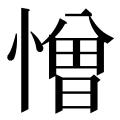
憎
| ||||||||
 | ||||||||
 | ||||||||
| ||||||||
Translingual
| Japanese | 憎 |
|---|---|
| Simplified | 憎 |
| Traditional | 憎 |
Alternative forms
Note difference between Chinese form, which uses 曾, and Japanese shinjitai which uses 曽.
Han character
憎 (Kangxi radical 61, 心+12 in Chinese, 心+11 in Japanese, 15 strokes in Chinese, 14 strokes in Japanese, cangjie input 心金田日 (PCWA), four-corner 98066, composition ⿰忄曾(GHTK) or ⿰忄曽(J))
References
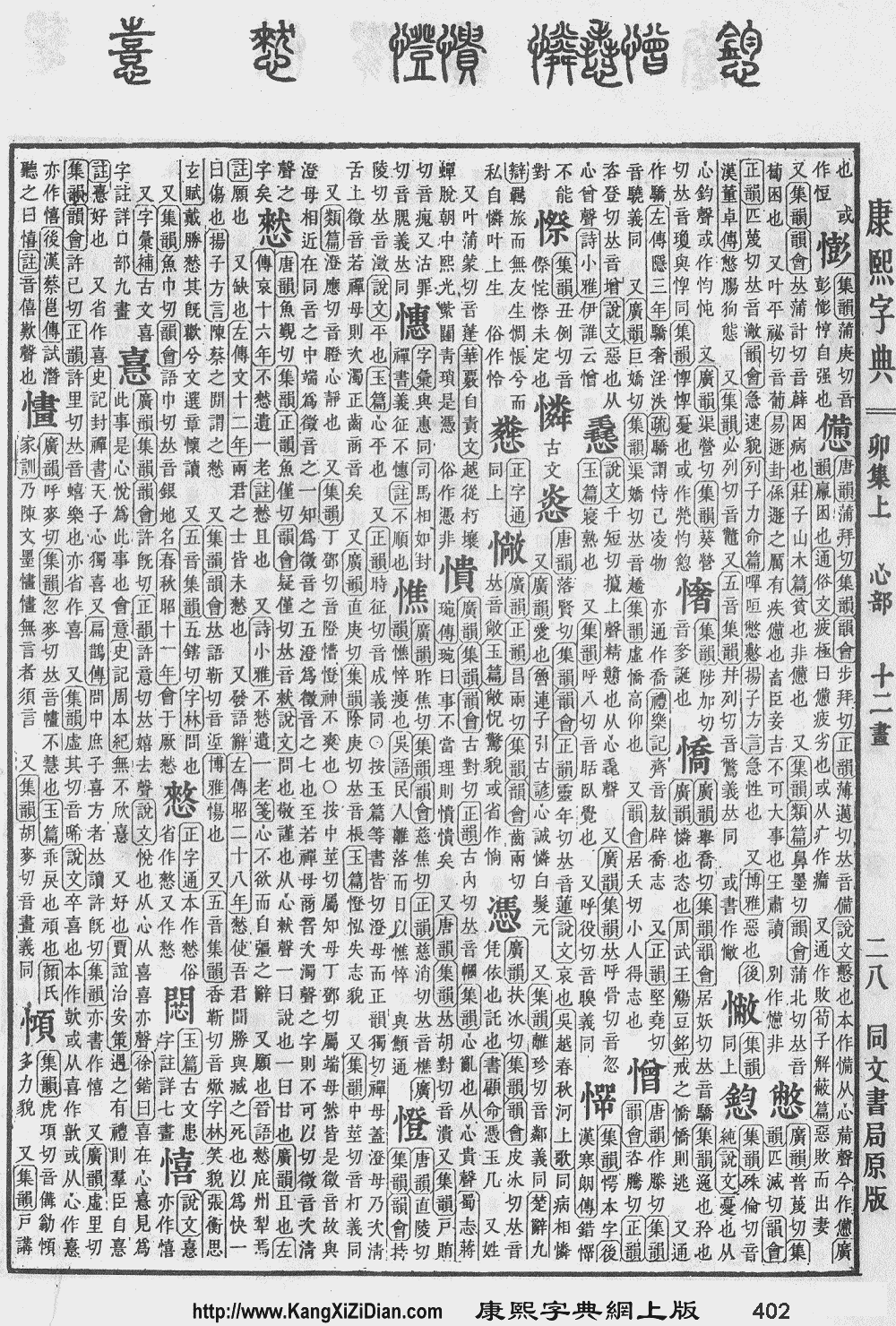
- Kangxi Dictionary: page 402, character 8
- Dai Kanwa Jiten: character 11188
- Dae Jaweon: page 742, character 10
- Hanyu Da Zidian (first edition): volume 4, page 2356, character 8
- Unihan data for U+618E
- Unihan data for U+FA3F
- Unihan data for U+FA89
- Unihan data for U+2F8AB
Chinese
| simp. and trad. |
憎 | |
|---|---|---|
Glyph origin
| Historical forms of the character 憎 |
|---|
| Shuowen Jiezi (compiled in Han) |
| Small seal script |
 |
Characters in the same phonetic series (曾) (Zhengzhang, 2003)
Phono-semantic compound (形聲/形声, OC *ʔsɯːŋ) : semantic 忄 (“heart”) + phonetic 曾 (OC *ʔsɯːŋ, *zɯːŋ).
Etymology
Possibly the same word as 增 (OC *ʔsɯːŋ, “to increase”), as in emotional accumulation (Schuessler, 2007).
Pronunciation
Synonyms
Dialectal synonyms of 討厭 (“to dislike; to loathe; to hate”) [map]
Dialectal synonyms of 恨 (“to hate”) [map]
| Variety | Location | Words |
|---|---|---|
| Formal (Written Standard Chinese) | 恨, 憎恨, 嫌惡 | |
| Mandarin | Beijing | 恨 |
| Taiwan | 恨 | |
| Xi'an | 恨 | |
| Yinchuan | 恨 | |
| Ürümqi | 恨 | |
| Wuhan | 恨, 懥怨 | |
| Chengdu | 恨 | |
| Liuzhou | 恨 | |
| Yangzhou | 恨 | |
| Hefei | 恨 | |
| Malaysia | 恨 | |
| Singapore | 恨 | |
| Cantonese | Guangzhou | 憎, 嬲 |
| Hong Kong | 憎 | |
| Dongguan | 憎 | |
| Yangjiang | 嬲 | |
| Kuala Lumpur (Guangfu) | 憎 | |
| Singapore (Guangfu) | 憎 | |
| Gan | Nanchang | 恨 |
| Hakka | Meixian | 恨 |
| Miaoli (N. Sixian) | 恨 | |
| Pingtung (Neipu; S. Sixian) | 恨 | |
| Hsinchu County (Zhudong; Hailu) | 恨 | |
| Taichung (Dongshi; Dabu) | 恨 | |
| Hsinchu County (Qionglin; Raoping) | 恨 | |
| Yunlin (Lunbei; Zhao'an) | 恨 | |
| Jin | Taiyuan | 恨 |
| Xinzhou | 恨 | |
| Northern Min | Jian'ou | 恨 |
| Eastern Min | Fuzhou | 恨 |
| Southern Min | Xiamen | 恨, 猌 |
| Zhangzhou | 猌 | |
| Taipei | 猌 GT, 恨 GT | |
| Penang (Hokkien) | 猌, 惱 | |
| Singapore (Hokkien) | 猌 | |
| Chaozhou | 恨 | |
| Southern Pinghua | Nanning (Tingzi) | 恨 |
| Wu | Suzhou | 恨 |
| Wenzhou | 恨 | |
| Xiang | Changsha | 恨 |
| Shuangfeng | 馮, 恨 | |
| Note | GT - General Taiwanese (no specific region identified) | |
Compounds
Descendants
- → Thai: ชัง (chang)
Japanese
| Shinjitai | 憎 | |
| Kyūjitai [1] |
憎 憎or 憎+ ︀? |
|
| 憎󠄀 憎+ 󠄀?(Adobe-Japan1) | ||
| 憎󠄃 憎+ 󠄃?(Hanyo-Denshi) (Moji_Joho) | ||
| The displayed kanji may be different from the image due to your environment. See here for details. | ||
Readings
Compounds
- 合憎 (ainiku, “unfortunately”)
- 生憎 (ainiku, “unfortunately”)
References
- “憎”, in 漢字ぺディア (Kanjipedia) (in Japanese), 日本漢字能力検定協会, 2015–2024
Korean
Hanja
憎 • (jeung) (hangeul 증, revised jeung, McCune–Reischauer chŭng, Yale cung)
- This term needs a translation to English. Please help out and add a translation, then remove the text
{{rfdef}}.
Vietnamese
This article is issued from Wiktionary. The text is licensed under Creative Commons - Attribution - Sharealike. Additional terms may apply for the media files.