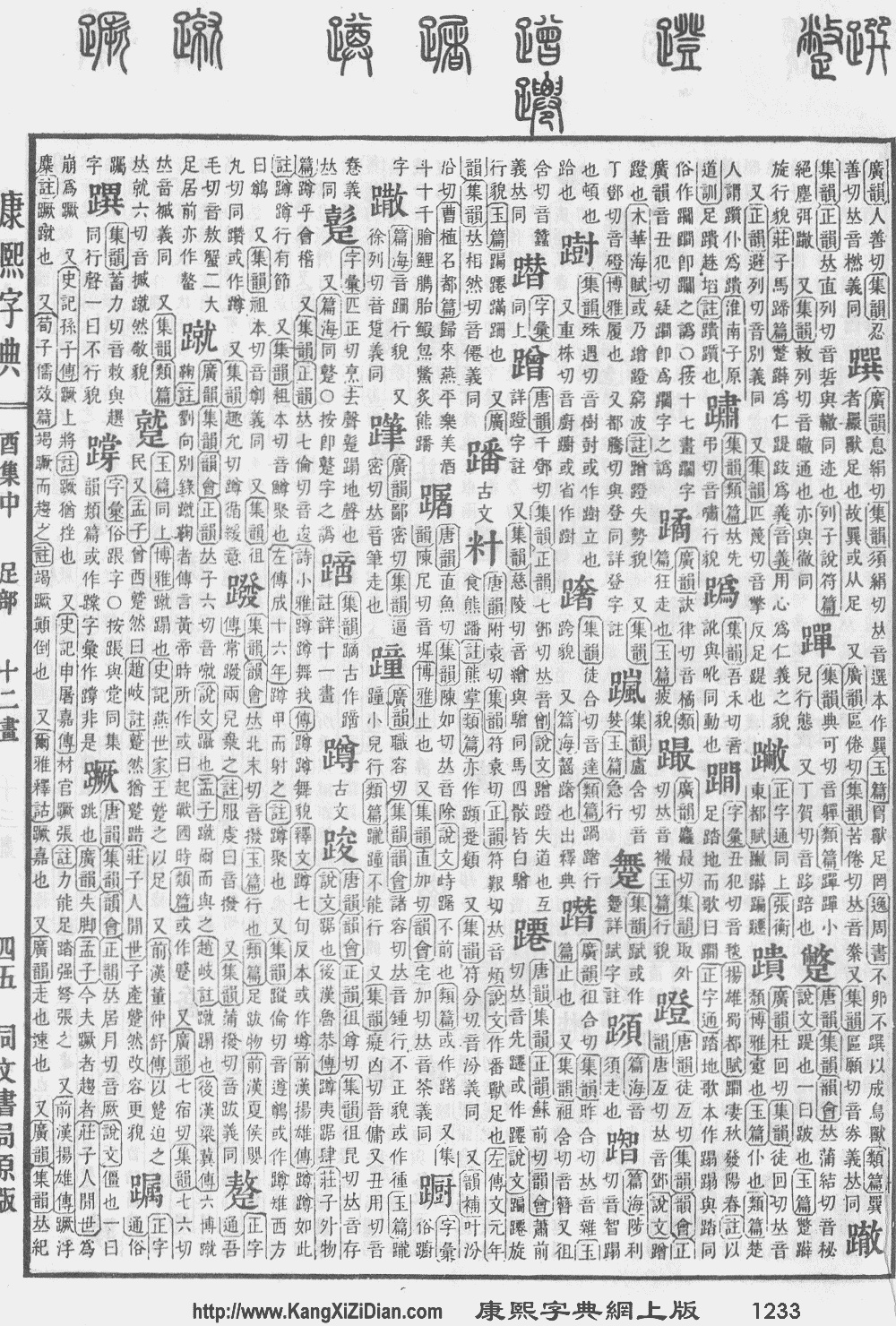
蹶

蹶 U+8E76, 蹶
CJK UNIFIED IDEOGRAPH-8E76
← 蹵
[U+8E75]
CJK Unified Ideographs 蹷 →
[U+8E77]

Translingual

Han character

蹶 (Kangxi radical 157, 足+12, 19 strokes, cangjie input 口一一廿人 (RMMTO), four-corner 61182, composition ⿰𧾷厥)

  1. stumble, fall down
  2. trample

References

  • Kangxi Dictionary: page 1233, character 41
  • Dai Kanwa Jiten: character 37880
  • Dae Jaweon: page 1706, character 6
  • Hanyu Da Zidian (first edition): volume 6, page 3738, character 9
  • Unihan data for U+8E76

Chinese

simp. and trad.
蹶
alternative forms 蹷

Glyph origin

Pronunciation


Rime
Character 蹶 蹶 蹶
Reading # 1/3 2/3 3/3
Initial (聲) 見 (28) 見 (28) 見 (28)
Final (韻) 祭 (38) 月 (68) 薛 (84)
Tone (調) Departing (H) Checked (Ø) Checked (Ø)
Openness (開合) Closed Closed Closed
Division (等) III III III
Fanqie 居衛切 居月切 紀劣切
Baxter kjwejH kjwot kjwet
Reconstructions
Zhengzhang
Shangfang
/kˠiuᴇiH/ /kʉɐt̚/ /kˠiuᴇt̚/
Pan
Wuyun
/kʷᵚieiH/ /kʷiɐt̚/ /kʷᵚiet̚/
Shao
Rongfen
/kiuæiH/ /kiuɐt̚/ /kiuæt̚/
Edwin
Pulleyblank
/kjwiajH/ /kuat̚/ /kwiat̚/
Li
Rong
/kjuɛiH/ /kiuɐt̚/ /kjuɛt̚/
Wang
Li
/kĭwɛiH/ /kĭwɐt̚/ /kĭuɛt̚/
Bernard
Karlgren
/ki̯wɛiH/ /ki̯wɐt̚/ /ki̯wɛt̚/
Expected
Mandarin
Reflex
guì jue jue
Expected
Cantonese
Reflex
gwai3 gyut3 gyut3
Baxter–Sagart system 1.1 (2014)
Character 蹶
Reading # 1/1
Modern
Beijing
(Pinyin)
jué
Middle
Chinese
‹ kjwot ›
Old
Chinese
/*kʷat/
English stumble, fall

Notes for Old Chinese notations in the Baxter–Sagart system:

* Parentheses "()" indicate uncertain presence;
* Square brackets "[]" indicate uncertain identity, e.g. *[t] as coda may in fact be *-t or *-p;
* Angle brackets "<>" indicate infix;
* Hyphen "-" indicates morpheme boundary;

* Period "." indicates syllable boundary.
Zhengzhang system (2003)
Character 蹶 蹶 蹶
Reading # 1/3 2/3 3/3
No. 7227 7228 7232
Phonetic
component
欮 欮 欮
Rime
group
祭 月 月
Rime
subdivision
3 3 3
Corresponding
MC rime
蹶 厥
Old
Chinese
/*krods/ /*krod/ /*kod/

Definitions

蹶

  1. to tumble; to fall down
  2. to run
  3. to fail
  4. to step on; to tread on
  5. rapidly; suddenly

Compounds

  • 一蹶不振 (yījuébùzhèn)
  • 劣蹶
  • 尥蹶子 (liàojuězi)
  • 屯蹶否塞
  • 撩蹶子
  • 痿蹶
  • 直蹶蹶
  • 竭蹶 (jiéjué)
  • 跛蹶
  • 蹶子 (juězi)
  • 蹶張/蹶张
  • 蹶然
  • 蹶痿
  • 蹶石伐木
  • 蹶角
  • 蹶踶
  • 蹶蹄
  • 蹶蹶

Pronunciation


Definitions

蹶

  1. This term needs a translation to English. Please help out and add a translation, then remove the text {{rfdef}}.

Pronunciation


Definitions

蹶

  1. This term needs a translation to English. Please help out and add a translation, then remove the text {{rfdef}}.

References

Japanese

Kanji

蹶

(uncommon “Hyōgai” kanji)

  1. to tumble; to fall down
  2. to defeat; to topple
  3. to spring out

Readings

Usage notes

In modern Japanese, 蹶 is mostly replaced by 決, due to the deprecation of non-tōyō kanji caused by the Japanese script reform.

Japanese terms with 蹶 replaced by daiyōji 決

Compounds

  • 蹶(けっ)起(き) (kekki)
  • 蹶(けつ)然(ぜん) (ketsuzen)
  • 一(いっ)蹶(けつ) (ikketsu)
  • 困(こん)蹶(けつ) (konketsu)
  • 転(てん)蹶(けつ), 顚(てん)蹶(けつ) (tenketsu)

Korean

Etymology 1

From Middle Chinese 蹶 (MC kjwot).

Historical readings

Pronunciation

Hanja

Wikisource 蹶 (eumhun 넘어질 궐 (neomeojil gwol))

  1. Hanja form? of 궐 (“to stumble; to fall down”).

Compounds

Etymology 2

From Middle Chinese 蹶 (MC kjwejH).

Historical readings

Pronunciation

Hanja

蹶 (eumhun 움직일 궤 (umjigil gwe))

  1. (literary) Hanja form? of 궤 (“to move”).

Compounds

References

  • 국제퇴계학회 대구경북지부 (國際退溪學會 大邱慶北支部) (2007). Digital Hanja Dictionary, 전자사전/電子字典.
This article is issued from Wiktionary. The text is licensed under Creative Commons - Attribution - Sharealike. Additional terms may apply for the media files.