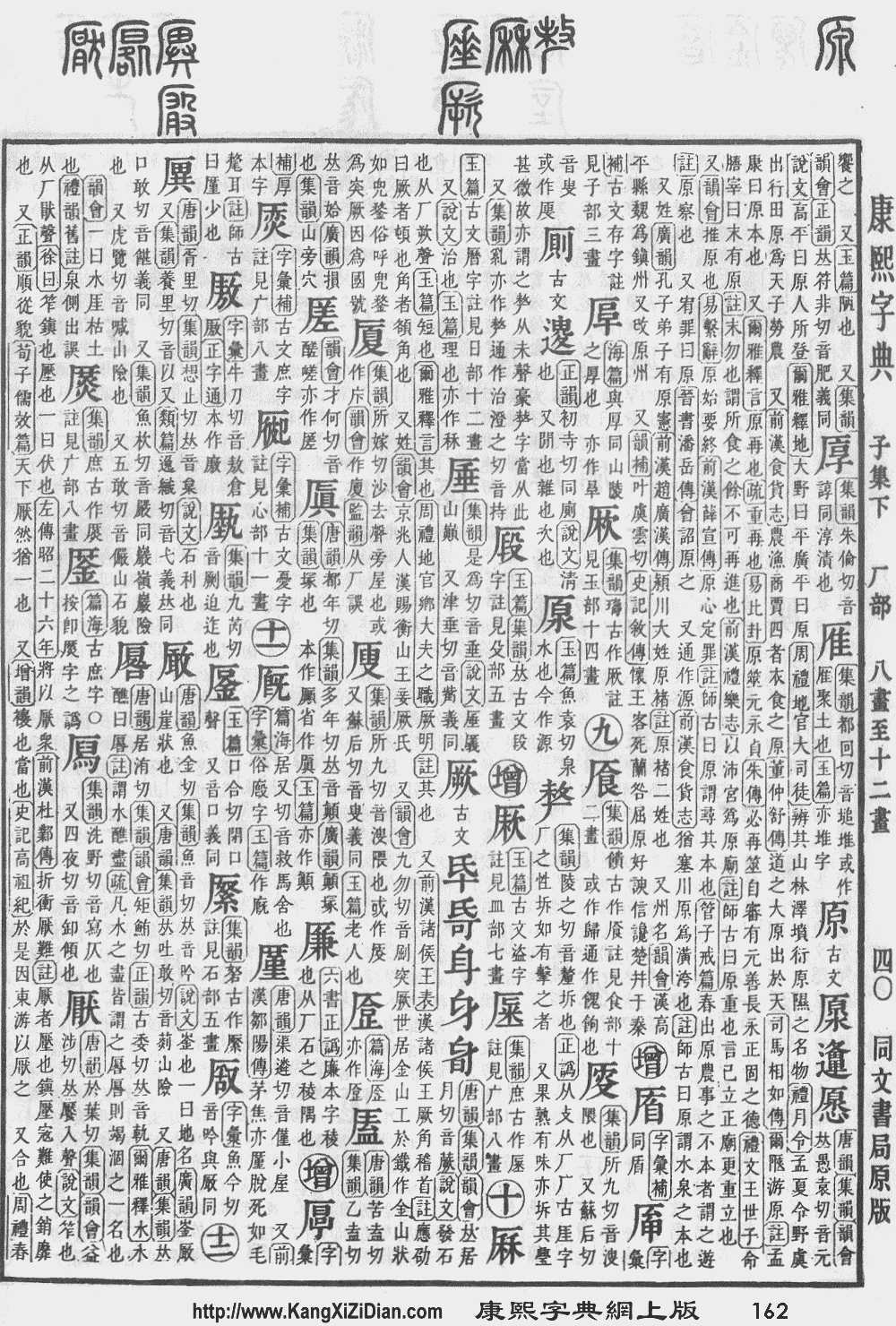
厥

厥 U+53A5, 厥
CJK UNIFIED IDEOGRAPH-53A5
← 厤
[U+53A4]
CJK Unified Ideographs 厦 →
[U+53A6]

Translingual

Han character

厥 (Kangxi radical 27, 厂+10, 12 strokes, cangjie input 一廿山人 (MTUO), four-corner 71282, composition ⿸厂欮)

Derived characters

References

  • Kangxi Dictionary: page 162, character 22
  • Dai Kanwa Jiten: character 2992
  • Dae Jaweon: page 370, character 8
  • Hanyu Da Zidian (first edition): volume 1, page 76, character 13
  • Unihan data for U+53A5

Chinese

simp. and trad.
厥
2nd round simp. 夬
alternative forms 𣅲

Glyph origin

Phono-semantic compound (形聲/形声, OC *kod, *kud) : semantic 厂 + phonetic 欮 (OC *kod).

Pronunciation


Rime
Character 厥
Reading # 2/2
Initial (聲) 見 (28)
Final (韻) 月 (68)
Tone (調) Checked (Ø)
Openness (開合) Closed
Division (等) III
Fanqie 居月切
Baxter kjwot
Reconstructions
Zhengzhang
Shangfang
/kʉɐt̚/
Pan
Wuyun
/kʷiɐt̚/
Shao
Rongfen
/kiuɐt̚/
Edwin
Pulleyblank
/kuat̚/
Li
Rong
/kiuɐt̚/
Wang
Li
/kĭwɐt̚/
Bernard
Karlgren
/ki̯wɐt̚/
Expected
Mandarin
Reflex
jue
Expected
Cantonese
Reflex
gyut3
Zhengzhang system (2003)
Character 厥
Reading # 1/2
No. 7229
Phonetic
component
欮
Rime
group
月
Rime
subdivision
3
Corresponding
MC rime
厥
Old
Chinese
/*kod/

Definitions

厥

  1. to faint; to lose consciousness
  2. a surname

Compounds

Etymology 2

Bodman (1980) relates it to Tibetan ཁྱོད (khyod, “you”).

Pronunciation


Rime
Character 厥
Reading # 2/2
Initial (聲) 見 (28)
Final (韻) 月 (68)
Tone (調) Checked (Ø)
Openness (開合) Closed
Division (等) III
Fanqie 居月切
Baxter kjwot
Reconstructions
Zhengzhang
Shangfang
/kʉɐt̚/
Pan
Wuyun
/kʷiɐt̚/
Shao
Rongfen
/kiuɐt̚/
Edwin
Pulleyblank
/kuat̚/
Li
Rong
/kiuɐt̚/
Wang
Li
/kĭwɐt̚/
Bernard
Karlgren
/ki̯wɐt̚/
Expected
Mandarin
Reflex
jue
Expected
Cantonese
Reflex
gyut3
Baxter–Sagart system 1.1 (2014)
Character 厥
Reading # 1/1
Modern
Beijing
(Pinyin)
jué
Middle
Chinese
‹ kjwot ›
Old
Chinese
/*kot/
English (3p possessive pronoun)

Notes for Old Chinese notations in the Baxter–Sagart system:

* Parentheses "()" indicate uncertain presence;
* Square brackets "[]" indicate uncertain identity, e.g. *[t] as coda may in fact be *-t or *-p;
* Angle brackets "<>" indicate infix;
* Hyphen "-" indicates morpheme boundary;

* Period "." indicates syllable boundary.
Zhengzhang system (2003)
Character 厥
Reading # 1/2
No. 7229
Phonetic
component
欮
Rime
group
月
Rime
subdivision
3
Corresponding
MC rime
厥
Old
Chinese
/*kod/

Definitions

厥

  1. † his; her; its; their

Compounds

  • 允執厥中/允执厥中
  • 克盡厥職/克尽厥职
  • 厥初
  • 厥功甚偉/厥功甚伟
  • 厥功至偉/厥功至伟
  • 厥後/厥后 (juéhòu)
  • 厥疾勿瘳
  • 厥角
  • 大放厥詞/大放厥词 (dàfàngjuécí)
  • 大放厥辭/大放厥辞
  • 大肆厥辭/大肆厥辞
  • 繩厥祖武/绳厥祖武
  • 詒厥/诒厥
  • 詒厥之謀/诒厥之谋
  • 詒厥孫謀/诒厥孙谋
  • 貽厥/贻厥
  • 貽厥孫謀/贻厥孙谋

Pronunciation


Rime
Character 厥
Reading # 1/2
Initial (聲) 見 (28)
Final (韻) 物 (60)
Tone (調) Checked (Ø)
Openness (開合) Closed
Division (等) III
Fanqie 九勿切
Baxter kjut
Reconstructions
Zhengzhang
Shangfang
/kɨut̚/
Pan
Wuyun
/kiut̚/
Shao
Rongfen
/kiuət̚/
Edwin
Pulleyblank
/kut̚/
Li
Rong
/kiuət̚/
Wang
Li
/kĭuət̚/
Bernard
Karlgren
/ki̯uət̚/
Expected
Mandarin
Reflex
ju
Expected
Cantonese
Reflex
gwat1
Zhengzhang system (2003)
Character 厥
Reading # 2/2
No. 7247
Phonetic
component
欮
Rime
group
物
Rime
subdivision
2
Corresponding
MC rime
Old
Chinese
/*kud/

Definitions

厥

  1. Only used in 突厥 (Tūjué).

Etymology 4

Contraction of 佢阿 (kì â).

Pronunciation


Definitions

厥

  1. (Hakka) his; her
    厥爸 [Sixian Hakka]  ―  kiâ pâ [Pha̍k-fa-sṳ]  ―  his/her father
Coordinate terms

Japanese

Kanji

厥

(uncommon “Hyōgai” kanji)

  1. This term needs a translation to English. Please help out and add a translation, then remove the text {{rfdef}}.

Readings

Korean

Hanja

厥 (eumhun 그 궐 (geu gwol))

  1. Hanja form? of 궐 (“he, she, it, they”).
  2. barbarian tribe or country, eg., 突厥 (돌궐, originally, 돌굴), compare 蕃國 (번국), 藩國 (번국)

厥 (eumhun 나라이름 굴 (naraireum gul))

  1. Hanja form? of 굴 (“used in place names”).

Vietnamese

Han character

厥: Hán Nôm readings: cột, quyết

  1. This term needs a translation to English. Please help out and add a translation, then remove the text {{rfdef}}.

References

This article is issued from Wiktionary. The text is licensed under Creative Commons - Attribution - Sharealike. Additional terms may apply for the media files.