軸
See also: 轴
| ||||||||
Translingual
Han character
軸 (Kangxi radical 159, 車+5, 12 strokes, cangjie input 十十中田 (JJLW), four-corner 55060, composition ⿰車由)
References
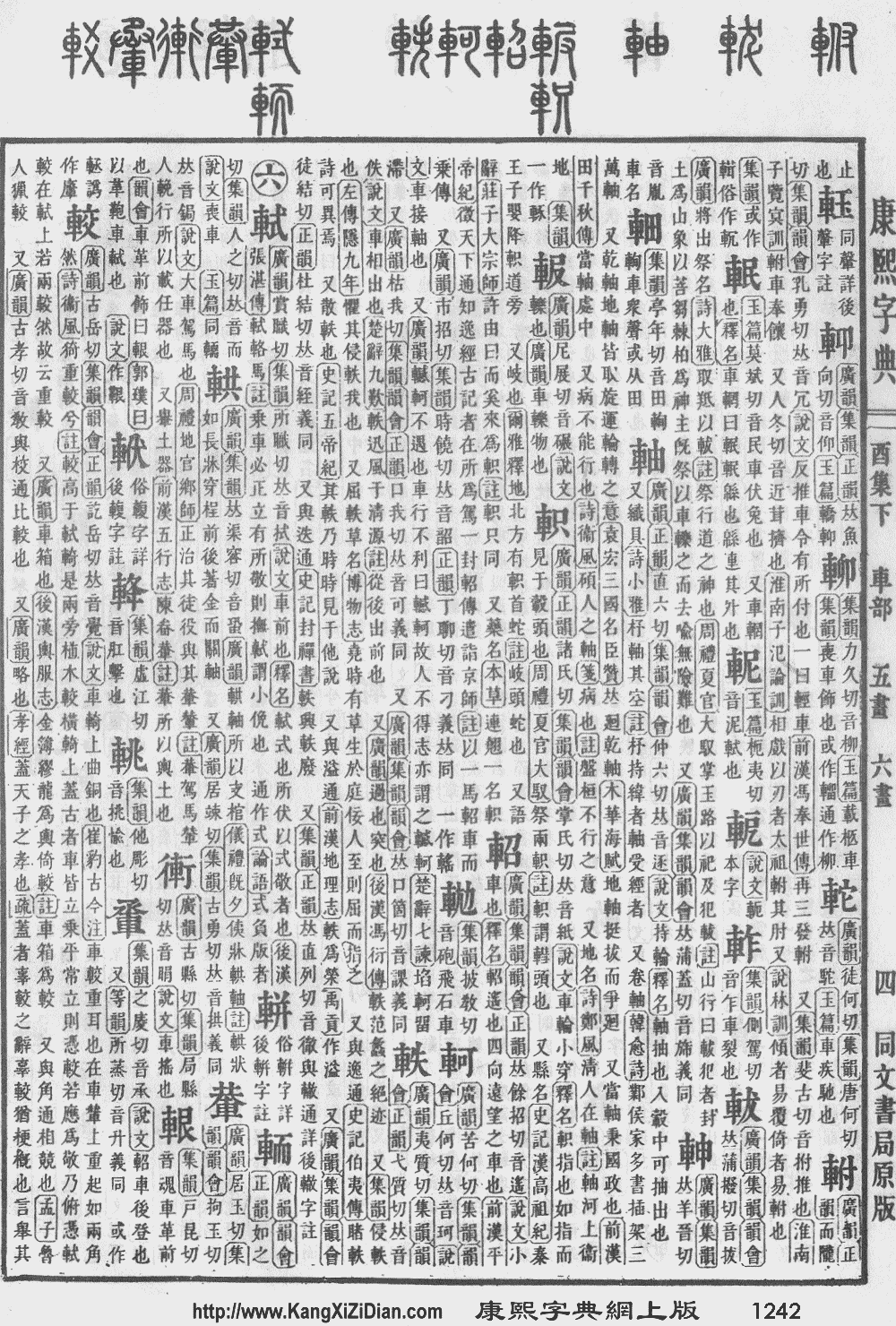
- Kangxi Dictionary: page 1242, character 13
- Dai Kanwa Jiten: character 38269
- Dae Jaweon: page 1718, character 4
- Hanyu Da Zidian (first edition): volume 5, page 3520, character 12
- Unihan data for U+8EF8
Chinese
| trad. | 軸 | |
|---|---|---|
| simp. | 轴 | |
Glyph origin
Characters in the same phonetic series (由) (Zhengzhang, 2003)
| Old Chinese | |
|---|---|
| 袖 | *ljɯwɢs |
| 岫 | *ljɯwɢs |
| 牰 | *ljɯwɢs, *lɯwɢs |
| 抽 | *l̥ʰɯw |
| 妯 | *l̥ʰɯw, *l'ɯwɢ |
| 紬 | *l'ɯw |
| 怞 | *l'ɯw |
| 鮋 | *l'ɯw, *ɦljɯw, *lɯw |
| 菗 | *rlɯw |
| 宙 | *l'ɯwɢs |
| 胄 | *l'ɯwɢs |
| 冑 | *l'ɯwɢs |
| 伷 | *l'ɯwɢs |
| 駎 | *l'ɯwɢs |
| 油 | *lɯw, *lɯwɢs |
| 由 | *lɯw |
| 蚰 | *lɯw |
| 秞 | *lɯw |
| 邮 | *lɯw |
| 釉 | *lɯwɢs |
| 柚 | *lɯwɢs, *l'ɯwɢ |
| 鼬 | *lɯwɢs |
| 苖 | *l'ɯːwɢ, *l̥ʰɯwɢ |
| 笛 | *l'ɯːwɢ |
| 迪 | *l'ɯːwɢ |
| 頔 | *l'ɯːwɢ |
| 軸 | *l'ɯwɢ |
| 舳 | *l'ɯwɢ |
Phono-semantic compound (形聲/形声, OC *l'ɯwɢ) and ideogrammic compound (會意/会意) : semantic 車 (“cart, carriage”) + phonetic 由 (OC *lɯw, “to pass through”) — the axle that passes through a cartwheel.
Etymology
(This etymology is missing or incomplete. Please add to it, or discuss it at the Etymology scriptorium.)
Pronunciation 1
Definitions
軸
- axle; axletree
- pivot
- axis
- spool; roller
- (Xiamen, Zhangzhou and Taiwanese Hokkien, Teochew) large, oblong banner of silk carrying an appropriate message (usually for funerals) (Classifier: 幅 mn mn-t)
- switch (of a keyboard key)
- See also: 鍵軸
- Cherry MX軸/Cherry MX轴 ― Cherry MX zhóu ― Cherry MX switch
- Classifier for rolled-up things.
Synonyms
Compounds
- 主軸/主轴 (zhǔzhóu)
- 二軸晶/二轴晶
- 光軸/光轴 (guāngzhóu)
- 卷軸/卷轴 (juànzhóu)
- 卷軸裝/卷轴装
- 反軸心國/反轴心国
- 同軸圓/同轴圆
- 同軸電纜/同轴电缆 (tóngzhóu diànlǎn)
- 地軸/地轴 (dìzhóu)
- 坐標軸/坐标轴
- 坤軸/坤轴
- 天軸/天轴
- 掛軸/挂轴
- 插架萬軸/插架万轴
- 晶軸/晶轴
- 曲軸/曲轴 (qūzhóu)
- 杼軸/杼轴 (zhùzhóu)
- 杼軸其空/杼轴其空
- 橫軸/横轴
- 機軸/机轴 (jīzhóu)
- 牙簽犀軸/牙签犀轴
- 牙籤玉軸/牙签玉轴
- 牙籤萬軸/牙签万轴
- 牙籤錦軸/牙签锦轴
- 磁軸/磁轴 (cízhóu)
- 穗軸/穗轴
- 空氣軸承/空气轴承
- 立軸/立轴
- 線軸兒/线轴儿
- 縱軸/纵轴
- 群輕折軸/群轻折轴
- 聯軸器/联轴器 (liánzhóuqì)
- 胚軸/胚轴
- 胯骨軸兒/胯骨轴儿
- 花軸/花轴 (huāzhóu)
- 葉軸/叶轴
- 車軸/车轴 (chēzhóu)
- 車軸草/车轴草
- 軸丘/轴丘 (zhóuqiū)
- 軸心/轴心 (zhóuxīn)
- 軸心國/轴心国 (zhóuxīnguó)
- 軸承/轴承 (zhóuchéng)
- 軸根系/轴根系
- 軸突/轴突 (zhóutū)
- 軸線/轴线 (zhóuxiàn)
- 軸艫千里/轴舻千里
- 軸距/轴距
- 軸轤/轴轳 (zhúlú)
- 輪軸/轮轴 (lúnzhóu)
- 轆軸/辘轴
- 轉軸/转轴 (zhuànzhóu)
- 連軸兒轉/连轴儿转
- 鈞軸/钧轴
Pronunciation 2
Japanese
Readings
Noun
Counter
軸 • (-jiku) ←ぢく (diku)?
- things wrapped about a central rod- scrolls, rolls of material, also yarn balls
- central axes
- favoured horses
References
- Matsumura, Akira, editor (2006), 大辞林 [Daijirin] (in Japanese), Third edition, Tōkyō: Sanseidō, →ISBN
Korean
Hanja
軸 • (chuk) (hangeul 축)
- This term needs a translation to English. Please help out and add a translation, then remove the text
{{rfdef}}.
Vietnamese
This article is issued from Wiktionary. The text is licensed under Creative Commons - Attribution - Sharealike. Additional terms may apply for the media files.