鷹
| ||||||||
Translingual
Han character
鷹 (Kangxi radical 196, 鳥+13, 24 strokes, cangjie input 戈土竹日火 (IGHAF), four-corner 00227, composition ⿸䧹鳥)
Derived characters
- 𪿅, 𬷺, 𪈾
References
- Kangxi Dictionary: page 1501, character 18
- Dai Kanwa Jiten: character 47377
- Dae Jaweon: page 2031, character 26
- Hanyu Da Zidian (first edition): volume 7, page 4666, character 2
- Unihan data for U+9DF9
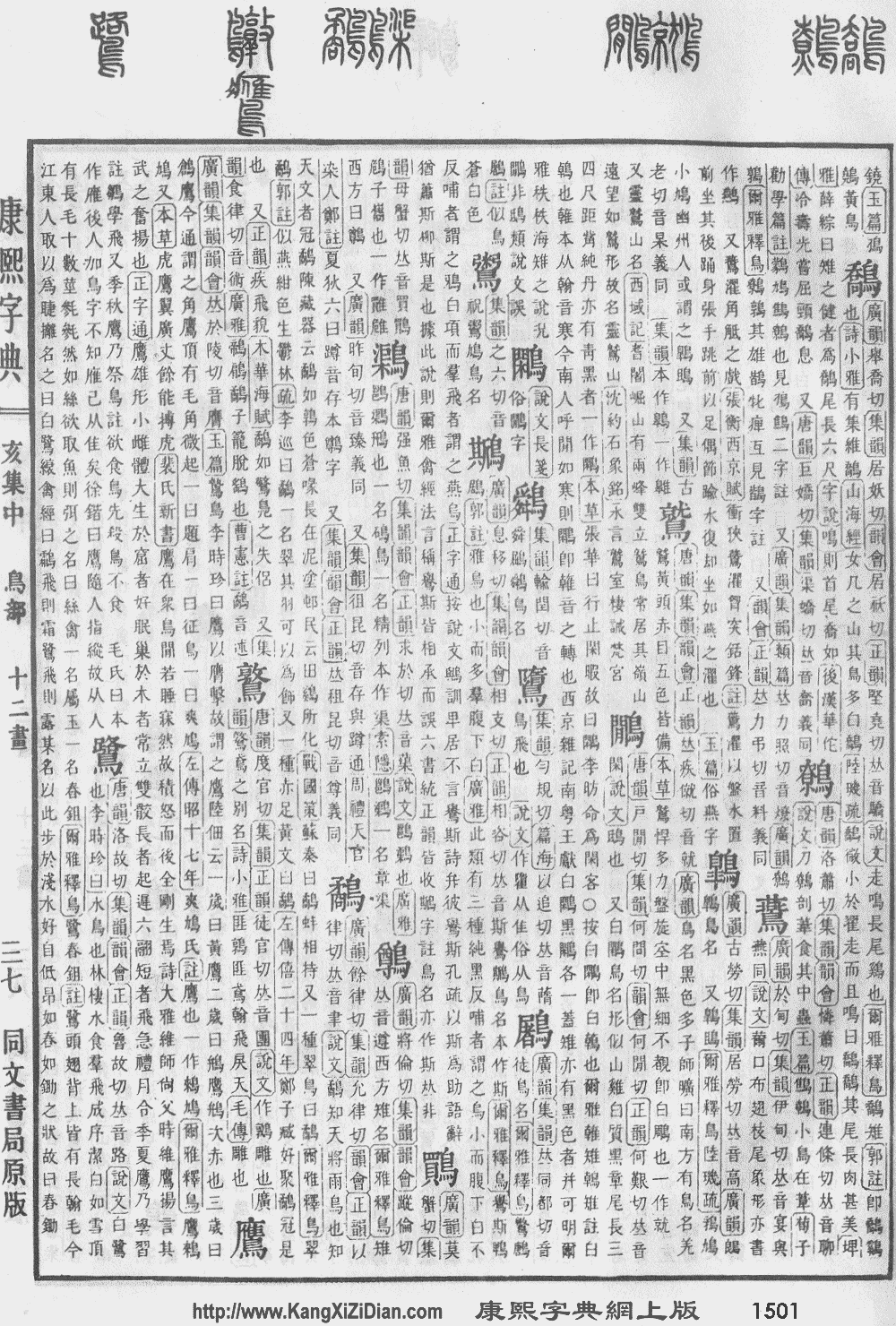
Chinese
| trad. | 鷹 | |
|---|---|---|
| simp. | 鹰 | |
| 2nd round simp. | ⿰应鸟 | |
| alternative forms | 䧹 | |
Glyph origin
Ideogrammic compound (會意/会意) and phono-semantic compound (形聲/形声, OC *qɯŋ) : phonetic 䧹 (OC *qɯŋ, “eagle; hawk”) + semantic 鳥 (“bird”).
Etymology
This word is possibly related to Proto-Sino-Tibetan *g-la(ŋ/k) (“bird of prey”), which is likely a loan from Proto-Mon-Khmer *laŋ ~ *laaŋ ~ *laiŋ (“large raptor”) > Proto-Bahnaric *klaːŋ (“hawk”), Proto-Palaungic *klaːŋ (“kite”), Mon လနေၚ် (“kite”), Khmer ខ្លែង (khlaeng, “kite”); within Tibeto-Burman, compare Tibetan གླག (glag, “eagle; vulture”), Burmese လင်းတ (lang:ta., “vulture”), Jingpho lang (“bird of the falcon family”) (Benedict, 1972; STEDT).
This word agrees better with Tibetan སྐྱིང་སེར (skying ser, “eagle; vulture”) if the Old Chinese is reconstructed as *s-ki̯əŋ (Benedict, 1990; Schuessler, 2007); Benedict (1976) reconstructs Proto-Sino-Tibetan *s-kiŋ for this, which Benedict (1990) suggests is the native Sino-Tibetan root.
Pronunciation
Definitions
鷹
- a bird of prey of Accipitriformes (eagles, hawks, kites, vultures), Falconiformes (falcons) or Strigiformes (owls)
Compounds
- 兀鷹/兀鹰 (wùyīng)
- 南鷂北鷹/南鹞北鹰
- 夜鷹/夜鹰 (yèyīng)
- 天鷹星座/天鹰星座
- 如鷹在籠/如鹰在笼
- 按鷹/按鹰
- 放鷹/放鹰 (fàngyīng)
- 放鷹逐犬/放鹰逐犬
- 熬鷹/熬鹰
- 犬牙鷹爪/犬牙鹰爪
- 獵鷹/猎鹰 (lièyīng)
- 禿鷹/秃鹰 (tūyīng)
- 老鷹/老鹰 (lǎoyīng)
- 蒼鷹/苍鹰 (cāngyīng)
- 虎嘯鷹揚/虎啸鹰扬
- 虎視鷹瞵/虎视鹰瞵
- 見兔放鷹/见兔放鹰
- 角鷹/角鹰
- 貓頭鷹/猫头鹰 (māotóuyīng)
- 雀鷹/雀鹰
- 韝上鷹/𫖕上鹰
- 飛鷹走犬/飞鹰走犬
- 飛鷹走狗/飞鹰走狗
- 飛鷹走馬/飞鹰走马
- 飢鷹餓虎/饥鹰饿虎
- 餓虎飢鷹/饿虎饥鹰
- 魚鷹/鱼鹰 (yúyīng)
- 鷂鷹/鹞鹰 (yàoyīng)
- 鷹勾鼻/鹰勾鼻
- 鷹師/鹰师
- 鷹式飛彈/鹰式飞弹
- 鷹抓燕雀/鹰抓燕雀
- 鷹揚/鹰扬 (yīngyáng)
- 鷹揚宴/鹰扬宴
- 鷹揚虎視/鹰扬虎视
- 鷹擊毛摯/鹰击毛挚
- 鷹架/鹰架
- 鷹洋/鹰洋 (yīngyáng)
- 鷹派/鹰派 (yīngpài)
- 鷹爪/鹰爪
- 鷹爪功/鹰爪功
- 鷹爪毛兒/鹰爪毛儿
- 鷹犬/鹰犬 (yīngquǎn)
- 鷹瞵鶚視/鹰瞵鹗视
- 鷹視/鹰视 (yīngshì)
- 鷹視狼步/鹰视狼步
- 鷹視狼顧/鹰视狼顾
- 鷹覷鶻望/鹰觑鹘望
- 鷹鸇/鹰鹯
- 鷹鼻鷂眼/鹰鼻鹞眼
References
- “鷹”, in 漢語多功能字庫 (Multi-function Chinese Character Database), 香港中文大學 (the Chinese University of Hong Kong), 2014–
Japanese
Etymology 1
| Kanji in this term |
|---|
| 鷹 |
| たか Jinmeiyō |
| kun’yomi |
From Old Japanese.[1] Compare Ainu タカ (taka, “hawk”).
Usage notes
- As with many terms that name organisms, this term is often spelled in katakana, especially in biological contexts (where katakana is customary), as タカ.
Derived terms
- 鷹の爪 (takanotsume)
Etymology 2
| Kanji in this term |
|---|
| 鷹 |
| くち Jinmeiyō |
| kun’yomi |
| For pronunciation and definitions of 鷹 – see the following entry. | ||
| ||
| (This term, 鷹, is an alternative spelling of the above term.) |
References
- Frellesvig, Bjarke, Stephen Wright Horn, et al. (eds.) (2023) “Old Japanese taka”, in Oxford-NINJAL Corpus of Old Japanese
- Matsumura, Akira, editor (2006), 大辞林 [Daijirin] (in Japanese), Third edition, Tōkyō: Sanseidō, →ISBN