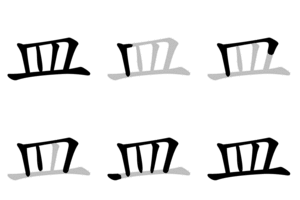
皿

See also: 血 and 罒
皿 U+76BF, 皿
CJK UNIFIED IDEOGRAPH-76BF
← 皾
[U+76BE]
CJK Unified Ideographs 盀 →
[U+76C0]
⽫ U+2F6B, ⽫
KANGXI RADICAL DISH
← ⽪
[U+2F6A]
Kangxi Radicals ⽬ →
[U+2F6C]

Translingual

Stroke order

Han character

皿 (Kangxi radical 108, 皿+0, 5 strokes, cangjie input 月廿 (BT), four-corner 77100, composition ⿴𠀃⿰丨丨 or ⿱𦉫一)

  1. Kangxi radical #108, ⽫.

Derived characters

References

  • Kangxi Dictionary: page 792, character 33
  • Dai Kanwa Jiten: character 22941
  • Dae Jaweon: page 1207, character 29
  • Hanyu Da Zidian (first edition): volume 4, page 2557, character 1
  • Unihan data for U+76BF

Chinese

simp. and trad.
皿
2nd round simp. 𠀃

Glyph origin

Historical forms of the character 皿
Shang Western Zhou Shuowen Jiezi (compiled in Han) Liushutong (compiled in Ming)
Oracle bone script Bronze inscriptions Small seal script Transcribed ancient scripts

Pictogram (象形) A pictograph of an empty container, such as a chalice. The handles are conjoined in the modern form.

Pronunciation


Note:
  • béng - literary;
  • bín - vernacular.

Rime
Character 皿
Reading # 1/1
Initial (聲) 明 (4)
Final (韻) 庚 (111)
Tone (調) Rising (X)
Openness (開合) Open
Division (等) III
Fanqie 武永切
Baxter mjaengX
Reconstructions
Zhengzhang
Shangfang
/mˠiæŋX/
Pan
Wuyun
/mᵚiaŋX/
Shao
Rongfen
/miaŋX/
Edwin
Pulleyblank
/miajŋX/
Li
Rong
/miɐŋX/
Wang
Li
/mĭɐŋX/
Bernard
Karlgren
/mi̯ɐŋX/
Expected
Mandarin
Reflex
mǐng
Expected
Cantonese
Reflex
ming5
Baxter–Sagart system 1.1 (2014)
Character 皿
Reading # 1/1
Modern
Beijing
(Pinyin)
mǐn
Middle
Chinese
‹ mjængX ›
Old
Chinese
/*mraŋʔ/
English vessel, bowl

Notes for Old Chinese notations in the Baxter–Sagart system:

* Parentheses "()" indicate uncertain presence;
* Square brackets "[]" indicate uncertain identity, e.g. *[t] as coda may in fact be *-t or *-p;
* Angle brackets "<>" indicate infix;
* Hyphen "-" indicates morpheme boundary;

* Period "." indicates syllable boundary.
Zhengzhang system (2003)
Character 皿
Reading # 1/1
No. 9151
Phonetic
component
皿
Rime
group
陽
Rime
subdivision
0
Corresponding
MC rime
皿
Old
Chinese
/*maŋʔ/

Definitions

皿

  1. dish; vessel
    培養皿/培养皿  ―  péiyǎngmǐn  ―  Petri dish
Usage notes
  • As a component of other characters, 皿 can be referred to as 皿字底 (mǐnzìdǐ), 皿墩 (mǐndūn) or 皿墩兒/皿墩儿 (mǐndūnr).

Compounds

Etymology 2

For pronunciation and definitions of 皿 – see 四 (“four; four directions; all directions; etc.”).
(This character is a variant form of 四).

Japanese

Kanji

皿

(grade 3 “Kyōiku” kanji)

Readings

Etymology

Kanji in this term
皿
さら
Grade: 3
kun’yomi
Alternative spelling
盤

From Old Japanese, from Proto-Japonic *sara.

Attested in the Nihon Shoki of 720 CE with the phonetic man'yōgana spelling 娑羅 (sara).[1]

Pronunciation

Noun

皿(さら) • (sara) 

  1. dish, plate

Descendants

  • → Korean: 사라 (sara)

References

  1. “皿・盤”, in 日本国語大辞典 (Nihon Kokugo Daijiten, “Nihon Kokugo Daijiten”)‎ (in Japanese), concise edition, Tōkyō: Shogakukan, 2000
  2. Matsumura, Akira, editor (2006), 大辞林 [Daijirin] (in Japanese), Third edition, Tōkyō: Sanseidō, →ISBN

Korean

Hanja

皿 (eumhun 그릇 명 (geureut myeong))

  1. Hanja form? of 명 (“dish”).

Vietnamese

Han character

皿: Hán Nôm readings: mãnh, mảng, mảnh, mịn

  1. This term needs a translation to English. Please help out and add a translation, then remove the text {{rfdef}}.
This article is issued from Wiktionary. The text is licensed under Creative Commons - Attribution - Sharealike. Additional terms may apply for the media files.