皮
See also: 𪪍
| ||||||||
| ||||||||
Translingual
| Stroke order | |||
|---|---|---|---|
 | |||
| Stroke order | |||
|---|---|---|---|
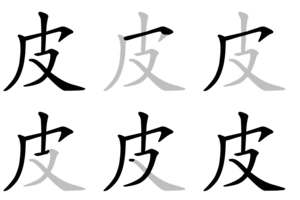 | |||
Han character
皮 (Kangxi radical 107, 皮+0, 5 strokes, cangjie input 木竹水 (DHE), four-corner 40247, composition ⿻⿱丨又⿰丿乛)
- Kangxi radical #107, ⽪.
Derived characters
- Appendix:Chinese radical/皮
- 佊, 𰃺, 𠱀, 坡, 𡛡, 㝿, 岥, 帔, 㢰, 彼, 怶, 披, 波, 狓, 陂, 𣃣, 柀, 𣥣, 㱟, 𣬼, 𭴗, 𤖷, 𤙎, 玻, 䏢, 𬒳, 𤱍, 𭼀, 𥅗, 破, 秛, 𬔜, 被, 𥹖, 紴, 𮉲, 𦍷, 翍, 耚, 𦚆, 𦨭, 蚾, 𪤻, 𫵃, 詖(诐), 䜵, 𧰸, 䝛, 貱(𬥶), 𧹞, 跛, 𨈵, 𮝌, 𨠜, 鈹(铍), 䩅, 鞁, 𮧸, 𩖽, 駊(𫘟), 骳, 𩫋, 𩲢, 𭊣, 𭠊, 鮍(鲏), 麬, 𦃯, 𪖞, 𮭛
- 㓟, 𠡄, 𫹄, 𣃤, 𦐢, 𦫗, 頗(颇), 𩠗, 𡛬, 𪓜, 𪚷, 髲, 𢇳, 疲, 𪠏, 旇
References
- Kangxi Dictionary: page 790, character 12
- Dai Kanwa Jiten: character 22823
- Dae Jaweon: page 1205, character 6
- Hanyu Da Zidian (first edition): volume 4, page 2753, character 1
- Unihan data for U+76AE

Chinese
| simp. and trad. |
皮 | |
|---|---|---|
Glyph origin
| Historical forms of the character 皮 | ||
|---|---|---|
| Western Zhou | Shuowen Jiezi (compiled in Han) | Liushutong (compiled in Ming) |
| Bronze inscriptions | Small seal script | Transcribed ancient scripts |
 |
 |
 |
Characters in the same phonetic series (皮) (Zhengzhang, 2003)
| Old Chinese | |
|---|---|
| 陂 | *pral, *prals |
| 詖 | *pral, *prals |
| 彼 | *pralʔ |
| 柀 | *pralʔ |
| 佊 | *pralʔ, *prals |
| 貱 | *prals |
| 跛 | *prals, *paːlʔ |
| 披 | *pʰral, *pʰralʔ |
| 鈹 | *pʰral |
| 帔 | *pʰral, *pʰrals |
| 鮍 | *pʰral |
| 耚 | *pʰral |
| 狓 | *pʰral |
| 翍 | *pʰral |
| 旇 | *pʰral, *brals |
| 秛 | *pʰral, *pʰrals |
| 紴 | *pʰralʔ, *paːl |
| 皮 | *bral |
| 疲 | *bral |
| 被 | *bralʔ, *brals |
| 髲 | *brals |
| 鞁 | *brals |
| 骳 | *mbralʔ |
| 波 | *paːl |
| 碆 | *paːl, *baːl |
| 菠 | *paːl |
| 簸 | *paːlʔ, *paːls |
| 駊 | *paːlʔ, *pʰaːlʔ |
| 頗 | *pʰaːl, *pʰaːlʔ, *pʰaːls |
| 坡 | *pʰaːl |
| 玻 | *pʰaːl |
| 破 | *pʰaːls |
| 婆 | *baːl |
| 蔢 | *baːl |
Pictogram (象形) – a hand (又) stripping the fur from an animal pelt (similar to 革). The pelt moved to the top left and became abstracted.
Etymology
- “skin”
- According to STEDT, 皮 (OC *m-pra-j) is likely derived from root 膚 (OC *pra) – further from Proto-Sino-Tibetan *p(r/j)a (“skin”) – and a voicing prefix – likely *m- which is found in several OC words for body parts like 鼻 (OC *m-bi[t]-s, “nose”), 肚 (OC *m-tˤaʔ, “belly”), 右 (OC *[ɢ]ʷəʔ-s (~ *m-qʷəʔ), “right-hand”) and 頭 (OC *[m-t]ˤo, “head”) (Baxter & Sagart, 2014).
- “pico-”
- Borrowed from English pico-.
Pronunciation 1
Definitions
皮
- skin (Classifier: 塊/块 m c; 層/层 m c); peel; shell
- 甩皮 [Cantonese] ― lat1 pei4 [Jyutping] ― to have flaky skin; to have peeling skin
- 樹皮/树皮 ― shùpí ― bark
- 香蕉皮 ― xiāngjiāo pí ― banana peel
- 牛則有皮,犀兕尚多。 [Classical Chinese, trad.]
- From: Commentary of Zuo, c. 4th century BCE, translated based on James Legge's version
- Niú zé yǒu pí, xīsì shàng duō. [Pinyin]
- Bulls still have skins; rhinoceroses and wild bulls still are many.
牛则有皮,犀兕尚多。 [Classical Chinese, simp.]- 誰家老-馬棄城-陰,毛-暗皮-乾瘦不-禁。 [Vietnamese Literary Sinitic, trad.]
- From: 阮攸 (Nguyễn Du),〈城下棄馬〉(Thành hạ khí mã, "The Abandoned Horse at the Wall's Bottom") in 《南中雜吟》(Nam trung tạp ngâm "Assorted Recitations while in the South"), 1805-1812
- Thùy gia lão mã khí thành âm, mao ám bì can sấu bất câm. [Sino-Vietnamese]
- Someone's old horse is abandoned under the wall's shadow; he is gaunt, his hair darkened, his skin parched, beyond bearing.
- hide; leather
- 皮鞋 ― píxié ― leather shoes
- wrapper; cover; skin
- surface; top part
- 水皮 ― shuǐpí ― water surface
- rubber
- thin sheet
- outer; superficial
- sticky; glutinous
- soggy; non-crispy
- naughty; disobedient
- thick-skinned
- pico- (SI unit prefix)
- (Cantonese, colloquial) ten thousand dollars
- (VTuber fandom slang) model
Compounds
- 一肚皮
- 下皮
- 上皮組織/上皮组织 (shàngpí zǔzhī)
- 中果皮
- 丹皮
- 五加皮 (wǔjiāpí)
- 仿羊皮紙/仿羊皮纸
- 俏皮
- 俏皮話/俏皮话
- 做面皮
- 光皮散兒/光皮散儿
- 內皮/内皮 (nèipí)
- 兩張皮/两张皮
- 兩扇皮/两扇皮
- 刁皮
- 刮地皮
- 刮臉皮/刮脸皮 (guā liǎnpí)
- 剝一層皮/剥一层皮
- 剝皮/剥皮
- 剝皮剉骨/剥皮剉骨
- 剝皮剔骨/剥皮剔骨
- 剝皮抽筋/剥皮抽筋
- 剝面皮/剥面皮
- 包皮 (bāopí)
- 卷地皮
- 厚皮香
- 厚臉皮/厚脸皮 (hòu liǎnpí)
- 反穿皮襖/反穿皮袄
- 口皮
- 合成皮
- 吹牛皮 (chuī niúpí)
- 單皮鼓/单皮鼓 (dānpígǔ)
- 單眼皮/单眼皮 (dānyǎnpí)
- 嘴皮子 (zuǐpízi)
- 嘻皮笑臉 (xīpíxiàoliǎn)
- 地皮 (dìpí)
- 地骨皮 (dìgǔpí)
- 壁上泥皮
- 外果皮 (wàiguǒpí)
- 夠皮/够皮
- 大吹牛皮
- 大腹皮 (dàfùpí)
- 大腦皮層/大脑皮层
- 大腦皮質/大脑皮质 (dànǎo pízhì)
- 大面皮兒/大面皮儿
- 奶皮 (nǎipí)
- 妍皮痴骨
- 嬉皮 (xīpí)
- 嬌皮嫩肉/娇皮嫩肉
- 嬉皮笑臉/嬉皮笑脸 (xīpíxiàoliǎn)
- 寢皮食肉/寝皮食肉
- 寬皮毛/宽皮毛
- 寬皮說話/宽皮说话
- 封皮 (fēngpí)
- 小眼薄皮
- 川種皮/川种皮
- 左皮氣/左皮气
- 心皮 (xīnpí)
- 憨皮
- 扯皮 (chěpí)
- 扯皮弄筋
- 扯破臉皮/扯破脸皮
- 拖狗皮
- 拉皮 (lāpí)
- 拉皮條/拉皮条 (lāpítiáo)
- 抽筋剝皮/抽筋剥皮
- 括地皮
- 掉皮
- 撂皮 (liàopí)
- 擀皮
- 敗鼓之皮/败鼓之皮
- 春捲皮/春卷皮
- 書皮/书皮 (shūpí)
- 有肚皮
- 杜皮 (Dùpí)
- 果皮 (guǒpí)
- 松皮癬/松皮癣
- 桑白皮 (sāngbáipí)
- 桂皮 (guìpí)
- 栓皮 (shuānpí)
- 栓皮櫟/栓皮栎
- 桑皮紙/桑皮纸
- 桂皮酸
- 棘皮動物/棘皮动物 (jípí dòngwù)
- 植皮手術/植皮手术
- 榆白皮
- 樹皮/树皮 (shùpí)
- 橡皮 (xiàngpí)
- 橘皮 (júpí)
- 橙皮 (chéngpí)
- 橡皮圈
- 橡皮圖章/橡皮图章 (xiàngpí túzhāng)
- 橡皮擦 (xiàngpícā)
- 橡皮樹/橡皮树
- 橡皮筋 (xiàngpíjīn)
- 橡皮膏 (xiàngpígāo)
- 樺皮臉/桦皮脸
- 橡皮艇 (xiàngpítǐng)
- 橡皮釘子/橡皮钉子
- 死皮賴臉/死皮赖脸 (sǐpílàiliǎn)
- 毛皮 (máopí)
- 毛蒂青皮
- 水皮子
- 水黃皮/水黄皮
- 沒皮子/没皮子
- 沒皮條/没皮条
- 沒皮沒臉/没皮没脸
- 沒皮賴臉/没皮赖脸
- 沒面皮/没面皮
- 油皮
- 洋鐵皮/洋铁皮
- 海桐皮
- 浮皮潦草
- 涎皮賴臉/涎皮赖脸 (xiánpílàiliǎn)
- 浮皮蹭癢/浮皮蹭痒
- 涎臉涎皮/涎脸涎皮
- 海蜇皮 (hǎizhépí)
- 涼皮/凉皮 (liángpí)
- 漆皮
- 漆皮兒/漆皮儿
- 滿肚皮/满肚皮
- 潑皮/泼皮 (pōpí)
- 潑皮無賴/泼皮无赖
- 潑皮貨/泼皮货
- 潑皮賴虎/泼皮赖虎
- 激皮皮 (kek-phî-phî) (Min Nan)
- 炒地皮
- 熟皮
- 燕皮 (yànpí)
- 燥皮
- 牆上泥皮/墙上泥皮
- 牛皮 (niúpí)
- 牛皮大王 (niúpí dàwáng)
- 牛皮癬/牛皮癣 (niúpíxuǎn)
- 牛皮糖
- 牛皮紙/牛皮纸 (niúpízhǐ)
- 犀皮
- 狗皮倒灶
- 狗皮膏藥/狗皮膏药
- 獃串了皮
- 環狀剝皮/环状剥皮
- 瓜皮帽 (guāpímào)
- 生皮
- 略知皮毛
- 畫皮/画皮 (huàpí)
- 瘦皮猴
- 癩皮狗/癞皮狗 (làipígǒu)
- 癩皮病/癞皮病
- 白淨面皮/白净面皮
- 白皮書/白皮书 (báipíshū)
- 白皮松 (báipísōng)
- 白鉛皮/白铅皮
- 白鐵皮/白铁皮
- 白面皮
- 皮下出血
- 皮下注射
- 皮下移植
- 皮下組織/皮下组织 (píxià zǔzhī)
- 皮之不存,毛將焉附/皮之不存,毛将焉附 (pí zhī bù cún, máo jiāng yān fù)
- 皮件
- 皮傅 (pífù)
- 皮冠
- 皮包 (píbāo)
- 皮包骨 (píbāogǔ)
- 皮匠 (píjiàng)
- 皮匣
- 皮囊
- 皮困秋
- 皮塑
- 皮夾/皮夹 (píjiā)
- 皮夾兒/皮夹儿
- 皮夾子/皮夹子 (píjiāzi)
- 皮婚
- 皮嬌肉嫩/皮娇肉嫩
- 皮子 (pízi)
- 皮孔
- 皮孩子
- 皮實/皮实 (píshi)
- 皮尺 (píchǐ)
- 皮層/皮层
- 皮山 (Píshān)
- 皮島/皮岛
- 皮帶/皮带 (pídài)
- 皮帶傳動/皮带传动
- 皮幣/皮币
- 皮弁
- 皮張/皮张
- 皮影戲/皮影戏 (píyǐngxì)
- 皮托管 (Pítuōguǎn)
- 皮拉勒 (Pílālè)
- 皮掌兒/皮掌儿
- 皮故
- 皮果
- 皮板兒/皮板儿
- 皮格
- 皮條/皮条 (pítiáo)
- 皮桶兒/皮桶儿
- 皮桶子
- 皮條客/皮条客 (pítiáokè)
- 皮條艇/皮条艇
- 皮棉
- 皮毛 (pímáo)
- 皮水
- 皮漏
- 皮焦肉爛/皮焦肉烂
- 皮燈毬/皮灯球
- 皮燈籠/皮灯笼
- 皮猴戲/皮猴戏 (píhóuxì)
- 皮球 (píqiú)
- 皮瑞
- 皮疹 (pízhěn)
- 皮癢/皮痒
- 皮皮
- 皮皮的
- 皮相 (píxiàng)
- 皮相士
- 皮破血流
- 皮硝 (píxiāo)
- 皮笑
- 皮笊籬/皮笊篱
- 皮筏 (pífá)
- 皮筒兒/皮筒儿
- 皮節/皮节 (píjié)
- 皮箱 (píxiāng)
- 皮簧
- 皮紙/皮纸
- 皮纏/皮缠
- 皮翼獸/皮翼兽
- 皮翼目
- 皮肉 (píròu)
- 皮肉之傷/皮肉之伤
- 皮肉生涯
- 皮脂 (pízhī)
- 皮脂腺 (pízhīxiàn)
- 皮膚/皮肤 (pífū)
- 皮膚炎/皮肤炎 (pífūyán)
- 皮膚甲錯/皮肤甲错
- 皮膚病/皮肤病 (pífūbìng)
- 皮膚癌/皮肤癌 (pífū'ái)
- 皮膜組織/皮膜组织
- 皮膚肌炎/皮肤肌炎 (pífūjīyán)
- 皮臉/皮脸
- 皮船
- 皮花
- 皮草 (pícǎo)
- 皮著臉/皮着脸
- 皮蛋 (pídàn)
- 皮衣 (píyī)
- 皮袋
- 皮裘
- 皮裡抽肉/皮里抽肉
- 皮裡春秋/皮里春秋
- 皮裡晉書/皮里晋书
- 皮裡膜外/皮里膜外
- 皮裡走肉/皮里走肉
- 皮裡陽秋/皮里阳秋 (pílǐyángqiū)
- 皮製品/皮制品
- 皮襖/皮袄 (pí'ǎo)
- 皮西那 (Píxīnà)
- 皮解庫/皮解库
- 皮諾丘/皮诺丘
- 皮貨/皮货
- 皮費/皮费
- 皮質/皮质 (pízhì)
- 皮質素/皮质素 (pízhìsù)
- 皮賴歪派/皮赖歪派
- 皮軒/皮轩
- 皮郛 (pífú)
- 皮重 (pízhòng)
- 皮開肉破/皮开肉破
- 皮開肉綻/皮开肉绽 (píkāiròuzhàn)
- 皮開肉裂/皮开肉裂
- 皮雕
- 皮面
- 皮革 (pígé)
- 皮靴 (píxuē)
- 皮靴頁兒/皮靴页儿
- 皮鞋 (píxié)
- 皮鞭
- 皮頭夯腦/皮头夯脑
- 皮風騷癢/皮风骚痒
- 皮鬆/皮松
- 皮鬆肉緊/皮松肉紧
- 皮鬆骨癢/皮松骨痒
- 皮黃/皮黄
- 皮黃劇/皮黄剧
- 皮黃腔/皮黄腔
- 真皮 (zhēnpí)
- 眼皮 (yǎnpí)
- 眼皮兒雜/眼皮儿杂
- 眼皮子 (yǎnpízi)
- 眼皮子淺/眼皮子浅
- 眼皮子高
- 石榴皮 (shíliúpí)
- 硬橡皮
- 硬著頭皮/硬着头皮 (yìngzhe tóupí)
- 磅皮
- 磨嘴皮
- 種皮/种皮
- 筍皮/笋皮
- 粉丹皮
- 粉皮 (fěnpí)
- 粘皮帶骨/粘皮带骨
- 紅皮書/红皮书
- 綠皮層/绿皮层
- 綠豆皮兒/绿豆皮儿
- 羊皮紙/羊皮纸 (yángpízhǐ)
- 羊質虎皮/羊质虎皮
- 羔皮 (gāopí)
- 翻皮
- 翻面皮
- 老剝皮/老剥皮
- 老臉皮/老脸皮
- 老著臉皮/老着脸皮
- 老虎皮
- 老起面皮
- 老面皮
- 耍嘴皮 (shuǎ zuǐpí)
- 耍嘴皮子 (shuǎ zuǐpízi)
- 耍賴皮/耍赖皮 (shuǎ làipí)
- 肉皮 (ròupí)
- 肉綻皮開/肉绽皮开
- 肚皮 (dùpí)
- 肚皮裡/肚皮里
- 脫皮/脱皮 (tuōpí)
- 脫皮裹劑/脱皮裹剂
- 膠皮/胶皮 (jiāopí)
- 膠皮車/胶皮车
- 膨皮
- 臊皮
- 臉皮/脸皮 (liǎnpí)
- 臉皮厚/脸皮厚
- 臉皮薄/脸皮薄
- 臉黃皮寡/脸黄皮寡
- 臭皮匠 (chòupíjiàng)
- 臭皮囊
- 與狐謀皮/与狐谋皮 (yǔhúmóupí)
- 與虎謀皮/与虎谋皮 (yǔhǔmóupí)
- 苦木皮
- 草皮 (cǎopí)
- 蕎麥皮/荞麦皮
- 藍皮書/蓝皮书
- 虎死留皮
- 虎皮
- 虎皮松
- 虎皮羊質/虎皮羊质
- 虼螂皮
- 蛇皮松
- 蛻皮/蜕皮 (tuìpí)
- 蝦皮/虾皮 (xiāpí)
- 蠟皮/蜡皮
- 蠻皮/蛮皮 (mánpí)
- 表皮 (biǎopí)
- 西皮 (xīpí)
- 西皮流水
- 討面皮/讨面皮
- 調皮/调皮 (tiáopí)
- 調皮搗蛋/调皮捣蛋
- 調皮鬼/调皮鬼 (tiáopíguǐ)
- 谷樹皮/谷树皮
- 豆皮 (dòupí)
- 豆腐皮 (dòufupí)
- 象皮病 (xiàngpíbìng)
- 象皮紙/象皮纸 (xiàngpízhǐ)
- 豹死留皮
- 豹皮帽
- 貂皮大衣
- 貼皮貼肉/贴皮贴肉
- 賊皮賊骨/贼皮贼骨
- 賴極皮/赖极皮
- 賴皮/赖皮 (làipí)
- 賴肉頑皮/赖肉顽皮
- 賴骨頑皮/赖骨顽皮
- 起皮子
- 踢皮球 (tī píqiú)
- 蹋皮兒/蹋皮儿
- 車皮/车皮 (chēpí)
- 軟青皮/软青皮
- 逗嘴皮子
- 連皮帶骨/连皮带骨
- 邊皮兒/边皮儿
- 邪皮
- 醫肚皮/医肚皮
- 野櫻皮/野樱皮
- 錯翻眼皮/错翻眼皮
- 鐵皮/铁皮 (tiěpí)
- 鑽皮出羽/钻皮出羽
- 陳皮/陈皮 (chénpí)
- 陳皮梅/陈皮梅 (chénpíméi)
- 隔皮斷貨/隔皮断货
- 雁皮
- 雞母皮/鸡母皮 (ke-bó-phôe) (Min Nan)
- 雞毛蒜皮/鸡毛蒜皮 (jīmáosuànpí)
- 雞皮/鸡皮 (jīpí)
- 雞皮栗子/鸡皮栗子
- 雞皮疙瘩/鸡皮疙瘩 (jīpí gēda)
- 雞皮鶴髮/鸡皮鹤发 (jīpíhèfà)
- 雙眼皮/双眼皮 (shuāngyǎnpí)
- 雞肫皮/鸡肫皮
- 青皮 (qīngpí)
- 面皮 (miànpí)
- 面皮厚
- 面皮失色
- 面皮焦黃/面皮焦黄
- 面皮薄
- 面皮鐵青/面皮铁青
- 韌皮纖維/韧皮纤维
- 韌皮部/韧皮部 (rènpíbù)
- 頂瓜皮/顶瓜皮
- 頑皮/顽皮 (wánpí)
- 頑皮賴骨/顽皮赖骨
- 頭皮/头皮 (tóupí)
- 頭皮兒薄/头皮儿薄
- 頭皮屑/头皮屑 (tóupíxiè)
- 顛番面皮/颠番面皮
- 食肉寢皮/食肉寝皮 (shíròuqǐnpí)
- 驢皮影/驴皮影 (lǚpíyǐng)
- 驢皮膠/驴皮胶
- 驢蒙虎皮/驴蒙虎皮
- 鶴髮雞皮/鹤发鸡皮
- 鹿皮冠 (lùpíguān)
- 麩皮/麸皮 (fūpí)
- 麻葉皮/麻叶皮
- 黃皮書/黄皮书
- 黑漆皮燈/黑漆皮灯
- 鼉皮鼓/鼍皮鼓
Pronunciation 2
Japanese
Compounds
Etymology
| Kanji in this term |
|---|
| 皮 |
| かわ Grade: 3 |
| kun’yomi |
/kapa/ → /kaɸa/ → /kawa/.
From Old Japanese, from Proto-Japonic *kapa.
Noun
- skin
- 938, Minamoto no Shitagō, Wamyō Ruijushō, volume 2, page 33:
- 皮 釋名云、皮. 音疲、加波
- Skin. The explanation says "skin; the Chinese reading is like that of 疲 (MC bje); the Japanese reading is kafa".
References
- Matsumura, Akira, editor (2006), 大辞林 [Daijirin] (in Japanese), Third edition, Tōkyō: Sanseidō, →ISBN
- Minamoto, Shitagō with Kyōto Daigaku Bungakubu Kokugogaku Kokubungaku Kenkyūshitu (931–938) Shohon Shūsei Wamyō Ruijushō: Honbunhen (in Japanese), Kyōto: Rinsen, published 1968, →ISBN.
Korean
Etymology
From Middle Chinese 皮 (MC bje). Recorded as Middle Korean 피 (phi) (Yale: phi) in Hunmong Jahoe (訓蒙字會 / 훈몽자회), 1527.
Compounds
Vietnamese
This article is issued from Wiktionary. The text is licensed under Creative Commons - Attribution - Sharealike. Additional terms may apply for the media files.