永
See also: 氷
| ||||||||
Translingual
| Stroke order | |||
|---|---|---|---|
 | |||
| Stroke order | |||
|---|---|---|---|
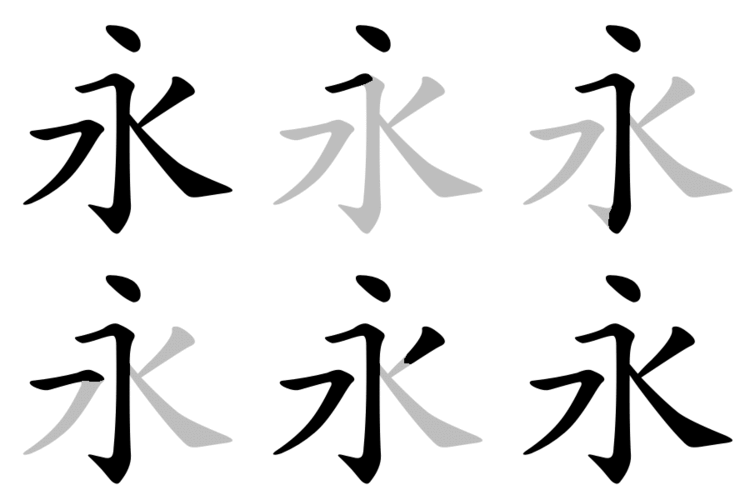 | |||
Han character
永 (Kangxi radical 85, 水+1, 5 strokes, cangjie input 戈弓水 (INE), four-corner 30232, composition ⿱丶⿲㇇𠃌⿺㇏丿)
Derived characters
References
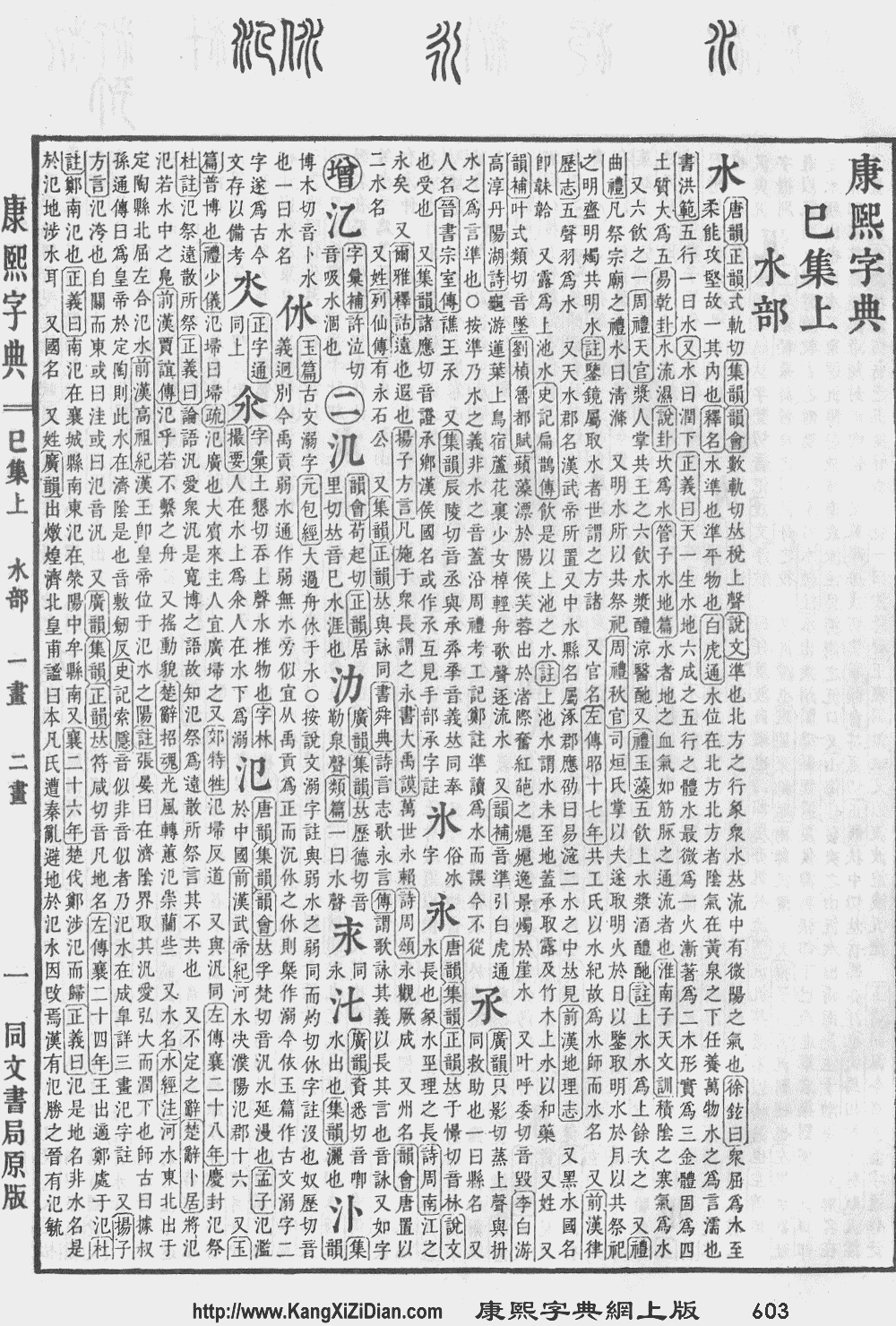
- Kangxi Dictionary: page 603, character 4
- Dai Kanwa Jiten: character 17088
- Dae Jaweon: page 996, character 4
- Hanyu Da Zidian (first edition): volume 3, page 1546, character 3
- Unihan data for U+6C38
Chinese
| simp. and trad. |
永 | |
|---|---|---|
Glyph origin
| Historical forms of the character 永 | |||
|---|---|---|---|
| Shang | Western Zhou | Shuowen Jiezi (compiled in Han) | Liushutong (compiled in Ming) |
| Oracle bone script | Bronze inscriptions | Small seal script | Transcribed ancient scripts |
 |
 |
 |
 |
Etymology
Uncertain.
- STEDT compares 永 (OC *ɢʷraŋʔ) to provisional Proto-Lolo-Burmese meso-root *ʔ-m(y)aŋ¹/³;
- Bodman (1980) derived 永 (OC *ɢʷraŋʔ) from Proto-Sino-Tibetan *wrjaŋ & considered it cognate with Lepcha ᰝᰥᰤᰰ (hryăn) as well as Tibetan རྒྱོང་བ (rgyong ba, “to extend; to stretch”) and རྒྱང་མ (rgyang ma, “distance”);
- Schuessler (2007) considered to be unclear any connection with 泂 (OC *ɡʷeːŋʔ) and Tibetan རིང (ring, “to be tall, long”), Western Tamang rehng pā (“to be long”), Burmese ရှည် (hrany, “to be long”), (all from Proto-Sino-Tibetan *s-r(i/u)ŋ (“to be long, to elongate”)) & Proto-Loloish *s/m-riŋ (“long (adv.)”); so Schuessler compared 永 (OC *ɢʷraŋʔ) to Khmer វែង (vɛɛng, “long”) and Khmer បង្វែង (bɑngvaeng, “to prolong, divert, mislead, deceive”) (both from Proto-Mon-Khmer *waiŋ (“long”)).
Pronunciation
Definitions
永
- perpetual; eternal; permanent; forever
- 投我以木李、報之以瓊玖。匪報也、永以為好也。 [Pre-Classical Chinese, trad.]
- From: The Classic of Poetry, c. 11th – 7th centuries BCE, translated based on James Legge's version
- Tóu wǒ yǐ mùlǐ, bào zhī yǐ qióngjiǔ. Fěi bào yě, yǒng yǐ wèi hǎo yě. [Pinyin]
- There was presented to me a plum, and I returned for it a beautiful jiu gem; not as a return for it, but that our friendship might be lasting.
投我以木李、报之以琼玖。匪报也、永以为好也。 [Pre-Classical Chinese, simp.]
- long (space or time)
- 漢之廣矣、不可泳思。江之永矣、不可方思。 [Pre-Classical Chinese, trad.]
- From: The Classic of Poetry, c. 11th – 7th centuries BCE, translated based on James Legge's version
- Hàn zhī guǎng yǐ, bùkě yǒng sī. Jiāng zhī yǒng yǐ, bùkě fāng sī. [Pinyin]
- The breath of the Han [river] cannot be dived across; the length of the Jiang [river] cannot be navigated with a raft.
汉之广矣、不可泳思。江之永矣、不可方思。 [Pre-Classical Chinese, simp.]
- to prolong; to lengthen
- 皎皎白駒、食我場苗。縶之維之、以永今朝。 [Pre-Classical Chinese, trad.]
- From: The Classic of Poetry, c. 11th – 7th centuries BCE, translated based on James Legge's version
- Jiǎojiǎo báijū, shí wǒ chǎng miáo. Zhí zhī wéi zhī, yǐ yǒng jīncháo. [Pinyin]
- Let the brilliant white colt feed on the young growth of my vegetable garden. Tether it by the foot, tie it by the collar, to prolong this morning.
皎皎白驹、食我场苗。絷之维之、以永今朝。 [Pre-Classical Chinese, simp.]
- 53rd tetragram of the Taixuanjing; "eternity" (𝌺)
- a surname
Compounds
- 一勞永逸/一劳永逸 (yīláoyǒngyì)
- 天人永隔
- 教澤永懷/教泽永怀
- 智永
- 暫勞永逸/暂劳永逸
- 更長漏永/更长漏永
- 永不磨滅/永不磨灭 (yǒngbùmómiè)
- 永不錄用/永不录用
- 永世 (yǒngshì)
- 永世無窮/永世无穷
- 永久 (yǒngjiǔ)
- 永久磁鐵/永久磁铁
- 永久齒/永久齿
- 永佃權/永佃权
- 永保無虞/永保无虞
- 永傳不朽/永传不朽
- 永別/永别 (yǒngbié)
- 永別酒/永别酒
- 永劫 (yǒngjié)
- 永吉 (Yǒngjí)
- 永和 (Yǒnghé)
- 永命
- 永嘉 (Yǒngjiā)
- 永嘉之亂/永嘉之乱 (Yǒngjiā Zhī Luàn)
- 永垂不朽 (yǒngchuíbùxiǔ)
- 永夕
- 永夜
- 永存 (yǒngcún)
- 永存不朽
- 永字八法 (yǒng zì bā fǎ)
- 永安 (Yǒng'ān)
- 永安宮/永安宫 (Yǒng'āngōng)
- 永定河 (Yǒngdìng Hé)
- 永州八記/永州八记
- 永巷
- 永年 (yǒngnián)
- 永康 (Yǒngkāng)
- 永恆/永恒 (yǒnghéng)
- 永慕
- 永日
- 永昌 (yǒngchāng)
- 永明體/永明体
- 永春 (Yǒngchūn)
- 永晝/永昼
- 永暑礁 (Yǒngshǔjiāo)
- 永業田/永业田
- 永樂/永乐 (Yǒnglè)
- 永樂大典/永乐大典
- 永樂宮/永乐宫
- 永樂窯/永乐窑
- 永樂錢/永乐钱
- 永永無窮/永永无穷
- 永活 (yǒnghuó)
- 永浴愛河/永浴爱河
- 永漋 (Yǒnglóng)
- 永濟渠/永济渠
- 永無寧日/永无宁日 (yǒngwúníngrì)
- 永無止境/永无止境 (yǒngwúzhǐjìng)
- 永珍 (Yǒngzhēn)
- 永生 (yǒngshēng)
- 永生永世
- 永生花
- 永生難忘/永生难忘
- 永眠 (yǒngmián)
- 永矢弗諼/永矢弗谖
- 永立 (Yǒnglì)
- 永結同心/永结同心
- 永續/永续 (yǒngxù)
- 永續林/永续林
- 永續經營/永续经营
- 永興莊/永兴庄 (Yǒngxīngzhuāng)
- 永訣/永诀 (yǒngjué)
- 永誌不忘/永志不忘 (yǒngzhìbùwàng)
- 永豐/永丰 (Yǒngfēng)
- 永逝 (yǒngshì)
- 永逸
- 永遠/永远 (yǒngyuǎn)
- 永錫不匱/永锡不匮
- 永隆 (Yǒnglóng)
- 永靖 (Yǒngjìng)
- 清新雋永/清新隽永
- 繞梁韻永/绕梁韵永
- 萱堂日永
- 雋永/隽永 (juànyǒng)
- 霽範永存/霁范永存
- 青春永駐/青春永驻
Japanese
Readings
Synonyms
Etymology 1
| Kanji in this term |
|---|
| 永 |
| えい Grade: 5 |
| kan’on |
From Middle Chinese 永 (MC hjwaengX).
The kan'on pronunciation, so likely a later borrowing.
Noun
永 • (ei)
- (historical) Abbreviation of 永楽銭 (eirakusen).
- (historical) This term needs a translation to English. Please help out and add a translation, then remove the text
{{rfdef}}.
Etymology 2
| Kanji in this term |
|---|
| 永 |
| よう Grade: 5 |
| goon |
From Middle Chinese 永 (MC hjwaengX).
The goon pronunciation, so likely the initial borrowing.
Pronunciation
- IPA(key): [jo̞ː]
Etymology 3
| Kanji in this term |
|---|
| 永 |
| なが Grade: 5 |
| kun’yomi |
| For pronunciation and definitions of 永 – see the following entry: なが |
(The following entry is uncreated: なが.)
References
- Matsumura, Akira, editor (2006), 大辞林 [Daijirin] (in Japanese), Third edition, Tōkyō: Sanseidō, →ISBN
Korean
References
Vietnamese
This article is issued from Wiktionary. The text is licensed under Creative Commons - Attribution - Sharealike. Additional terms may apply for the media files.