丩
See also: 니
| ||||||||
Translingual
Han character
丩 (Kangxi radical 2, 丨+1, 2 strokes, cangjie input 女中 (VL) or 難難女中 (XXVL), four-corner 22700, composition ⿰𠄌丨)
Derived characters
Descendants
References
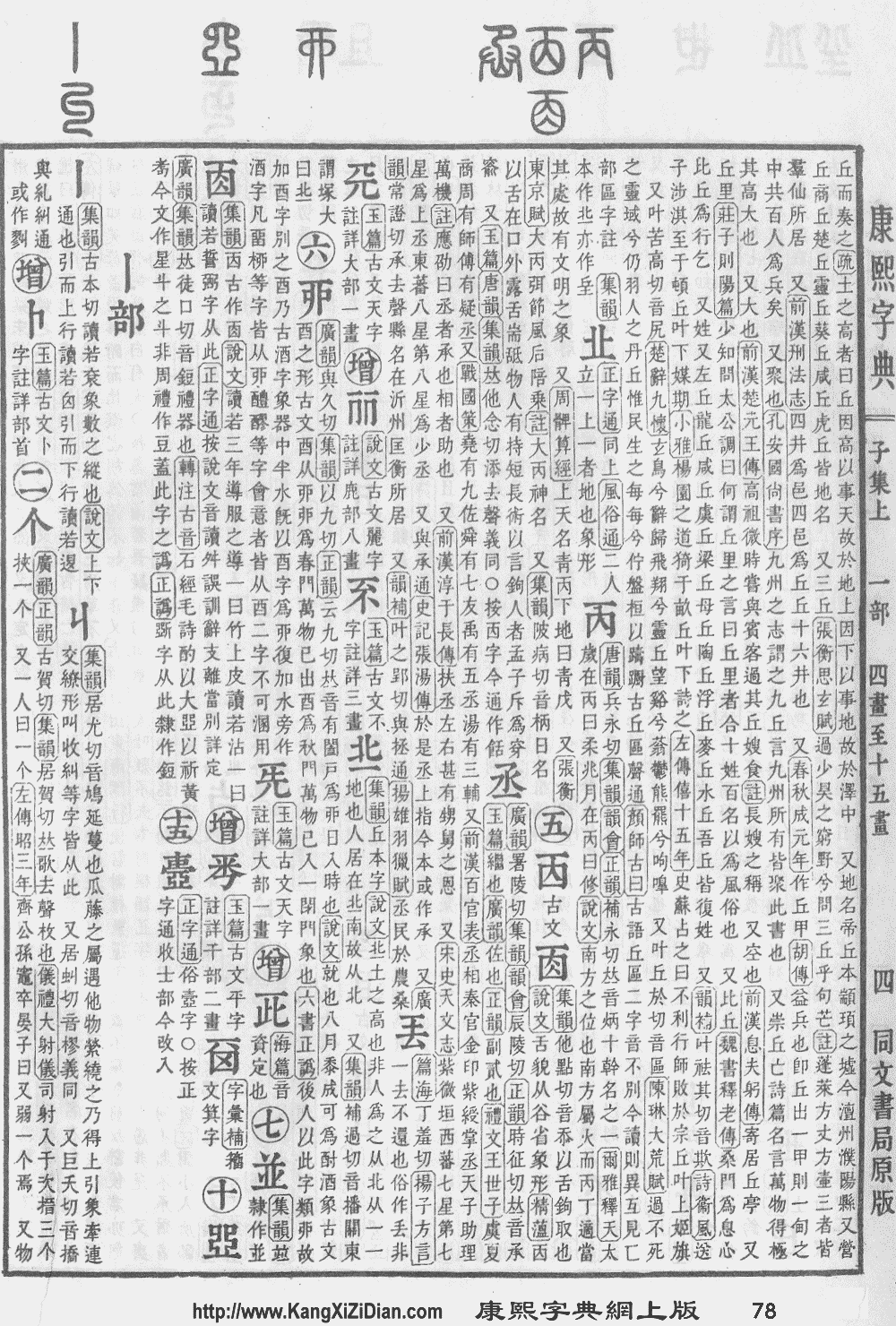
- Kangxi Dictionary: page 78, character 21
- Dai Kanwa Jiten: character 68
- Hanyu Da Zidian (first edition): volume 1, page 49, character 2
- Unihan data for U+4E29
Chinese
| simp. and trad. |
丩 | |
|---|---|---|
Glyph origin
| Historical forms of the character 丩 | |||||||
|---|---|---|---|---|---|---|---|
| Shang | Western Zhou | Spring and Autumn | Warring States | Shuowen Jiezi (compiled in Han) | Liushutong (compiled in Ming) | ||
| Oracle bone script | Bronze inscriptions | Bronze inscriptions | Chu slip and silk script | Qin slip script | Small seal script | Transcribed ancient scripts | |
 |
 |
 |
 |
 |
 |
 | |
| |||||||
|
References: Mostly from Richard Sears' Chinese Etymology site (authorisation),
| |||||||
Characters in the same phonetic series (丩) (Zhengzhang, 2003)
Pictogram (象形) : two entangled ropes – to entangle; to intertwine. Original form of 糾.
Pronunciation
Japanese
Readings
- Go-on: く (ku); ぎょう (gyō)←げう (geu, historical)
- Kan-on: きゅう (kyū)←きう (kiu, historical); きょう (kyō)←けう (keu, historical)
- Kun: まつわる (matsuwaru, 丩わる)←まつはる (matufaru, 丩はる, historical)
Korean
Hanja
丩 • (gu) (hangeul 구, revised gu, McCune–Reischauer ku)
- This term needs a translation to English. Please help out and add a translation, then remove the text
{{rfdef}}.
This article is issued from Wiktionary. The text is licensed under Creative Commons - Attribution - Sharealike. Additional terms may apply for the media files.