偉
See also: 伟
| ||||||||
Translingual
| Japanese | 偉 |
|---|---|
| Simplified | 伟 |
| Traditional | 偉 |
Alternative forms
In Japanese kanji, the bottom component of 韋 is written ヰ with four strokes. In Traditional Chinese, the bottom component is written 㐄 with three strokes.
Han character
偉 (Kangxi radical 9, 人+9 in Chinese, 人+10 in Japanese, 11 strokes in Chinese, 12 strokes in Japanese, cangjie input 人木一手 (ODMQ), four-corner 24256, composition ⿰亻韋)
Derived characters
- 𬎉, 𬿭, 𫉔
Related characters
References
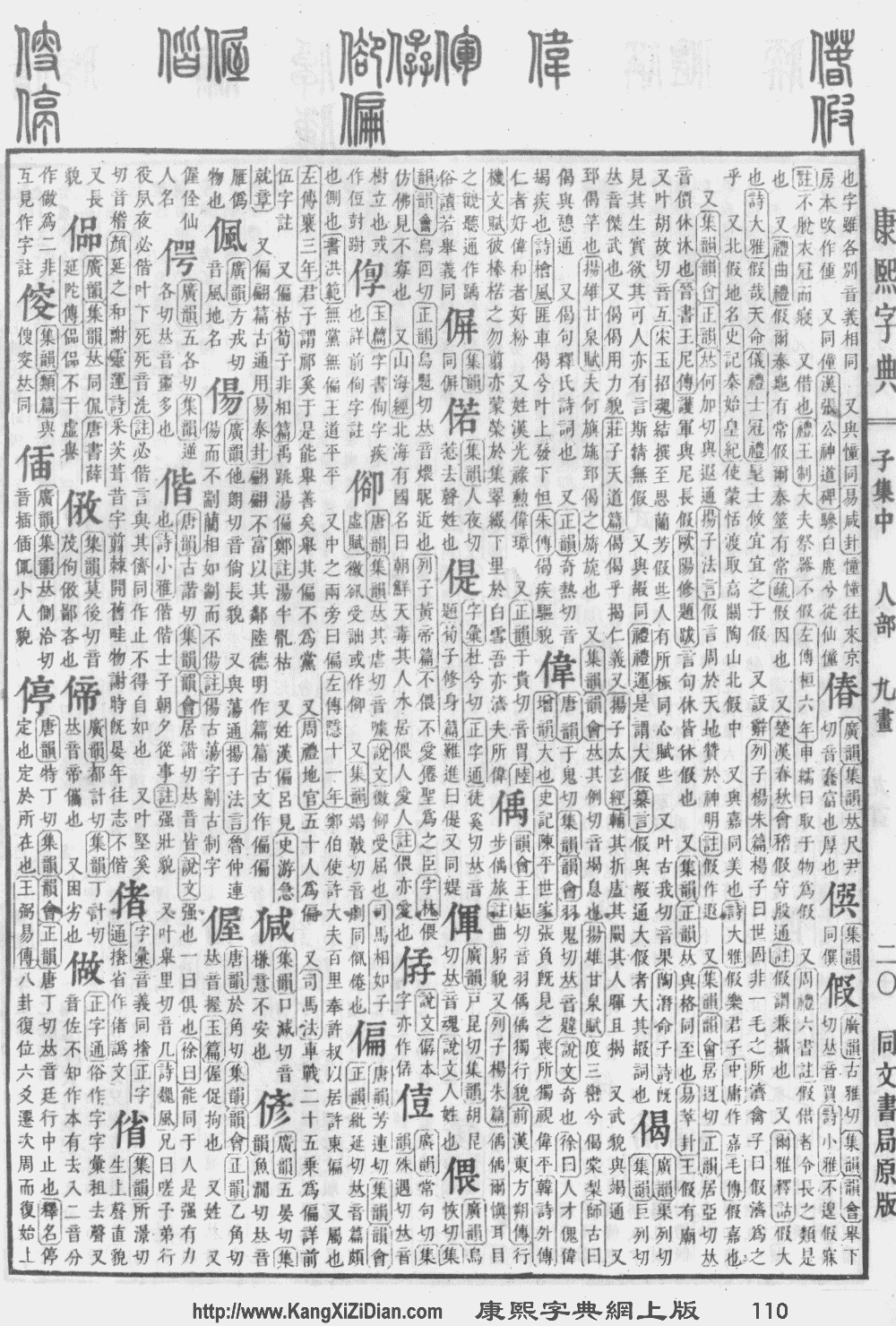
- Kangxi Dictionary: page 110, character 5
- Dai Kanwa Jiten: character 837
- Dae Jaweon: page 234, character 2
- Hanyu Da Zidian (first edition): volume 1, page 198, character 4
- Unihan data for U+5049
Chinese
| trad. | 偉 | |
|---|---|---|
| simp. | 伟 | |
Glyph origin
| Historical forms of the character 偉 | ||||||||||
|---|---|---|---|---|---|---|---|---|---|---|
| Shuowen Jiezi (compiled in Han) | Liushutong (compiled in Ming) | |||||||||
| Small seal script | Transcribed ancient scripts | |||||||||
 |
 | |||||||||
|
|
References: Mostly from Richard Sears' Chinese Etymology site (authorisation),
| ||||||||||


Characters in the same phonetic series (韋) (Zhengzhang, 2003)
Phono-semantic compound (形聲/形声, OC *ɢʷɯlʔ) : semantic 亻 + phonetic 韋 (OC *ɢʷɯl).
Pronunciation
Compounds
- 俊偉/俊伟 (jùnwěi)
- 偉丈夫/伟丈夫
- 偉人/伟人 (wěirén)
- 偉器/伟器 (wěiqì)
- 偉大/伟大 (wěidà)
- 偉岸/伟岸 (wěi'àn)
- 偉懋/伟懋 (wěimào)
- 偉晶岩/伟晶岩
- 偉服/伟服
- 偉業/伟业 (wěiyè)
- 偉績/伟绩 (wěijì)
- 偉麗/伟丽
- 傀偉/傀伟
- 厥功甚偉/厥功甚伟
- 厥功至偉/厥功至伟
- 壯偉/壮伟 (zhuàngwěi)
- 奇偉/奇伟
- 宏偉/宏伟 (hóngwěi)
- 宏偉壯觀/宏伟壮观
- 恢偉/恢伟
- 氣勢雄偉/气势雄伟
- 英才俊偉/英才俊伟
- 英風偉烈/英风伟烈
- 衣冠甚偉/衣冠甚伟
- 豐偉/丰伟
- 豐功偉業/丰功伟业 (fēnggōngwěiyè)
- 豐功偉績/丰功伟绩 (fēnggōngwěijī)
- 鉅卿偉公/巨卿伟公
- 雄偉/雄伟 (xióngwěi)
- 雄偉壯麗/雄伟壮丽
- 雄材偉略/雄材伟略
- 魁偉/魁伟 (kuíwěi)
- 魁梧奇偉/魁梧奇伟
Japanese
| Shinjitai | 偉 |  |
| Kyūjitai [1] |
偉󠄃 偉+ 󠄃?(Hanyo-Denshi) (Moji_Joho) |
 |
| The displayed kanji may be different from the image due to your environment. See here for details. | ||
Readings
Inflection
Inflection of 偉
| Stem forms | |||
|---|---|---|---|
| Imperfective (未然形) | 偉だろ | いだろ | i daro |
| Continuative (連用形) | 偉で | いで | i de |
| Terminal (終止形) | 偉だ | いだ | i da |
| Attributive (連体形) | 偉な | いな | i na |
| Hypothetical (仮定形) | 偉なら | いなら | i nara |
| Imperative (命令形) | 偉であれ | いであれ | i de are |
| Key constructions | |||
| Informal negative | 偉ではない 偉じゃない |
いではない いじゃない |
i de wa nai i ja nai |
| Informal past | 偉だった | いだった | i datta |
| Informal negative past | 偉ではなかった 偉じゃなかった |
いではなかった いじゃなかった |
i de wa nakatta i ja nakatta |
| Formal | 偉です | いです | i desu |
| Formal negative | 偉ではありません 偉じゃありません |
いではありません いじゃありません |
i de wa arimasen i ja arimasen |
| Formal past | 偉でした | いでした | i deshita |
| Formal negative past | 偉ではありませんでした 偉じゃありませんでした |
いではありませんでした いじゃありませんでした |
i de wa arimasen deshita i ja arimasen deshita |
| Conjunctive | 偉で | いで | i de |
| Conditional | 偉なら(ば) | いなら(ば) | i nara (ba) |
| Provisional | 偉だったら | いだったら | i dattara |
| Volitional | 偉だろう | いだろう | i darō |
| Adverbial | 偉に | いに | i ni |
| Degree | 偉さ | いさ | isa |
References
- “偉”, in 漢字ぺディア (Kanjipedia) (in Japanese), 日本漢字能力検定協会, 2015–2024
- Matsumura, Akira, editor (2006), 大辞林 [Daijirin] (in Japanese), Third edition, Tōkyō: Sanseidō, →ISBN
Korean
Vietnamese
Han character
- This term needs a translation to English. Please help out and add a translation, then remove the text
{{rfdef}}.
This article is issued from Wiktionary. The text is licensed under Creative Commons - Attribution - Sharealike. Additional terms may apply for the media files.