な
 | ||||||||
Japanese
| Stroke order | |||
|---|---|---|---|
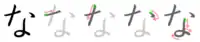 | |||
Pronunciation
- IPA(key): [na̠]
Etymology 1
Derived in the Heian period from writing the man'yōgana kanji 奈 in the cursive sōsho style.
Syllable
な • (na)
See also
Etymology 2
Probably derived from mild emphatic interjection and sentence-final particle ね, itself from Old Japanese, indicating a general sense of admiration or consideration, or hope that the preceding statement comes to pass.
Interjection
な • (na)
Particle
な • (na)
Usage notes
Often used when you are speaking to yourself, and can be considered less formal than the agreement-asking particle ね.
Etymology 3
/ni aru/ → /naru/ → /na/
From Old Japanese. Originally an abbreviation of に (ni, particle) + ある (aru, the attributive form of classical あり ari, “to be”).[1]
Particle
な • (na)
Usage notes
The older なる (naru) form is still used to impart a more formal, archaic, or poetic sense.
Descendants
- → English: な-adjective
Etymology 4
From Old Japanese. Probably the root na of the negative adjective ない (nai).[2][3] An alternative theory is that this is the imperfective conjugation of negative auxiliary verb ず (zu).[2]
First cited to the Nihon Shoki of 720.[2]
Particle
な • (na)
Usage notes
Considered very informal and potentially brusque depending on tone of voice. This would never be used in polite conversation, where the construction ~ないで下さい (~naide kudasai) would be used instead, appended to the imperfective stem of the verb in question. Examples:
Etymology 5
Clipping of polite imperative auxiliary verb form なさい (nasai).
Suffix
な • (-na)
Usage notes
- A casual way of issuing commands; not as rough as the imperative conjugation of a verb.
- Usage is restricted to addressing friends, children, or subordinates.
- 食べな ― tabena ― Eat!
- In spoken Japanese, the prohibitive na and the imperative na are also differentiated by pitch accent patterns. For prohibitive na, the pitch on the suffix follows the pitch on the verb stem; and for imperative na, the pitch is higher than on the verb stem.
Etymology 6
The readings of various kanji, as derived from native Japonic roots.
| For pronunciation and definitions of な – see the following entries. | ||
| ||
| ||
| ||
| ||
| (This term, な, is the hiragana spelling of the above terms.) For a list of all kanji read as な, see Category:Japanese kanji read as な.) |
Etymology 7
The readings of various kanji, as borrowed from Chinese.
| For pronunciation and definitions of な – see the following entries. | ||
| ||
| (This term, な, is the hiragana spelling of the above term.) For a list of all kanji read as な, see Category:Japanese kanji read as な.) |
References
- Shōgaku Tosho (1988) 国語大辞典(新装版) [Unabridged Dictionary of Japanese (Revised Edition)] (in Japanese), Tōkyō: Shogakukan, →ISBN
- “な”, in 日本国語大辞典 (Nihon Kokugo Daijiten, “Nihon Kokugo Daijiten”) (in Japanese), concise edition, Tōkyō: Shogakukan, 2000
- Matsumura, Akira, editor (2006), 大辞林 [Daijirin] (in Japanese), Third edition, Tōkyō: Sanseidō, →ISBN
Old Japanese
Etymology 1
Possibly cognate with modern Korean 날 (nal, “blade”).
Listed in various sources as the na portion in the term 刀 (katana), with the na described as meaning 刃 (“blade, edge”).[1][2][3] However, there is no historical attestation for any na reading for this character.
Noun
な (na)
- any sharp and thin cutting implement: a blade, edge
- ,[4] text here
- 劔大刀名惜雲吾者無君爾不相而年之經去禮者
- turugi₁-tati na no₂ wosike₁ku mo ware pa nasi ki₁mi₁ ni apazute to₂si no₂ pe₂nureba
- I do not even miss precious you, given the years that have passed without meeting with you.
- [Note: turugi₁-tati (literally “double-edged longsword”) is a pillow word establishing a poetic association with the following na, literally meaning blade or edge and alluding to sharpness and importance. This na could also elliptically mean 名 (na, “name”) or even 汝 (na, “you”) depending on context, based on the homophonic readings.]
- ,[4] text here
Noun
な (na)
- middle
- 720, Nihon Shoki:
- 三國坂中井中、此云那
- Nawi in Mikuni (read 中 as na)
- 天渟中渟中此云農難原瀛眞人天皇
- The Emperor Ama-no₂-nunahara oki₁ no₂ mabi₁to₂ (read 中 as nuna)
- 譯語田渟中倉太珠敷尊
- WOSADA NO₂ NUna KURA NO₂ PUTO₁ TAMASIKI₁ NO₂ MI₁KO₂TO₂
- A son of Kinmei Tennō.
Derived terms
- 中 (naka)
Etymology 3
Possibly an apophonic form of の (no₂), from assimilation with adjacency to vowels such as a or u. Usage is mostly restricted to fixed expressions like 掌 (tanagokoro, “palm of the hand”, parsed as ta “hand” + na [possessive] + kokoro “heart, center”, changing to gokoro due to rendaku), due to such assimilation.
Vovin (2020, pp. 119-123) suggests that this may instead be a plural marker, which is supported by some terms changing due to rendaku, typically a contraction of -no₂- or -ni-.
Particle
な (na)
- genitive case marker
Derived terms
Etymology 4
Various other terms.
Pronoun
な (na)
References
- Shōgaku Tosho (1988) 国語大辞典(新装版) [Unabridged Dictionary of Japanese (Revised Edition)] (in Japanese), Tōkyō: Shogakukan, →ISBN
- Matsumura, Akira, editor (2006), 大辞林 [Daijirin] (in Japanese), Third edition, Tōkyō: Sanseidō, →ISBN
- Matsumura, Akira (1995) 大辞泉 [Daijisen] (in Japanese), First edition, Tōkyō: Shogakukan, →ISBN
- Satake, Akihiro with Hideo Yamada, Rikio Kudō, Masao Ōtani, and Yoshiyuki Yamazaki (c. 759) Shin Nihon Koten Bungaku Taikei 1: Man’yōshū 1 (in Japanese), Tōkyō: Iwanami Shoten, published 1999, →ISBN.